Ravi River
The provided search results do not contain information regarding the etymological origin or the specific naming history of the Ravi River. The records note…
What is the origin of the name ‘Ravi River’?
The provided search results do not contain information regarding the etymological origin or the specific naming history of the Ravi River. The records note that the river was historically known as the Hydraotes, but they do not explain the derivation of the name “Ravi” itself.1
What is the historical and cultural significance of the Ravi River in the region?
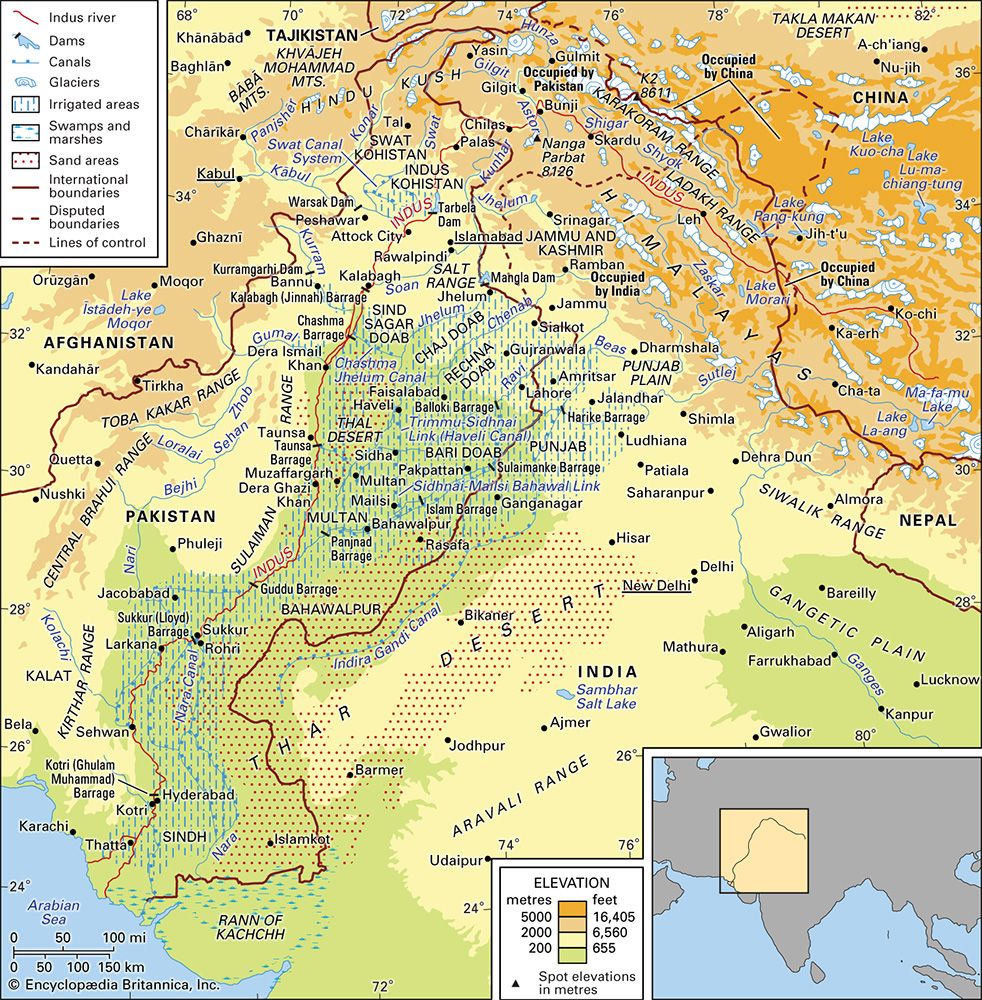
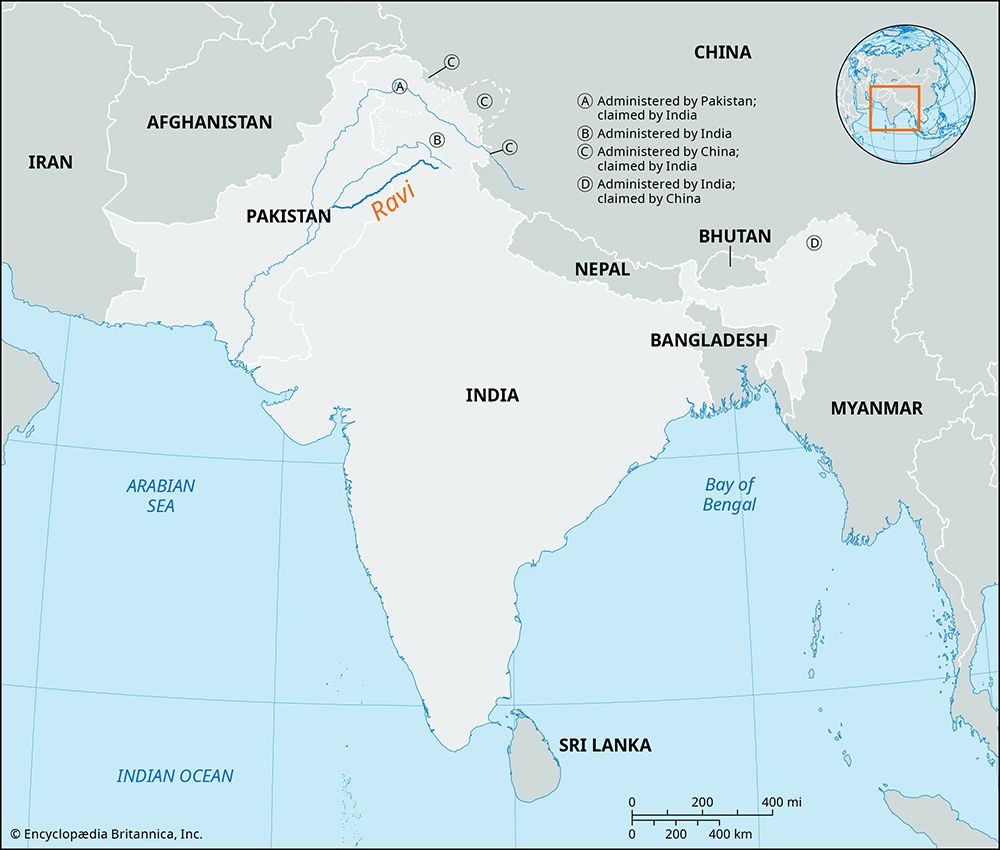
The Ravi River holds significant historical and cultural importance as one of the five major tributaries of the Indus River system, which gives the Punjab region its name, meaning “Five Rivers.”1
Its historical significance is deeply rooted in the region’s development. Evidence indicates that the Ravi, along with other rivers in the system, has shifted its course over the last 4,500 years, a phenomenon observed since the time of the Indus civilization. Culturally and economically, the river has been a lifeline for the region, supporting extensive irrigation through systems like the Upper Bari Doab Canal, completed in 1878–79, and the Lower Bari Doab Canal.31
In the modern era, the river became a focal point of international diplomacy. Following frequent disputes over water usage, India and Pakistan signed the Indus Waters Treaty in 1960. This agreement allocated the waters of the Ravi, Beas, and Sutlej to India, while granting Pakistan exclusive rights to the Indus and its western tributaries, reflecting the river’s critical role in regional stability and resource management.14
How does the flow of the Ravi River change during different seasons?
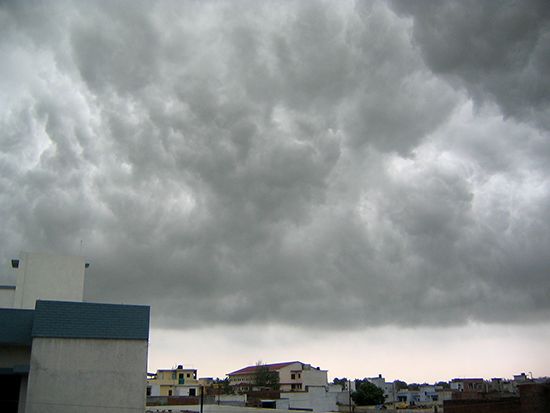
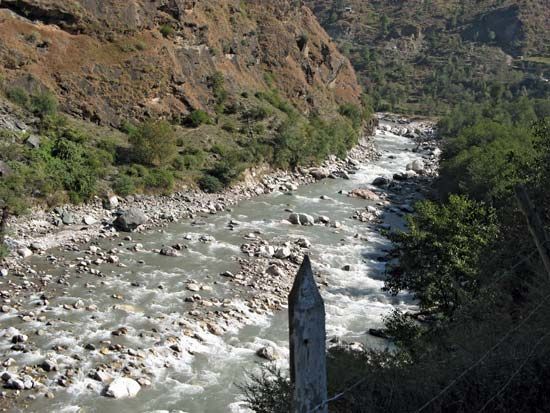
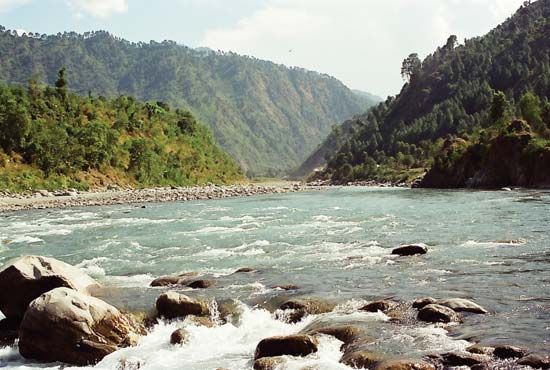
The flow of the Ravi River is primarily dictated by two seasonal factors: spring snowmelt and the South Asian monsoon.1
During the summer monsoon season, which occurs from June to September, the river experiences significant increases in volume due to heavy rainfall. These conditions can lead to substantial flood discharges, sometimes exceeding 600,000 cubic feet (17,000 cubic meters) per second.1
Conversely, the river’s flow is substantially reduced during the winter months. This seasonal decline is accompanied by a decrease in the river’s suspended sediment load, reflecting the lower energy and reduced water volume characteristic of the dry season.1
How has the Indus Waters Treaty affected the management and use of the Ravi River?
The Indus Waters Treaty, signed in 1960, fundamentally restructured the management of the Ravi River by resolving long-standing disputes that arose following the 1947 partition of British India.41
Allocation and Management
Under the treaty, the waters of the three eastern rivers—the Ravi, Beas, and Sutlej—were reserved exclusively for India. In exchange, Pakistan received exclusive rights to the waters of the western rivers (Indus, Jhelum, and Chenab). This agreement was designed to address the disruption caused when the international boundary cut through the existing irrigation systems of the Bari Doab, leaving headworks in India and canals in Pakistan.5641
Infrastructure and Impact
To compensate for the loss of water from the eastern rivers, the treaty facilitated the construction of major infrastructure in Pakistan, including the Mangla Dam and the Tarbela Dam, alongside a network of link canals and barrages. These projects allowed Pakistan to divert water from its western rivers to areas previously dependent on the eastern tributaries. Conversely, India has utilized its allocation to build various dams, barrages, and link canals to support irrigation in the Punjab and neighboring states.16
Sources
- Ravi River — Encyclopædia Britannica
- Ravi — Merriam-Webster
- Indus River - Hydrology of the Indus River — Encyclopædia Britannica
- Indus Waters Treaty: Top Questions — Encyclopædia Britannica
- Indus River - Irrigation of the Indus River — Encyclopædia Britannica
- Indus Waters Treaty — Encyclopædia Britannica
Published on · 2 min read