Rhea
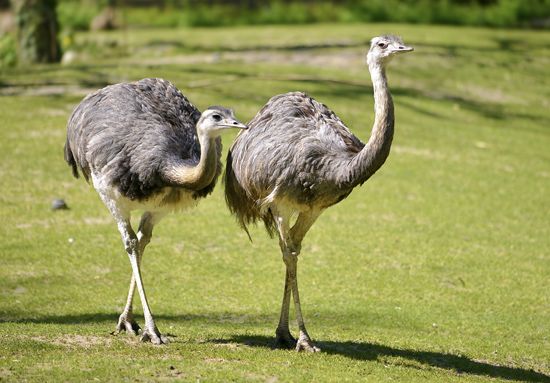
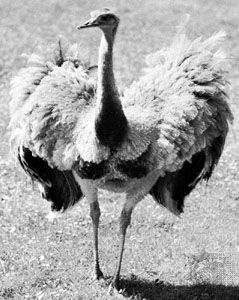
Rheas are large, flightless birds native to South America. They primarily inhabit open, treeless country across the continent.
Where are rheas primarily found in the wild?
Rheas are large, flightless birds native to South America. They primarily inhabit open, treeless country across the continent.1
Their specific distribution depends on the species:
- Common rhea (Rhea americana): Found in open regions stretching from northeastern Brazil southward to Argentina.1
- Darwin’s rhea (Pterocnemia pennata): Ranges from Peru southward to Patagonia at the southern tip of the continent.1
These birds are well-adapted to these environments, often associating with other animals like deer or guanacos to form mixed herds.1
What are the two main species of rhea, and how do they differ?
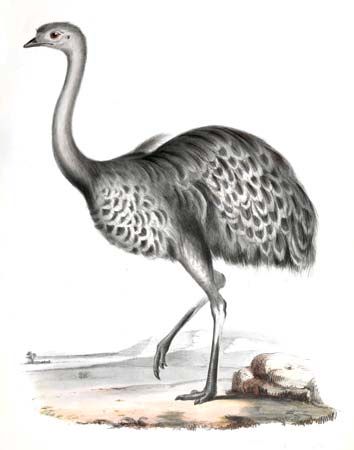
The two main species of rhea are the common rhea (Rhea americana) and Darwin’s rhea (Pterocnemia pennata). While both are large, flightless birds native to South America, they differ primarily in their geographic range and physical appearance.1
Geographic Distribution
- Common rhea: Inhabits open country ranging from northeastern Brazil down to Argentina.1
- Darwin’s rhea: Found further south and west, ranging from Peru down to Patagonia at the southern tip of the continent.1
Physical Characteristics
- Size: The common rhea is larger, standing approximately 120 cm (4 feet) tall and weighing about 20 kg (50 pounds). Darwin’s rhea is somewhat smaller.1
- Plumage: The common rhea features brown or gray upper parts with whitish underparts. Darwin’s rhea is characterized by brownish plumage that is tipped with white.1
Both species share similar behaviors, such as being omnivorous and having the male take sole responsibility for incubating eggs and raising the young.1
How do rheas differ from other flightless birds like ostriches and emus?
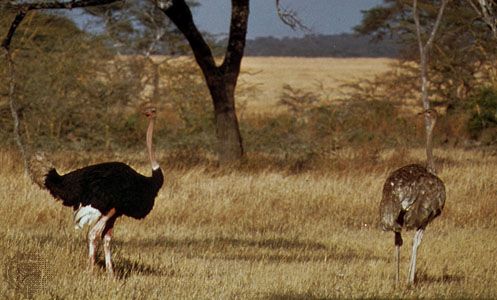
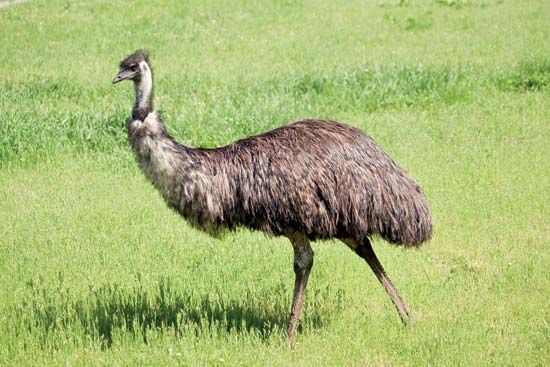
Rheas are members of the ratite group, which includes other flightless birds like ostriches and emus. While they share the common trait of being flightless, they are distinguished from ostriches by several key physical and behavioral characteristics.13
Key Differences from Ostriches
- Foot Structure: The most notable anatomical difference is that rheas have three-toed feet, whereas ostriches possess a unique two-toed foot structure.14
- Size: Rheas are significantly smaller than ostriches. A common rhea stands about 120 cm (4 feet) tall and weighs approximately 20 kg (50 pounds), while an adult male ostrich can reach 2.75 meters (about 9 feet) and weigh over 150 kg.14
- Plumage: Unlike ostriches, which are known for their fine, decorative plumes, rheas lack these specialized feathers and typically display a brownish coloration.14
- Reproductive Behavior: While both species are polygamous, rheas do not form the same type of harem structures seen in ostriches. Instead, a male rhea will incubate the eggs of several females that have laid their clutches in a single, shallow nest he has prepared.14
What is the social behavior and mating system of rheas?
Rheas exhibit a distinct social and mating system characterized by polygamy and male-led parental care. These birds do not form lasting pairs; instead, they engage in a system where a single male mates with multiple females.1
Mating and Nesting
- Nest Preparation: A male rhea digs a shallow, grass-lined nest in the ground.1
- Egg Laying: Multiple females deposit their eggs into this single nest, with the total number of eggs reaching up to 50.1
- Incubation and Rearing: The male takes sole responsibility for incubating the eggs, which hatch in approximately 6 weeks. Following hatching, the male continues to herd and care for the chicks for another 6 weeks.1
Social Behavior
Outside of the breeding season, rheas are social animals that frequently associate with other species. They are known to form mixed herds with deer or guanacos, a behavior similar to the associations seen between ostriches, zebras, and antelopes in other parts of the world.1
Sources
- Rhea — Encyclopædia Britannica
- rhea — Merriam-Webster
- Flightless bird — Encyclopædia Britannica
- Ostrich — Encyclopædia Britannica
- Struthionidae — Merriam-Webster
- struthioniform — Merriam-Webster
Published on · 3 min read