Ring-necked Snake
Sorry, the Britannica knowledge base does not contain information regarding the average lifespan of a ring-necked snake in the wild.
What is the average lifespan of a ring-necked snake in the wild?
Sorry, the Britannica knowledge base does not contain information regarding the average lifespan of a ring-necked snake in the wild.
Where are ring-necked snakes typically found, and what habitats do they prefer?
The ring-necked snake (Diadophis punctatus) is a small, terrestrial snake widely distributed across North America. Its range spans the eastern and western United States, southeastern Canada, and northeastern Mexico.1
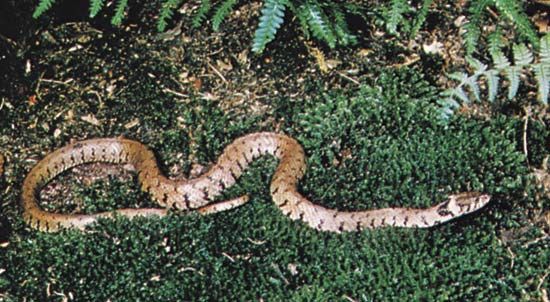
Regarding their habitat, these snakes are primarily found in areas where they can forage within surface litter. They are secretive, ground-dwelling creatures that rely on this cover to hunt for prey, including worms, arthropods, frogs, salamanders, and other small reptiles.1
Are there any unique behaviors or adaptations that ring-necked snakes have developed?
The ring-necked snake (Diadophis punctatus) has developed several unique behavioral adaptations, particularly regarding defense:
- Warning Coloration: These snakes often display bright red or yellow undersides as a defensive mechanism. When threatened, they may turn over or curl their tails to expose this brightly colored undersurface. This behavior is believed to serve as a form of aposematism, or warning coloration, signaling to potential predators that the snake may be distasteful or dangerous.13
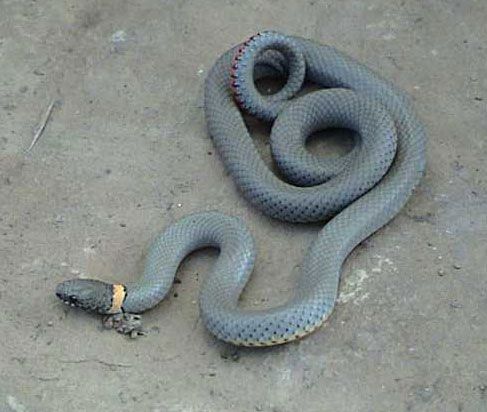
- Neck Markings: The species is named for the prominent ring or collar around its neck, which is typically white or yellow. While the exact function of this marking remains unknown, it is thought to serve either as a form of camouflage or as a signaling device. Interestingly, this collar is often large in young snakes and gradually shrinks or disappears as the individual matures.4
- Foraging Habits: These snakes are secretive, ground-dwelling animals that forage within surface litter. This behavior allows them to hunt for prey such as worms, arthropods, frogs, and salamanders while remaining protected from larger predators.4
What is the typical diet of ring-necked snakes, and how do they hunt their prey?
The ring-necked snake (Diadophis punctatus) is a small, terrestrial predator that maintains a specialized diet consisting primarily of worms, arthropods, frogs, salamanders, and other small reptiles.1
These snakes are secretive, ground-dwelling animals that hunt by foraging within surface litter. While the specific hunting mechanics of the ring-necked snake are not detailed in the provided search results, they belong to the family Colubridae, a group that generally utilizes Jacobson’s organ to detect chemical cues from prey via their tongues. Unlike some other colubrids that rely on constriction or venom to secure food, ring-necked snakes are primarily known for their foraging behavior in leaf litter and soil cover.16
Sources
- ring-necked snake — Encyclopædia Britannica
- ring-necked snake — Merriam-Webster
- reptile - Odours — Encyclopædia Britannica
- reptile - Display of colour — Encyclopædia Britannica
- snake - Coloration — Encyclopædia Britannica
- spitting cobra — Encyclopædia Britannica
- colubrid — Encyclopædia Britannica
- snake - Specializations for securing food — Encyclopædia Britannica
Published on · 2 min read