Ringed Seal
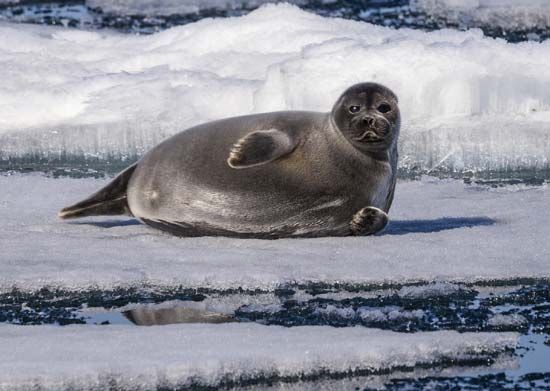
The ringed seal (Pusa hispida, or Phoca hispida) is a nonmigratory, earless seal belonging to the family Phocidae. It is primarily found in North Polar seas…
What is ringed seal?
The ringed seal (Pusa hispida, or Phoca hispida) is a nonmigratory, earless seal belonging to the family Phocidae. It is primarily found in North Polar seas, though some populations inhabit freshwater lakes in Europe and on Baffin Island.1
Named for the distinct pale, ringlike spots on its grayish or yellowish coat, this species typically grows to about 1.5 meters (5 feet) in length and weighs approximately 90 kilograms (200 pounds). Ringed seals are closely related to the Caspian seal and the Baikal seal.123
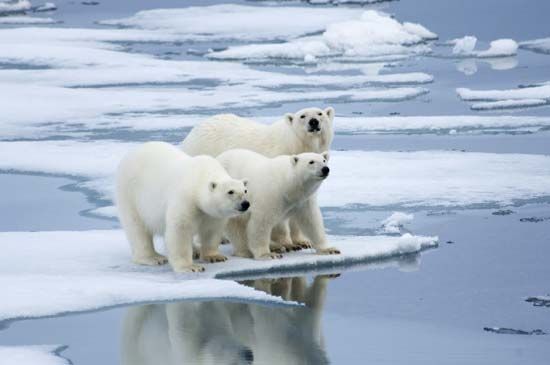
These seals live near pack ice and feed on crustaceans, mollusks, and various fish. Each year, the female gives birth to a single white-coated pup in a den excavated within the snow. As a common species in the Arctic, the ringed seal serves as a vital resource for the Inuit, providing leather, oil, and meat. Additionally, they are a primary food source for polar bears.14
How do ringed seals survive in freezing Arctic temperatures?
Ringed seals survive in the freezing Arctic environment primarily through the use of blubber, a thick layer of fat that provides essential insulation against the cold. Unlike some other marine mammals that rely on dense fur for warmth, seals utilize this layer of fat to maintain their body temperature in water, which has a much higher thermal conductivity than air.1
Additionally, ringed seals exhibit specific behavioral adaptations to cope with the harsh climate. During the winter and spring, females excavate dens within the snow to provide a protected environment for their pups. These snow dens offer a crucial microclimate that shields the young from extreme temperatures and predators. While other marine mammals, such as sea otters, maintain their body heat through exceptionally high metabolic rates and dense fur, the ringed seal’s reliance on blubber is a hallmark of its adaptation to the frigid North Polar seas.61
What are the main differences between ringed seals and other seal species?
The ringed seal (Pusa hispida) is a member of the family Phocidae, commonly known as true or earless seals. While they share the general characteristics of all pinnipeds—such as being web-footed aquatic mammals with blubber for insulation—they possess distinct traits that set them apart from other species.1
Key Differences
- Physical Appearance: Unlike the harp seal, which features a large black blotch on a silver-gray coat, or the harbour seal with its marbled pattern, the ringed seal is identified by characteristic pale, ringlike blotches covering its entire body.1
- Locomotion: As true seals, they lack external ears and have shorter flippers than eared seals (family Otariidae). On land, they cannot rotate their hind flippers forward, forcing them to move by wriggling on their bellies, whereas eared seals can use all four limbs for movement.1
- Habitat and Behavior: Ringed seals are nonmigratory and are uniquely adapted to live near pack ice, often excavating dens in the snow to birth their pups. In contrast, many other seal species are oceangoing and undertake regular, extended migrations.21
- Size: They are relatively small compared to giants like the elephant seal, which can weigh up to 3,700 kg.1
How do Inuit communities traditionally rely on ringed seals?
For generations, the Inuit have relied on the ringed seal as a vital resource for survival in the harsh Arctic environment. This species serves as a primary source of meat, which provides essential sustenance in a region where vegetation is extremely limited.19
Beyond nutrition, the ringed seal is highly valued for its versatile materials:
- Oil: Traditionally used as a critical fuel source for heat and light.
- Leather: Utilized for crafting durable clothing, footwear, and equipment necessary for enduring subzero temperatures.1
Inuit hunters have historically harvested these seals using specialized tools like harpoons, either while stalking them on the sea ice or by hunting from kayaks in open water. This relationship highlights the deep interdependence between the Inuit and the local fauna, reflecting a traditional lifestyle adapted to the unique demands of the North Polar seas.91
We could dive deeper into the specific hunting techniques used by Inuit communities or explore how other Arctic wildlife species are integrated into their traditional culture.
Sources
- ringed seal — Encyclopædia Britannica
- ringed seal — Merriam-Webster
- Caspian seal — Encyclopædia Britannica
- polar bear: Top Questions — Encyclopædia Britannica
- Arctic - Marine fauna — Encyclopædia Britannica
- How do sea otters stay warm? — Encyclopædia Britannica
- Why are polar bears white? — Encyclopædia Britannica
- seal — Encyclopædia Britannica
- Inuit: Top Questions — Encyclopædia Britannica
Published on · 3 min read