Elephant Seal
Elephant seals are distinct from other seal species primarily due to their immense size and unique physical features. As members of the family Phocidae (true…
How do elephant seals differ from other seal species?
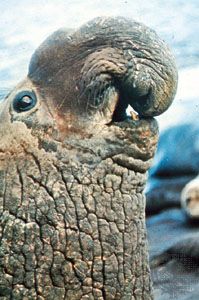
Elephant seals are distinct from other seal species primarily due to their immense size and unique physical features. As members of the family Phocidae (true or earless seals), they are the largest of all pinnipeds, with males reaching lengths of up to 6.5 meters and weights exceeding 3,500 kg.12
The most notable characteristic of the male elephant seal is its large, inflatable, trunklike snout, or proboscis, from which the animal derives its name. Like other true seals, they lack external ear flaps and possess short front flippers, which prevents them from rotating their hind flippers forward to walk on land; instead, they move by wriggling on their bellies.1342
Socially, elephant seals are highly gregarious during the breeding season. Males are known for their aggressive behavior, fighting to establish territories and secure harems of up to 40 cows. This intense competition is a clear example of sexual dimorphism, as males are significantly larger than females.125

What are the feeding habits and diet of elephant seals?
Elephant seals are carnivores that primarily consume fish and cephalopods, such as squid. Like other pinnipeds, they are adapted for hunting in aquatic environments, where they utilize their agility to capture prey.16
While their diet is relatively specialized compared to some other seal species—such as the leopard seal, which is known to consume penguins and other seals—elephant seals rely on the rich resources of the ocean to sustain their massive body size. Their thick layer of blubber serves as a vital energy reserve, allowing them to survive during periods when they are on land for breeding or molting, during which time they typically do not feed.16
What is the social structure and breeding behavior of elephant seals?
Elephant seals are highly gregarious animals that exhibit a complex social structure and aggressive breeding behavior, particularly during the time they spend on land to breed and molt.1
Social Structure and Breeding
During the breeding season, elephant seals become notably aggressive toward one another. The social hierarchy is dominated by large, powerful males known as bulls, which engage in intense physical combat to establish and defend territories along beaches.1
- Harem Formation: Successful bulls secure harems of up to 40 cows, a behavior driven by the intense competition for mating opportunities.1
- Sexual Dimorphism: This structure is supported by significant physical differences between the sexes; males are much larger than females, reaching lengths of approximately 6.5 meters and weights of about 3,530 kg, compared to the 3.5-meter length and 900 kg weight of females.1
- Reproductive Cycle: Cows produce a single brownish-black pup annually. Mating occurs approximately three weeks after the delivery of the pup. A unique aspect of their reproduction is a three-month dormancy period before the fertilized ovum implants, resulting in a total pregnancy duration of about 11 months.1
We could dive deeper into the differences between the northern and southern elephant seal populations or explore their unique molting processes.
What are the main differences between ‘eared’ and ‘earless’ seals?
The primary differences between “eared” seals (family Otariidae) and “earless” or “true” seals (family Phocidae) involve their anatomy, locomotion, and communication styles.36
Anatomical Differences
- Ears: As their names suggest, eared seals possess visible external ear flaps, while earless seals lack these flaps and have only small ear holes.36
- Flippers: Eared seals have long front flippers used for propulsion. Their hind flippers can rotate forward, allowing them to walk or move on all four limbs while on land. In contrast, earless seals have short front flippers and hind flippers that cannot rotate forward; consequently, they must move on land by wriggling on their bellies or pulling themselves forward.36
Behavior and Communication
- Swimming: When in the water, eared seals primarily use their long front flippers to row, whereas earless seals propel themselves by moving their hind flippers side-to-side like a fish tail.36
- Sociality and Sound: Eared seals are generally more social and vocal, often congregating in large groups and communicating through loud barking or bellowing. Earless seals are typically quieter, often communicating with soft grunts, and tend to spend more time in the water.3
Sources
- elephant seal — Encyclopædia Britannica
- elephant seal — Merriam-Webster
- What’s the Difference Between Seals and Sea Lions? — Encyclopædia Britannica
- Sexual dimorphism — Encyclopædia Britannica
- Migration - Marine mammals — Encyclopædia Britannica
- seal — Encyclopædia Britannica
- elephant - Reproduction and life cycle — Encyclopædia Britannica
- Sex - Sex differences in animals — Encyclopædia Britannica
- osteoglossomorph - Form and function — Encyclopædia Britannica
Published on · 3 min read