Harp Seal
Harp seals (Pagophilus groenlandica) are primarily found in the northernmost Arctic and Atlantic waters, ranging from the Kara Sea in Russia westward to the…
Where are harp seals typically found, and what is their habitat like?
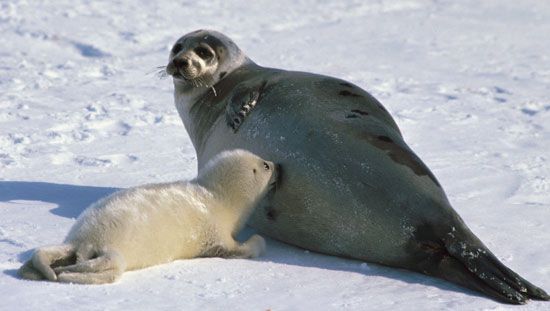
Harp seals (Pagophilus groenlandica) are primarily found in the northernmost Arctic and Atlantic waters, ranging from the Kara Sea in Russia westward to the Gulf of St. Lawrence in Canada. They are divided into three distinct populations that inhabit the northwestern Atlantic, the Barents Sea, and the region between Jan Mayen Island and eastern Greenland.1
Their habitat is defined by their reliance on sea ice. While they spend most of their lives in the water, they require pack ice as a seasonal platform to give birth, rear their young, and molt. During the summer, they inhabit northern Arctic waters, but they migrate to the southern limits of their range between late February and March to breed on ice floes. Because they depend on this specific environment, reductions in ice coverage—often linked to global warming—can significantly impact their ability to successfully whelp and raise their pups.123
What is the diet of harp seals, and how do they hunt for food?
Harp seals are opportunistic predators that consume a wide variety of prey, though their diet is primarily centered on small fishes and various invertebrates.1
Key components of their diet include:
Contrary to some common misconceptions, harp seals rarely consume Atlantic cod, which is a commercially significant species.1
Regarding their hunting behavior, harp seals are not considered strong divers when compared to other seal species. They typically reach a maximum dive depth of 370 metres (1,200 feet) and generally remain underwater for no more than 16 minutes before they must return to the surface to breathe.1
How do harp seals reproduce and care for their young?
Harp seals reproduce and raise their young on seasonal platforms of pack ice, which they relocate to between late February and March. This timing is facilitated by a biological process called delayed implantation; after mating, the egg develops into a blastocyst that floats freely in the uterus for four months before implanting, ensuring birth occurs when ice conditions are optimal.1
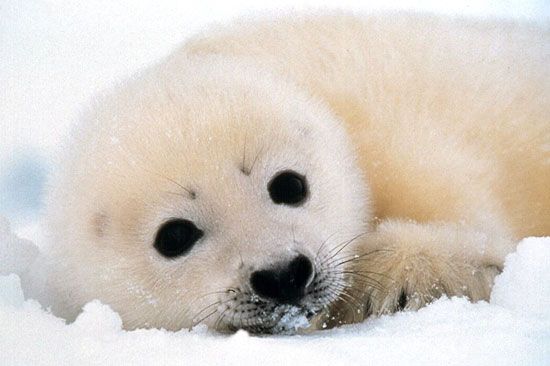
Each female typically gives birth to a single pup. Newborns, known as “whitecoats” due to their white pelage, weigh about 11 kg (24 pounds) and rely on their mother’s fat-rich milk for insulation and growth. During a brief 12-day nursing period, pups gain approximately 2 kg (4.4 pounds) of blubber per day. Weaning is abrupt, as females stop nursing to mate with males. Following this, the pups do not feed for up to six weeks, losing over half their body mass before hunger eventually drives them to enter the water and begin hunting on their own.1
What is a harp seal?
The harp seal (Pagophilus groenlandicus) is a medium-sized, earless seal native to the North Atlantic and Arctic Oceans. It is widely recognized for the distinct, black, harp-shaped or saddle-shaped marking found on the backs of adults, which contrasts with their otherwise light gray bodies and black faces.56
As one of the most abundant seal species, with a global population estimated at nearly 7.5 million, they are primarily found on or near ice floes ranging from the Kara Sea in Russia to the Gulf of St. Lawrence in Canada. They spend the majority of their lives in the water, coming ashore or onto ice only to breed, rear their young, and molt.6
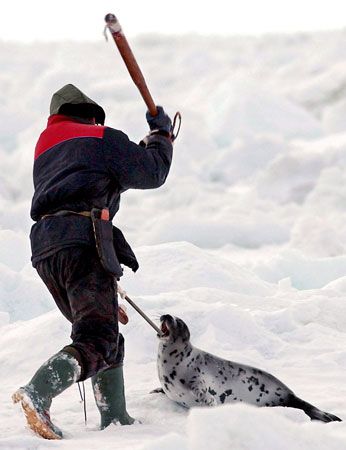
Harp seals are well-known for their developmental stages, which include the iconic white-furred “whitecoats” at birth, followed by “graycoats,” “beaters,” and “bedlamers” as they mature toward adulthood. They are also the subject of a long-standing and highly publicized commercial sealing industry that has faced significant international controversy regarding hunting practices and animal welfare.6
Sources
- harp seal — Encyclopædia Britannica
- Migration - Marine mammals — Encyclopædia Britannica
- sea ice - The emerging impacts of recent changes to sea ice — Encyclopædia Britannica
- fur seal — Encyclopædia Britannica
- harp seal — Merriam-Webster
- harbour seal — Encyclopædia Britannica
Published on · 3 min read