Harbour Seal
The harbour seal (Phoca vitulina) is a nonmigratory, earless seal belonging to the family Phocidae. These gregarious animals are found throughout the…
What is harbour seal?
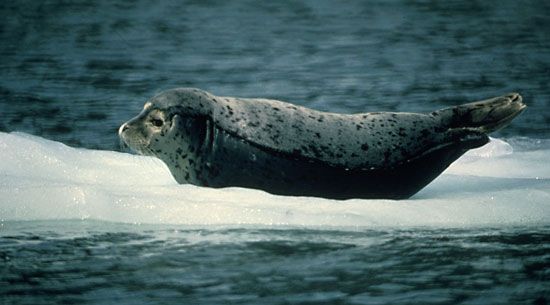
The harbour seal (Phoca vitulina) is a nonmigratory, earless seal belonging to the family Phocidae. These gregarious animals are found throughout the Northern Hemisphere, inhabiting coastlines and select freshwater lakes in Canada and Alaska.1
Physically, harbour seals are whitish or grayish at birth, while adults typically display a gray coat with black spots. Adult males can reach lengths of approximately 1.8 meters (6 feet) and weigh about 130 kg (290 pounds), with females being slightly smaller. Their diet consists primarily of fish, squid, and crustaceans. While they are of little economic value, they are sometimes viewed as a nuisance by local fishermen.1
What are the main differences between harbour seals and harp seals?
While both the harbour seal and the harp seal are earless seals (family Phocidae) found in the Northern Hemisphere, they differ significantly in their behavior, appearance, and habitat preferences.
Key Differences
Feature
Harbour Seal
Harp Seal
Habitat
Primarily coastal; sedentary/nonmigratory.
Open ocean and ice floes; migratory.
Appearance
Gray with black spots or a marbled coat.
Silver-gray with a black, harp-shaped marking on the back.
Social Behavior
Gregarious, often found in coastal groups.
Highly gregarious, forming enormous herds on ice.
Pups
Whitish or grayish at birth.
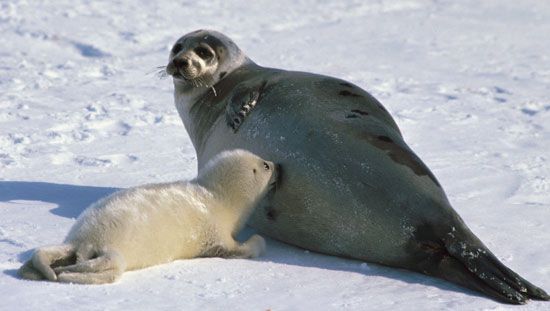
Born with pure white fur (“whitecoats”).
Diving Ability
Generally coastal foragers.
Less capable divers; max depth ~370 meters.
Behavioral and Ecological Distinctions
Harbour seals are largely sedentary, preferring to stay near coastlines and some freshwater lakes. In contrast, harp seals are oceangoing animals that make regular migrations and rely heavily on pack ice for breeding and molting. While harbour seals maintain a relatively consistent spotted or marbled appearance throughout their lives, harp seals undergo dramatic color changes as they age, transitioning from white to gray, and eventually developing their signature black “harp” marking upon reaching sexual maturity.123
How do harbour seals adapt to living in both water and on land?
Harbour seals (Phoca vitulina) have evolved specialized physical and sensory adaptations that allow them to thrive in both aquatic and terrestrial environments.
Sensory Adaptations
To navigate the challenges of hearing in two different mediums, harbour seals have developed a unique auditory system. Unlike whales, which have fully transitioned to aquatic hearing, harbour seals maintain a “double system” that provides excellent sensitivity to both aerial and underwater sounds. While they have lost the external pinna—a streamlining feature that aids in rapid movement through water—they retain the ability to close their ear openings when diving. Their underwater hearing is particularly acute, capable of detecting frequencies as high as 160,000 hertz, while their aerial hearing remains highly effective for specific frequency ranges.1
Diving and Physiological Adaptations
Harbour seals are well-equipped for breath-holding dives. Unlike humans, who are susceptible to thoracic squeeze during deep dives, these seals possess highly elastic chest cavities. This anatomical flexibility allows their lungs to compress safely under extreme pressure without the tissue damage or collapse that would affect a human diver. Furthermore, their bodies are adapted to manage gases in the bloodstream more conservatively during long periods underwater.5
What are some of the natural predators that harbour seals face in the wild?
Harbour seals (Phoca vitulina) face several formidable natural predators in their marine environments. Because they are pinnipeds, they are frequently targeted by large marine carnivores that occupy the upper levels of the food chain.
The primary natural predators of harbour seals include:
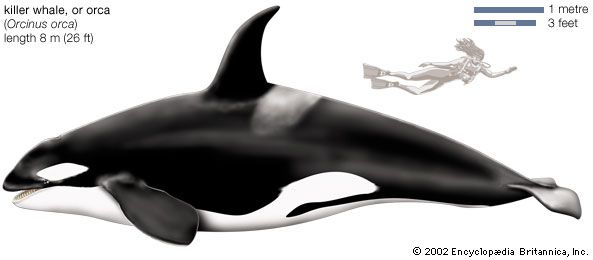
- Killer whales: As apex predators, orcas are highly intelligent hunters that often work in groups to capture seals. They are known to use sophisticated strategies to isolate and secure their prey.18
- Large sharks: Various species of large sharks, most notably the white shark, are significant predators. These sharks typically employ an ambush strategy, rushing their prey from below to inflict a fatal bite.9
- Polar bears: In Arctic regions, polar bears are major predators of pinnipeds. They are known to stalk seals resting on ice, ambush them near breathing holes, and even dig young seals out of snow shelters.210
While these animals are the most significant natural threats, harbour seals have evolved various behaviors to minimize their risk, such as remaining vigilant while hauled out on land or ice and utilizing their agility in the water to escape.
Sources
- harbour seal — Encyclopædia Britannica
- harp seal — Encyclopædia Britannica
- hooded seal — Encyclopædia Britannica
- seal — Encyclopædia Britannica
- sound reception - Marine mammals — Encyclopædia Britannica
- cetacean - Circulation and thermoregulation — Encyclopædia Britannica
- thoracic squeeze — Encyclopædia Britannica
- polar bear — Encyclopædia Britannica
- white shark - Feeding habits — Encyclopædia Britannica
- Why are orcas called killer whales? — Encyclopædia Britannica
- cetacean - Feeding — Encyclopædia Britannica
Published on · 3 min read