Rock Glacier
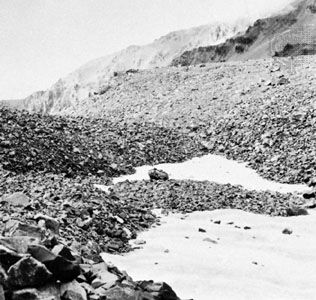
A rock glacier is a tonguelike, mobile landform composed of coarse rock fragments found in high-mountain regions above the timberline. These features…
What is rock glacier?
A rock glacier is a tonguelike, mobile landform composed of coarse rock fragments found in high-mountain regions above the timberline. These features typically form when ice fills the pore spaces within thick accumulations of talus, allowing the entire mass of rock and ice to move slowly downslope under the influence of gravity.12
Key characteristics include:
- Composition: They consist of angular rock debris, often originating from cliff faces, with interstitial ice in the center. Some may contain cores of pure ice and could represent the final stages of retreating valley glaciers buried under debris.12
- Movement: They move at rates sometimes exceeding 150 centimeters per year, likely through the flowage of interstitial ice or frost-induced creep.1
- Surface Features: Their surfaces often display wavelike, convex ridges that indicate flow.1
As they reach their terminus, the ice melts, depositing the rock material to form a steep talus slope.1
What is the difference between a felsenmeer and a rock glacier?
While both felsenmeers and rock glaciers are landforms associated with high-mountain or cold environments, they differ significantly in their structure and mobility.
- Felsenmeer: Often called a “sea of rocks,” this is a static mantle of angular, frost-shattered rock fragments that covers exposed bedrock. These deposits form in place through repeated freeze-thaw cycles that break up the underlying rock. They typically accumulate on surfaces where the slope is not steep enough to cause the debris to slide away.245
- Rock Glacier: In contrast, a rock glacier is a distinct, mobile landform. It forms when ice fills the pore spaces within a thick accumulation of talus, creating a mass that moves slowly downslope under the influence of gravity, similar to a glacier. While a felsenmeer is essentially a stationary cover of rubble, a rock glacier is a dynamic, lobate feature that can contain significant amounts of interstitial or core ice.2
How does frost action contribute to the movement of rock glaciers?
Frost action is considered one of the primary mechanisms contributing to the movement of rock glaciers. This process, often referred to as frost-induced creep, facilitates the slow, downslope migration of the rock-and-ice mass through the following dynamics:
- Frost Heaving: As interstitial water within the talus accumulations freezes, the resulting expansion forces rock particles upward and outward, perpendicular to the slope.1
- Gravity-Driven Settlement: When the ice melts or thaws, these particles are no longer supported in their elevated positions. Gravity then pulls the particles directly downward, resulting in a net movement downslope.1
- Cumulative Effect: This cycle of freezing and thawing, repeated over time, causes the entire mass of rock and ice to creep slowly down the valley.21
While the movement of rock glaciers is also attributed to the flowage of interstitial ice—similar to the internal deformation seen in traditional glaciers—frost-induced creep remains a critical factor in the gradual, lobate progression of these landforms in high-mountain environments.27
What are the main differences between a rock glacier and a true glacier?
The primary differences between a rock glacier and a glacier lie in their composition and formation:
- Composition: A true glacier is a large mass of perennial ice that originates on land through the recrystallization of snow or other solid precipitation. In contrast, a rock glacier is a tonguelike body composed primarily of coarse rock fragments that have fallen from valley walls, containing only interstitial ice within its center.19
- Formation: Glaciers form from the accumulation and compaction of snow. Rock glaciers form in high-mountain environments where rock debris accumulates and becomes cemented by ice.19
- Movement: Glaciers move primarily through internal deformation and basal sliding, processes heavily influenced by the ice’s temperature and pressure-melting point. While rock glaciers also exhibit flowage, their movement is attributed to the flow of interstitial ice or creeping caused by frost action.39
- Appearance: Glaciers are defined by their mass of ice, whereas rock glaciers resemble the debris-heavy material found at the terminus of a true glacier, often featuring wavelike surface ridges that indicate flow.9
Sources
- rock glacier — Encyclopædia Britannica
- glacial landform - Felsenmeers, talus, and rock glaciers — Encyclopædia Britannica
- glacial landform - Glacial erosion — Encyclopædia Britannica
- felsenmeer — Encyclopædia Britannica
- felsenmeer — Merriam-Webster
- glacier - Transformation of snow to ice — Encyclopædia Britannica
- creep — Encyclopædia Britannica
- hydrologic sciences - The movement of glaciers — Encyclopædia Britannica
- glacier — Encyclopædia Britannica
Published on · 3 min read