Sailfish
The sailfish (genus Istiophorus) is a highly valued game and food fish belonging to the family Istiophoridae. Found in warm and temperate waters globally, it…
What is sailfish?
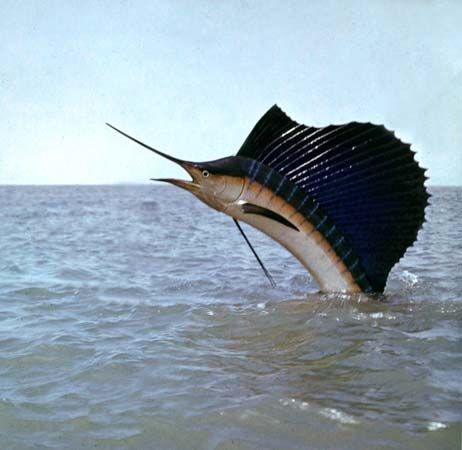
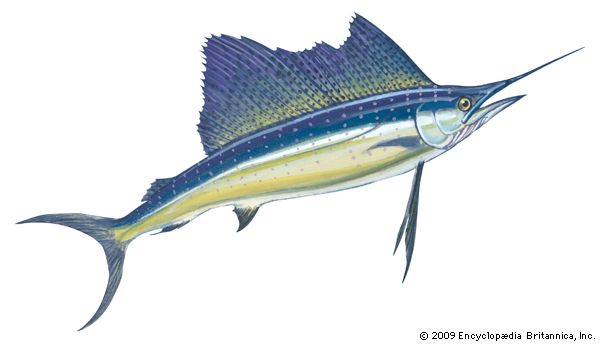
The sailfish (genus Istiophorus) is a highly valued game and food fish belonging to the family Istiophoridae. Found in warm and temperate waters globally, it is easily identified by its large, sail-like dorsal fin, slim body, and a long, rounded spear extending from its snout. These fish can reach lengths of up to 3.4 metres (11 feet) and weigh 90 kg (200 pounds) or more, primarily feeding on other fish. While classification remains somewhat uncertain, scientists often distinguish between the Indo-Pacific sailfish and the Atlantic sailfish.1
It is important to note that the sailfish is distinct from the snailfish, a small, tadpole-shaped fish found in cold waters that possesses a specialized sucking disk for attachment to the sea floor.2
How fast can a sailfish swim?
The sailfish is widely recognized as one of the fastest animals in the ocean. While obtaining precise, verifiable measurements for aquatic speeds is challenging, the sailfish is considered a top contender among the fastest fish, with an estimated top speed of at least 67 miles per hour (approximately 108 kilometers per hour).1
It is worth noting that while the sailfish is incredibly swift, some sources suggest the black marlin may reach even higher speeds of up to 80 miles per hour. These high-speed capabilities are essential for locomotion and hunting in their marine environments.1
What makes the sailfish’s dorsal fin unique?
The sailfish’s dorsal fin is its most defining characteristic, distinguishing it from other billfish such as marlins. This feature is exceptionally large and sail-like in appearance, often described as a prominent, bright blue, and spotted structure that spans a significant portion of the fish’s back.14
Beyond its size, the fin serves as a key diagnostic trait for the genus Istiophorus. While the sailfish shares a long, rounded spear on its snout with its relatives, the combination of its slimmer body, elongated pelvic fins, and this expansive dorsal fin sets it apart within the family Istiophoridae.1
How do sailfish use their spear-like snouts to hunt?
While the sailfish is characterized by the long, rounded spear extending from its snout, the provided information does not detail the specific mechanics of how it uses this feature to hunt. It is known that the sailfish is a predator that feeds mainly on other fishes, but the specific role of the snout in capturing prey is not described in the available data.1
It is important to clarify that while some animals possess spearlike bills, their functions vary significantly; for example, some birds with spearlike bills use them for grasping rather than impaling.5
Sources
- sailfish — Encyclopædia Britannica
- snailfish — Encyclopædia Britannica
- The Fastest Animals on Earth — Encyclopædia Britannica
- sailfish — Merriam-Webster
- billfish — Encyclopædia Britannica
- Ciconiiform - Bill shape — Encyclopædia Britannica
Published on · 2 min read