Gymnophiona
Gymnophiona is one of the three major extant orders of the class Amphibia. Its members are commonly known as caecilians, a name derived from the Latin word…
What is Gymnophiona?
Gymnophiona is one of the three major extant orders of the class Amphibia. Its members are commonly known as caecilians, a name derived from the Latin word caecus, meaning “sightless” or “blind”.1
These animals are characterized by a limbless, wormlike appearance and are typically found living underground in humid tropical regions across the world. Because of their subterranean lifestyle, they are often unfamiliar to the general public.12
Key features of caecilians include:
- Morphology: They possess compact, bony heads that form a strong, spadelike braincase, which aids in tunneling through soil.3
- Sensory Adaptations: While their vision is not acute, they have well-developed nasal organs and use a specialized tentacle to enhance chemosensory perception.3
- Locomotion: They move through soil using a process called concertina locomotion, where the body alternately folds and extends along its length.3
What do Gymnophiona look like?
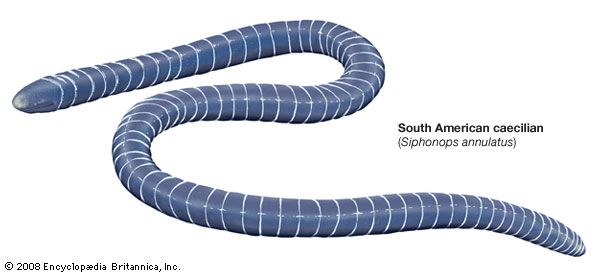
Gymnophiona, commonly known as caecilians, are characterized by a highly specialized, wormlike appearance adapted for a subterranean lifestyle. Their physical traits include:21
- Body Shape: They have long, limbless, cylindrical bodies that are segmented by primary grooves called annuli. In some species, these segments contain embedded dermal scales.67
- Head Structure: They possess a compact, bony, and blunt head. The skull is reinforced by fused bones to create a strong, spadelike braincase, which aids in burrowing through soil.27
- Sensory Features: Their eyes are degenerate and typically covered by skin or bone, reflecting their limited reliance on vision. They feature a unique, projectable sensory tentacle located between the eye and nostril, which enhances their chemosensory perception.672
- Mouth and Teeth: Their teeth are curved, and they possess a distinct arrangement of jaw muscles that attach to a retroarticular process on the lower jaw.267
Depending on the species, they may have a short, pointed tail or lack one entirely. Would you like to discover more about their unique reproductive strategies?6
Where do these amphibians live?
Gymnophiona, or caecilians, are primarily found in humid tropical regions throughout the world. Most species lead a subterranean existence, dwelling within moist soil where they can feed, reproduce, and avoid predators.1278
Their geographic distribution includes:
- The Americas: Five of the ten known families are found here, including populations in the Amazon rainforest.2
- Africa and Asia: Both regions harbor three families each.2
- Island Habitats: They are present in Sri Lanka, the Philippines, Indonesia, and the Seychelles. Notably, they are absent from Madagascar and New Guinea.2
While the vast majority are terrestrial burrowers, a few species are aquatic, such as those in the family Typhlonectidae, which inhabit ponds and streams.97103
How do Gymnophiona move and survive underground?
Gymnophiona, or caecilians, are highly specialized for a subterranean life, utilizing unique anatomical adaptations to navigate and survive underground.
Movement
Caecilians move through soil using a method known as concertina locomotion. This process involves the body alternately folding and extending itself along its entire length, utilizing both internal flexures and movements within their skin envelope. Their axial musculoskeletal system is uniquely structured: the skin is attached to the axial muscles, forming a tough, outer muscular sheath that is largely disconnected from the vertebral musculature. This allows the skin and superficial muscles to move as a single unit, facilitating efficient tunneling.12
Survival Adaptations
- Cranial Structure: They possess a compact, bony, and blunt head with fused ossification centers, creating a strong, spadelike braincase that acts as a tool for tunneling through soil.12
- Sensory Perception: Because vision is of little use underground, their eyes are degenerate and often covered by skin or bone. Instead, they rely on well-developed nasal organs and a unique, projectable chemosensory tentacle to locate prey, such as earthworms.1102
- Feeding: They capture prey using powerful, recurved teeth.102
Sources
- Gymnophiona — Encyclopædia Britannica
- amphibian - Caecilians — Encyclopædia Britannica
- Gymnophiona — Merriam-Webster
- moss animal - Reproduction — Encyclopædia Britannica
- Animal reproductive system — Encyclopædia Britannica
- Gymnophiona - Annotated classification — Encyclopædia Britannica
- Gymnophiona - Form and function — Encyclopædia Britannica
- Gymnophiona - Breeding behaviour — Encyclopædia Britannica
- Gymnophiona - Distribution and abundance — Encyclopædia Britannica
- Gymnophiona - Feeding habits — Encyclopædia Britannica
Published on · 3 min read