Sandbar
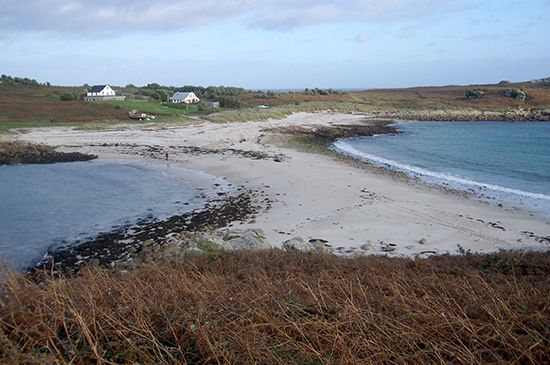
A sandbar is a ridge of sand or coarse sediment that is either submerged or partially exposed, typically built by wave action offshore from a beach.
What is sandbar?
A sandbar is a ridge of sand or coarse sediment that is either submerged or partially exposed, typically built by wave action offshore from a beach.1
The formation process involves wave turbulence creating a trough in the sandy bottom. Sand is then deposited on the offshore flank of this trough, supplemented by material from backwash, rip currents, and deeper water. These features are dynamic: they often migrate shoreward during gentle seas and seaward during high seas.1
Variations of these formations include:
- Bay-mouth bars: Extend partially or entirely across the mouth of a bay.1
- Bay-head bars: Located at the heads of bays, near the shore.1
- Barrier bars: Exposed sandbars that remain above water, often separated from the mainland by shallow lagoons.1
While sandbars are most pronounced during stormy seasons, they are often more submerged at those times. They are commonly found along low-lying coastal plains, such as the shores of the Gulf of Mexico.1
How do tides affect the visibility of sandbars?
Tides significantly influence the visibility of sandbars by altering the water depth above them. Because sandbars are ridges of sediment typically located just below or near the water’s surface, their emergence is directly tied to the daily rise and fall of the sea level.14
During low tide, the water level drops, which can cause submerged sandbars to become emergent, allowing them to be seen or even walked upon. Conversely, during high tide, the increased water depth often hides these features beneath the surface.41
Beyond simple visibility, tides also play a role in the physical development of these landforms:
- Sediment Transport: In constricted areas like inlets or estuaries, tidal currents can reach speeds sufficient to transport the sand that forms and maintains these bars.2
- Shoreline Shifting: The rise and fall of the tide redistributes wave energy across the shore zone. On gently sloping coasts, this movement can shift the shoreline by significant distances, changing where waves interact with the bottom to build or erode sandbars.2
What is the difference between a sandbar and a barrier island?
While both sandbars and barrier islands are sandy features formed by wave and current action, they differ significantly in their structure, permanence, and relationship to the coastline.
Key Differences
- Definition and Structure: A sandbar is typically a submerged or partially exposed ridge of sediment located offshore from a beach. It is a dynamic feature that shifts position based on wave energy and sea levels. In contrast, a barrier island is a long, broad, and more permanent sandy landform that parallels the shore. These islands are complex systems that often feature well-developed beaches, coastal dunes, and diverse environments like marshes or tidal flats on their landward side.251
- Relationship to the Mainland: Sandbars are generally located in the immediate surf zone. Barrier islands are separated from the mainland by lagoons, which are narrow bodies of water that provide a protected environment between the island and the coast.21
- Formation: While both rely on sediment supply and wave action, barrier islands often form on low-lying coastal plains where the slope is relatively flat. They act as a protective buffer, shielding the mainland from the full force of the ocean.615
How do waves contribute to the movement of sand along a coast?
Waves are the primary drivers of sediment movement along a coast, acting through both direct impact and the generation of currents. As waves travel into shallow water, they interact with the ocean floor, picking up and suspending sediment particles that would otherwise remain stationary.9
The movement of this sediment occurs in two primary directions:
- Perpendicular to the shore: During calm conditions, waves typically transport sediment toward the coast, depositing it to build up the beach. Conversely, during intense storm conditions, larger, steeper waves erode the beach and transport sediment offshore into deeper water.910
- Along the shore: Because waves often approach the coast at an angle, they undergo refraction as they enter shallow water. This process generates a longshore current that flows parallel to the shoreline. While the waves themselves suspend the sediment, this current acts as the transport mechanism, moving large quantities of material along the coast.11
The intensity and direction of this transport are dictated by wave size, the angle of approach, and prevailing wind patterns.11
Sources
- sandbar — Encyclopædia Britannica
- sandbar — Merriam-Webster
- sandbars — Merriam-Webster
- coastal landforms - Tides — Encyclopædia Britannica
- barrier island — Merriam-Webster
- lagoon - Waves , tides, and surf — Encyclopædia Britannica
- lagoon - Barrier bars and sediment sources — Encyclopædia Britannica
- coastal landforms - Barrier island/estuarine systems — Encyclopædia Britannica
- coastal landforms - Longshore currents — Encyclopædia Britannica
- coastal landforms - Waves — Encyclopædia Britannica
- coastal landforms - Beaches — Encyclopædia Britannica
- breakwater — Encyclopædia Britannica
Published on · 3 min read