Sand Dune
Sand dunes are mounds or ridges of sand shaped by the wind under the influence of gravity. They form when wind-blown sand grains—moving primarily through a…
How do sand dunes move and change over time?
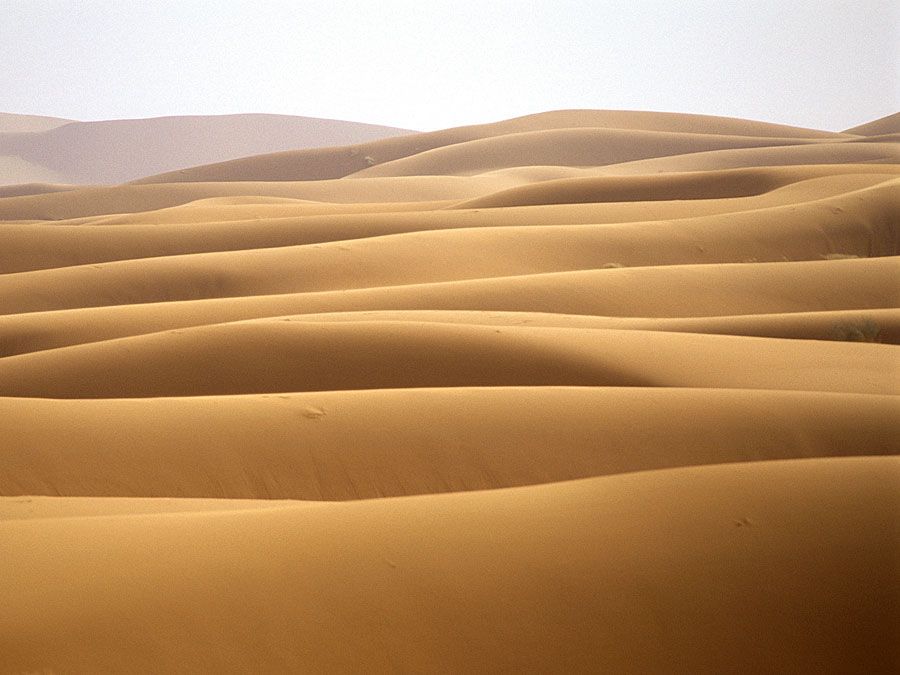
Sand dunes are mounds or ridges of sand shaped by the wind under the influence of gravity. They form when wind-blown sand grains—moving primarily through a process called saltation (jumping)—encounter a surface patch large enough to trap them.12
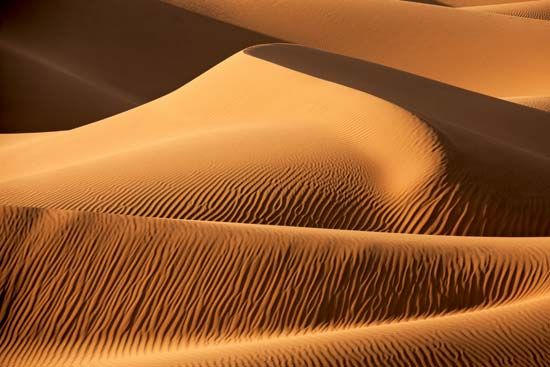
As a dune grows, the windward slope adjusts to the airflow, eventually reaching an equilibrium where there is no net gain or loss of sand. The leeward side steepens until it reaches the angle of repose (about 32°), creating a “slip face”. At this stage, the dune moves forward as a whole: sand is eroded from the windward side and deposited onto the leeward slip face.2
Movement rates vary significantly based on dune size; smaller dunes generally migrate faster than larger ones because they require less sand to reconstitute their form. Depending on local conditions, dunes can travel anywhere from 20 to 100 metres per year. Their shapes and movement are further modified by wind velocity, direction, and turbulence, as well as topographical obstructions.23
What are the different types of sand dunes?
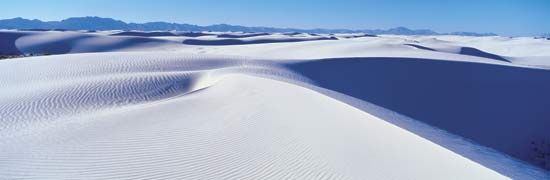
Sand dunes exhibit a variety of shapes and sizes, largely determined by wind patterns, sand supply, and local topography. Some of the most recognized types include:
- Barchan Dunes: These are small, crescent-shaped dunes that form in areas where the wind blows consistently from one direction. They are convex toward the wind, with their “horns” pointing downwind, marking the lateral advancement of the sand.56
- Transverse Ridges: When there is a continuous supply of sand, dunes often form long, straight ridges oriented at right angles to the prevailing wind. These are frequently composed of alternating crescentic elements.5
- Compound Dunes: Also known as mega-dunes or draa, these are massive features that can reach heights of nearly 200 metres. They often feature a hierarchy of smaller dunes and ripples superimposed on their surfaces.5
- Star Dunes (Pyramidal Dunes): These dunes resemble a several-pointed star in plan view, with sharp-crested ridges rising from a base to a central peak. They are formed by strong winds blowing from various directions and can remain stable for centuries.7
- Reversing Dunes: These form in areas where winds blow from opposing directions during different seasons, causing the slip face to shift back and forth.5
- Echo Dunes: These large accumulations form on the upwind side of high scarps or large hill massifs, separated by a corridor kept clear of sand by rolling air eddies.5
What is the process of sand dune stabilization, and why is it important?
Sand dune stabilization is the process of anchoring shifting sand to prevent erosion and manage the movement of dunes. This is primarily achieved through the conservation and cultivation of specific plant communities.1011
The Process of Stabilization
Stabilization relies on the interaction between vegetation and the sandy substrate:
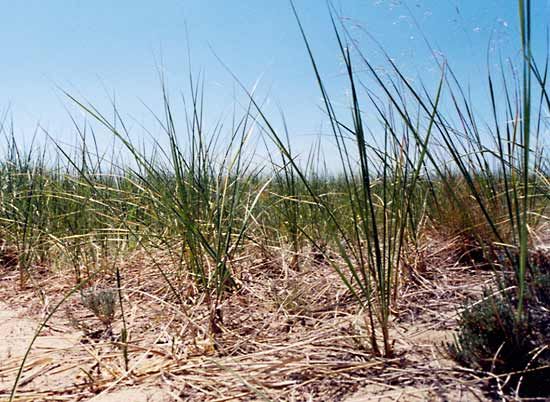
- Root Networks: Plants such as marram grass (or beach grass) are essential because they spread tuberous roots just beneath the surface. These roots form an underground web that physically binds the sand particles together.12
- Surface Protection: The upper portions of these plants act as a barrier, shielding the soil from the direct impact of surface winds, which prevents the sand from being lifted and transported.1011
- Engineering Measures: In addition to biological methods, human-made windbreaks—typically lines of fast-growing trees—can be established to slow wind speeds and inhibit the encroachment of dunes into developed or agricultural areas.10
Why It Is Important
Stabilization is critical for maintaining land stability and protecting ecosystems. By holding sand in place, vegetation allows dunes to grow higher and prevents the loss of soil productivity. Furthermore, stabilization helps protect coastal and inland regions from the encroachment of active, shifting sands, which can otherwise damage infrastructure and disrupt local environments.121011
What role do sand dunes play in coastal ecosystems?
Coastal dunes play a vital role in the development and protection of shorelines. Located immediately landward of the beach, these large, linear accumulations of sand form as wind transports sediment from the shore and deposits it around obstructions.12
Their primary functions include:
- Promoting Coastal Growth: Dunes act as a mechanism for a coast to prograde, or grow seaward. Small wind-shadow dunes, known as coppice mounds, can develop into foredunes—the seaward-most line of coastal dunes—which serve as the foundation for further land expansion.12
- Stabilization and Habitat Support: Coastal dunes are often colonized by specialized vegetation, such as marram grass. These plants create underground root webs that bind sand particles together, preventing erosion and allowing the dunes to increase in height.123
- Sediment Management: Dunes serve as a reservoir for sand within the coastal system. The presence of vegetation is a key factor in determining whether a dune remains active and mobile or becomes stabilized, which in turn influences the local landscape’s topography.12
Sources
- sand dune - Formation and growth of dunes — Encyclopædia Britannica
- sand dune - Winds — Encyclopædia Britannica
- sand dune — Encyclopædia Britannica
- sand dune - Fixed dunes in semiarid regions — Encyclopædia Britannica
- sand dune - Dune and sheet patterns — Encyclopædia Britannica
- barchan — Encyclopædia Britannica
- sand dune - Sands — Encyclopædia Britannica
- barchan — Merriam-Webster
- sand mountain — Encyclopædia Britannica
- 11 Questions About Useful Plants Answered - Why do people plant marram grass on sand dunes? — Encyclopædia Britannica
- desertification - Solutions to desertification — Encyclopædia Britannica
- coastal landforms - Coastal dunes — Encyclopædia Britannica
- sand dune - Geomorphic characteristics — Encyclopædia Britannica
Published on · 4 min read