Tombolo
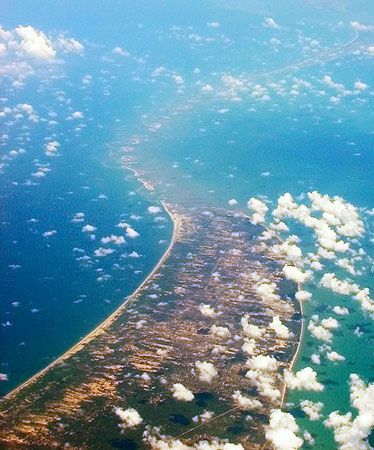
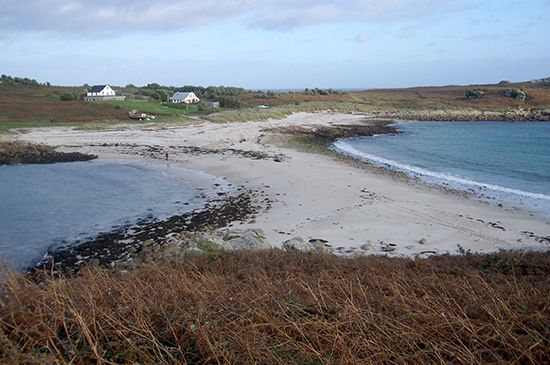
A tombolo is a coastal landform consisting of one or more sandbars or spits that connect an island to the mainland.

What is tombolo?
A tombolo is a coastal landform consisting of one or more sandbars or spits that connect an island to the mainland.1
These features typically form in the shallower waters between an island and the shore, where sediment accumulates to create a bridge. Depending on the geography, a single tombolo may link a tied island to the mainland, while a double tombolo can enclose a lagoon that eventually fills with sediment. A notable historical example is Adam’s Bridge, which once connected Sri Lanka to India before changes in sea level altered its structure.1
How do ocean currents create sandbars?
It is a common misconception that ocean currents are the primary force behind the creation of sandbars; in reality, sandbars are primarily built by the action of waves.2
While currents like longshore currents are essential for transporting sediment along the coast, the formation of a sandbar is driven by the swirling turbulence of waves breaking offshore. As waves break, they excavate a trough in the sandy bottom. Some of the displaced sand is carried toward the beach, while the remainder is deposited on the offshore flank of the trough.32
Additional sediment is contributed to the bar by sand suspended in the backwash and rip currents, as well as sand moving shoreward from deeper water. The height of the bar is typically maintained below the still-water level by the constant plunge of breaking waves. While tidal currents can transport significant quantities of sediment in constricted areas like inlets, they are generally not swift enough to form sandbars on the open coast.24
What is the difference between a spit and a tombolo?
While both features are coastal landforms composed of sediment, they are distinguished by their connection to the land and their structural purpose.
A spit is a narrow coastal formation that is attached to the mainland at only one end. These features typically form where the coastline abruptly changes direction, such as across the mouth of an estuary or at a harbor entrance, and are created by the longshore movement of sediment. They often develop a characteristic recurved or hooked shape due to wave refraction at their terminal end.6
In contrast, a tombolo acts as a bridge, connecting an island to the mainland or linking two islands together. While a tombolo may be formed by a spit that has extended far enough to reach an island, its defining characteristic is this physical connection between two landmasses. A single tombolo creates a “tied island,” whereas a double tombolo can enclose a lagoon between the two connecting bars.7
How does sea level change affect coastal landforms?
Changes in sea level significantly reshape coastal environments by altering the position of the shoreline and the distribution of wave energy. Because the shoreline is dynamic, its location can shift rapidly in response to rising or falling water levels, which are often driven by long-term climatic cycles and the growth or melting of glaciers12.9
Geomorphological Impacts
- Estuary Formation: The existence of estuaries is highly dependent on sea level relative to freshwater discharge. As sea levels rose following the last glacial period, marine waters flooded entrenched river valleys, creating drowned river estuaries and fjords.10
- Barrier Islands and Lagoons: Rising sea levels can lead to the formation of lagoons by flooding low-lying land behind barrier islands. These features persist as long as the barrier maintains its elevation above the sea and is not yet filled with sediment.4
- Shoreline Migration: When sea levels fall, estuarine and coastal zones are forced to migrate seaward toward the edge of the continental shelf. Conversely, rising seas force these environments to migrate landward.10
Environmental and Human Consequences
Rising sea levels increase the frequency and severity of flooding, storm surges, and erosion. These processes threaten coastal ecosystems and human infrastructure, posing significant risks to the approximately 40 percent of the global population living in vulnerable coastal areas.11
Sources
- tombolo — Encyclopædia Britannica
- coastal landforms - Coastal dunes — Encyclopædia Britannica
- sandbar — Encyclopædia Britannica
- coastal landforms - Tides — Encyclopædia Britannica
- coastal landforms - Longshore currents — Encyclopædia Britannica
- spit — Encyclopædia Britannica
- spit — Merriam-Webster
- tombolo — Merriam-Webster
- sea level rise: Top Questions — Encyclopædia Britannica
- estuary - Geology and geomorphology — Encyclopædia Britannica
- lagoon - Waves , tides, and surf — Encyclopædia Britannica
- sea level — Encyclopædia Britannica
- paleogeography - Shorelines and continental margins — Encyclopædia Britannica
Published on · 3 min read