Sandhill Crane
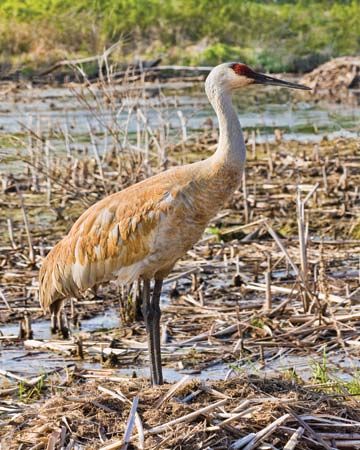
The sandhill crane (Grus canadensis) is a species of crane belonging to the family Gruidae. It is considered one of the oldest existing bird species.…
What is Sandhill crane?
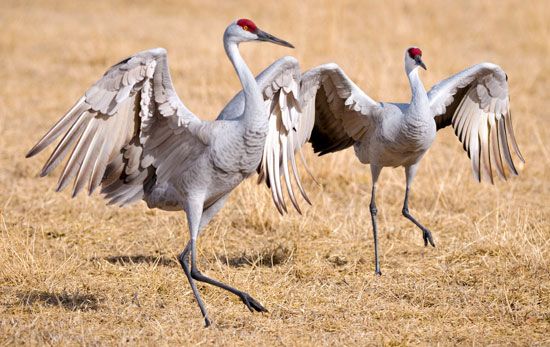
The sandhill crane (Grus canadensis) is a species of crane belonging to the family Gruidae. It is considered one of the oldest existing bird species. Measuring approximately 35 to 43 inches (90 to 110 cm) in length, these birds are characterized by a red crown, a bluish or brownish-gray body often tinged with sandy yellow, and a distinctively long, harsh, and penetrating call.12
These birds are known for their impressive migrations, with some populations traveling up to 4,000 miles between their nesting grounds in Alaska and eastern Siberia and their wintering areas in the southern United States. While most are migratory, a smaller subspecies is nonmigratory and breeds in Florida and southern Georgia.312
Sandhill cranes have played a significant role in conservation efforts, serving as surrogate parents to help save the endangered whooping crane from extinction.1
How do sandhill cranes help in the conservation of whooping cranes?
Sandhill cranes have played a vital role in the recovery of the whooping crane by serving as surrogate parents for the endangered species.4
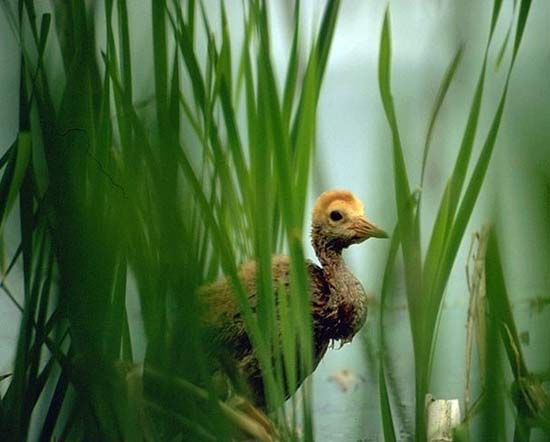
Because whooping cranes have a low reproductive rate and face high infant mortality, conservationists have utilized sandhill cranes to help raise whooping crane chicks. By fostering these chicks, sandhill cranes have assisted in increasing the population of this rare bird, which at one point in the early 21st century numbered fewer than 300 individuals in the wild.1
While the use of surrogate parents is one method, modern conservation efforts have also evolved to include innovative techniques, such as raising whooping crane hatchlings with scientists dressed in crane-like costumes to prevent the birds from imprinting on humans. These birds are then taught migration routes by following ultralight aircraft.1
What makes the sandhill crane one of the oldest bird species?
The sandhill crane (Grus canadensis) is recognized as one of the oldest existing bird species because it belongs to the family Gruidae, an ancient group of birds with a deep evolutionary history.12
The broader order to which cranes belong, Gruiformes, possesses one of the most extensive fossil records of any avian order, stretching back over 80 million years to the Late Cretaceous Epoch. The first representatives of the modern crane family appeared during the Eocene Epoch, which began approximately 56 million years ago. While many other lineages within the Gruiformes order have declined or become restricted in range over time, the sandhill crane has persisted as a representative of this ancient evolutionary lineage.526
How do cranes physically adapt for their long-distance migrations?
Cranes are renowned for their spectacular long-distance migrations, covering thousands of miles between their breeding and wintering grounds. While the provided search results do not detail specific physiological adaptations unique to cranes for these journeys, they highlight general avian traits that facilitate high-altitude flight and efficient travel.23
Birds, including migratory species, possess a highly efficient respiratory system that enables them to extract more oxygen from the air than mammals, a critical advantage at the high altitudes often reached during migration. Additionally, birds are lightweight due to their pneumatic bones, which allow them to soar with minimal effort.3
In flight, cranes exhibit a characteristic wing action consisting of a slow downstroke followed by a quick, flicking upstroke. While they are capable of long-distance flight, cranes are also noted for their preference for walking, moving across landscapes with a deliberate and dignified gait.2
Sources
- Sandhill crane — Encyclopædia Britannica
- Crane — Encyclopædia Britannica
- Gruiform - Migration and locomotion — Encyclopædia Britannica
- Whooping crane — Encyclopædia Britannica
- Gruiform - Evolution and paleontology — Encyclopædia Britannica
- sandhill crane — Merriam-Webster
- Gruiform — Encyclopædia Britannica
- How high do birds fly? — Encyclopædia Britannica
Published on · 3 min read