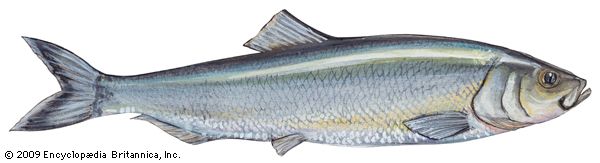
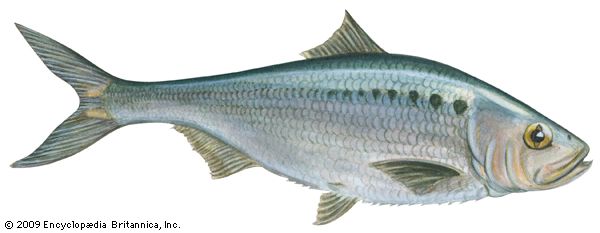
Sardine
A sardine is a term used for various small, silvery, elongated food fishes belonging to the herring family, Clupeidae. The name primarily refers to members…
What is sardine?
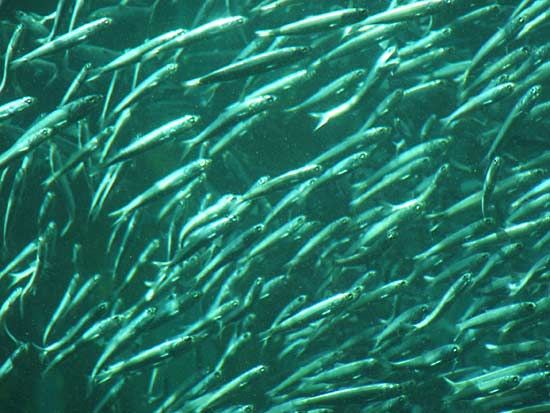
A sardine is a term used for various small, silvery, elongated food fishes belonging to the herring family, Clupeidae. The name primarily refers to members of the genera Sardina, Sardinops, and Sardinella, though it is also applied to the common herring when canned in oil.1
These fish typically measure 15 to 30 cm (6 to 12 inches) in length and live in dense schools, feeding on plankton. The European sardine, often called a pilchard in Britain, is found in the Mediterranean Sea and along the Atlantic coasts of Europe.12
Commercially, sardines are caught using encircling nets, such as the purse seine, and are utilized for human consumption, fish meal, and oil. Their oil is notably used in the production of paint, varnish, and linoleum.1
What role do sardines play in the ocean food web?
Sardines play a vital role in the ocean food web as primary consumers that bridge the gap between microscopic life and larger marine predators. By feeding on vast quantities of plankton—including diatoms, flagellates, copepods, and various larvae—sardines efficiently convert these small organisms into biomass.13
Because they live in dense, highly migratory schools, sardines serve as a critical energy source for a wide array of larger marine animals. Their abundance and widespread distribution across the Pacific, Indian, and Atlantic oceans make them a foundational component of the marine ecosystem. This role as a key forage fish supports the health and stability of the broader food chain, as they are a primary food source for many predatory fish, marine mammals, and seabirds.13
How do schools of fish like sardines protect themselves from predators?
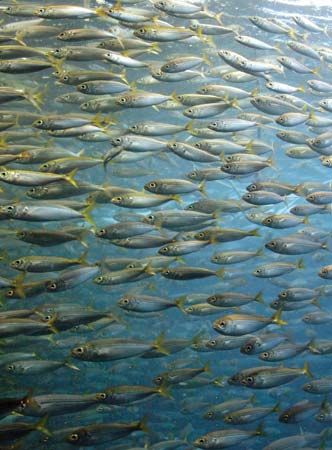
Schools of fish like sardines protect themselves from predators primarily through schooling behaviour. By swimming together in massive, coordinated groups, these fish appear to act as a single, large organism, which provides significant safety for the individual.45
When a predator approaches, sardines react by swimming closer together, often forming tight, compact balls. In more intense scenarios, such as with anchovies, a school that may be spread over hundreds of meters will rapidly contract into a dense, writhing sphere only a few meters across. This defensive maneuver thwarts predators by making it difficult for them to isolate or concentrate on a single individual, often leading to frustration in their attempts to hunt.54
Beyond protection, this behavior is facilitated by the lateral line system, which helps fish maintain their position relative to their neighbors, and precise, leaderless movements that allow the school to change direction with remarkable fluidity.5
What are the nutritional benefits of eating sardines?
While sardines are a significant source of fish meal and oil used in various industrial applications, the provided search results do not contain specific information regarding their nutritional benefits for human consumption.
The available data focuses on their biological classification, commercial fishing methods, and processing techniques—such as canning in oil or sauces—rather than their vitamin, mineral, or fatty acid content.1
Sources
- sardine — Encyclopædia Britannica
- pilchard — Encyclopædia Britannica
- clupeiform - Food ecology — Encyclopædia Britannica
- Schooling behaviour — Encyclopædia Britannica
- clupeiform - Schooling behaviour — Encyclopædia Britannica
Published on · 2 min read