Saskatchewan River
The Saskatchewan River served as a vital transportation artery for the expansion of Western Canada, functioning for a long period as an essential fur-trading…
What role did the Saskatchewan River play in the early exploration and settlement of Western Canada?
The Saskatchewan River served as a vital transportation artery for the expansion of Western Canada, functioning for a long period as an essential fur-trading route. Following its initial exploration by Henry Kelsey in 1690, the river became a primary corridor for European traders, explorers, and missionaries.12
During the era of the Hudson’s Bay Company, which held rights to the vast territory of Rupert’s Land, the river facilitated the movement of goods and people across the plains. Along with First Nations and Métis populations, these groups relied on the river system to support the fur and provisioning trade that dominated the region’s economy until the latter half of the 19th century. While the river is no longer a major navigational route, its historical role was foundational in connecting the interior of the continent to broader trade networks.21
How long is the Saskatchewan River and what are its major tributaries?
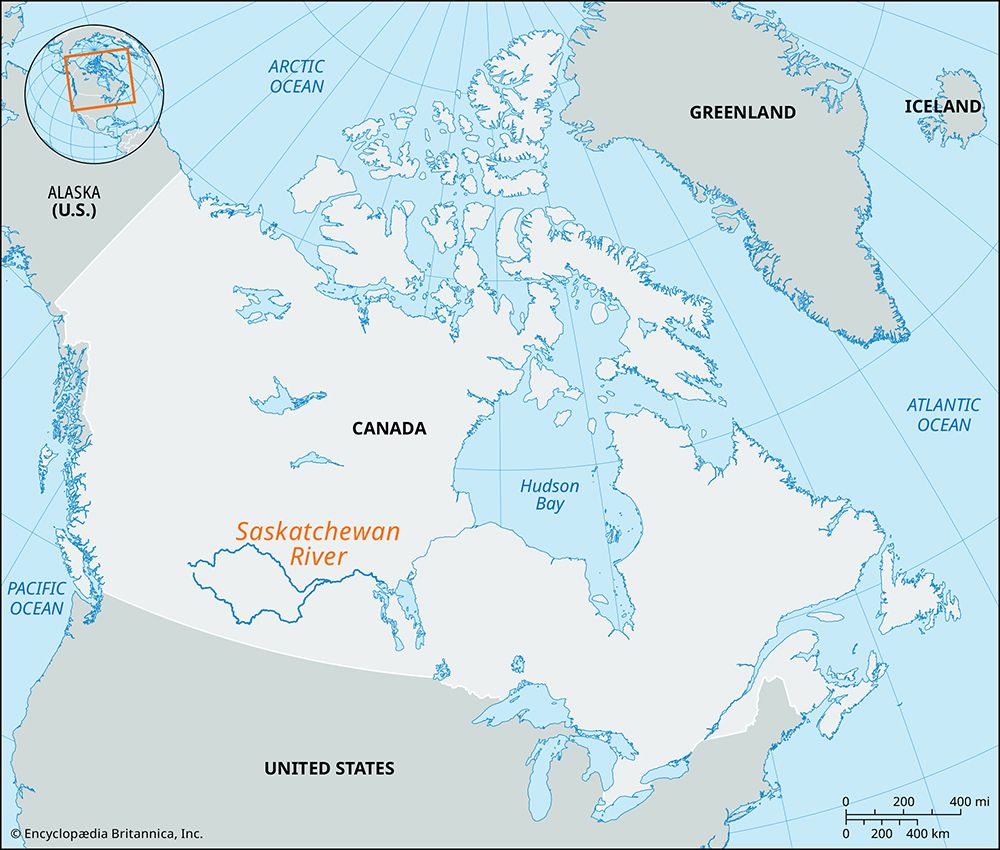
The Saskatchewan River is 1,205 miles (1,939 km) long, measured from the head of the Bow River.
The river system is formed by two primary headstreams that originate in the Canadian Rockies:
- North Saskatchewan River: 800 miles (1,287 km) long.
- South Saskatchewan River: 865 miles (1,392 km) long.
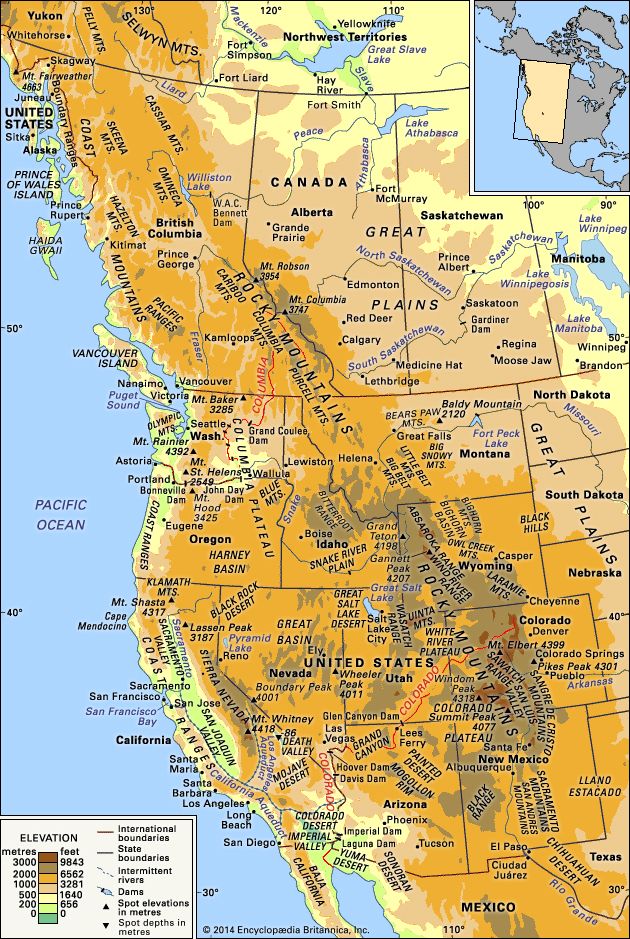
These two streams unite east of Prince Albert to form the main river, which flows eastward for 340 miles (550 km) before entering Lake Winnipeg.
Several significant tributaries contribute to the system, including:
- Battle River
- Bow River
- Oldman River
- Red Deer River
What is the Saskatchewan River and where is it located in Canada?
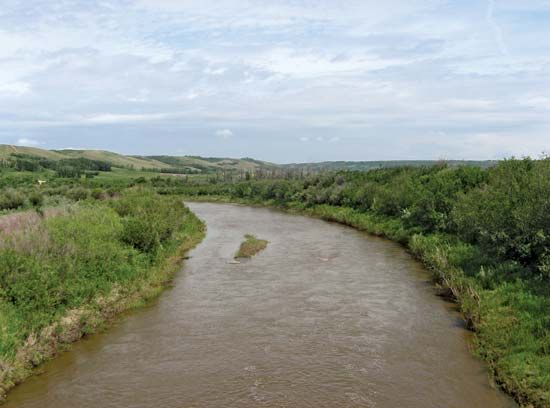
The Saskatchewan River is the largest river system in the Canadian provinces of Alberta and Saskatchewan. Its name is derived from a Cree word meaning “swift-flowing current.”
The river originates in the Canadian Rockies of western Alberta, where it begins as two major headstreams: the North Saskatchewan and South Saskatchewan rivers. These streams flow eastward, crossing the provincial boundary before uniting east of Prince Albert. The combined river continues its eastward path for 340 miles (550 km) until it empties into Lake Winnipeg in Manitoba via Cedar Lake.
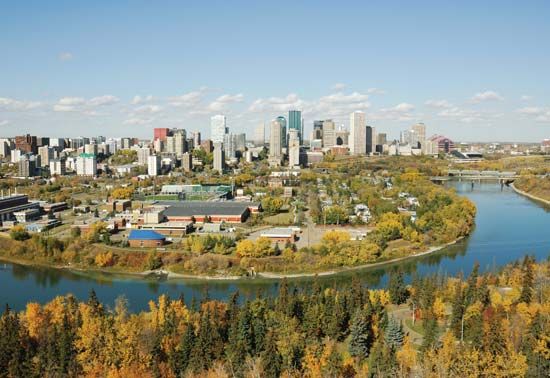
Spanning a total length of 1,205 miles (1,939 km) from the head of the Bow River, the system drains an area of 148,000 square miles. Today, it is a critical resource for hydroelectric power and irrigation, supporting major cities such as Edmonton, Calgary, Saskatoon, and Regina.
What are some of the major cities and towns located along the Saskatchewan River?
Several major cities and towns are located along the Saskatchewan River or its primary tributaries, including the North Saskatchewan River and the South Saskatchewan River. These urban centers have historically served as vital nodes for trade, agriculture, and industry.
Key cities and towns situated within this river basin include:
- Edmonton: Located on the North Saskatchewan River.
- Calgary: Situated on the Bow River, a major tributary.
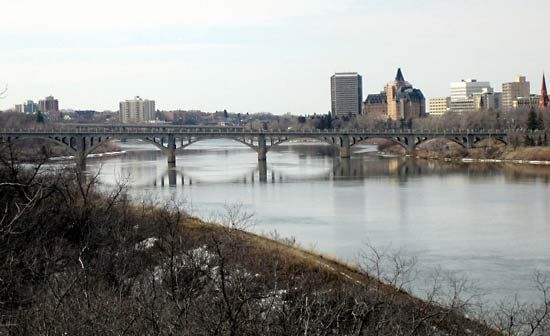
- Saskatoon: Located on the South Saskatchewan River, serving as a major service and distribution hub.17
- Prince Albert: Positioned near the confluence where the North and South Saskatchewan rivers unite.1
- Medicine Hat: Located along the South Saskatchewan River.
- Red Deer: Situated on the Red Deer River, a tributary of the South Saskatchewan.
- Lethbridge: Located along the Oldman River, another key tributary.
- North Battleford: Situated on the North Saskatchewan River, opposite the mouth of the Battle River.
Sources
- Saskatchewan River — Encyclopædia Britannica
- Saskatchewan - History of Saskatchewan — Encyclopædia Britannica
- Assiniboine River — Encyclopædia Britannica
- Qu’Appelle River — Encyclopædia Britannica
- Saskatchewan - Drainage — Encyclopædia Britannica
- Battle River — Encyclopædia Britannica
- Saskatchewan - Settlement patterns — Encyclopædia Britannica
- list of cities and towns in Canada - Saskatchewan — Encyclopædia Britannica
- Saskatoon — Encyclopædia Britannica
Published on · 3 min read