Red Deer River
The Red Deer River is a major tributary of the South Saskatchewan River located in southern Alberta, Canada.
What is Red Deer River?
The Red Deer River is a major tributary of the South Saskatchewan River located in southern Alberta, Canada.1
Rising in the Front Ranges of the Canadian Rocky Mountains within Banff National Park, the river flows for 450 miles (724 km) in a northeast and then southeast direction before joining the South Saskatchewan River just across the Saskatchewan border. The river’s name is a historical misnomer; early Scottish settlers confused the local elk population with the red deer native to Scotland.1
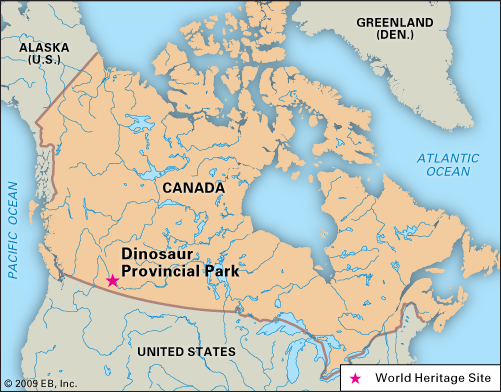
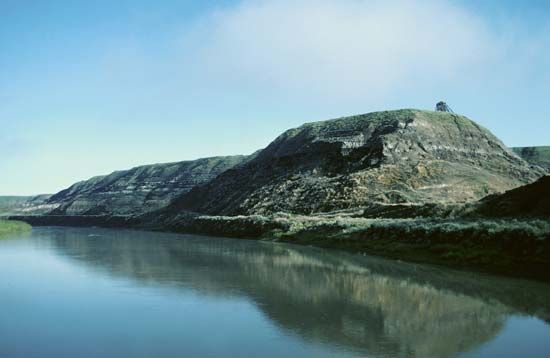
The river flows through the cities of Red Deer and Drumheller, as well as Dinosaur Provincial Park, a site renowned for its significant dinosaur fossil discoveries. In its lower reaches, the river has carved deep channels into the plains, creating extensive badlands along its banks.1
What are the unique features of the Canadian Badlands?
The Canadian Badlands, particularly the region surrounding Dinosaur Provincial Park, are defined by a unique combination of extreme geological erosion and rich paleontological history.
Geological Formation
Badlands are characterized by deep, tortuous gullies and saw-toothed divides created by intense erosion. Because the bedrock is not uniform, the landscape features stair-step profiles, isolated spires, and small, flat-topped mesas or buttes. These formations typically develop in arid or semiarid climates where poorly cemented rock is subjected to sudden, heavy rainfall, which strips away surface material and leaves the gullies bare. In the Canadian context, glaciers played a significant role in carving out these features, exposing deep layers of sedimentary rock.34
Paleontological Significance
The Canadian Badlands are world-renowned for their extensive fossil beds. During the Late Cretaceous Epoch, this area was a swampy river delta covered in subtropical forests. Silt deposited by the Red Deer River preserved the remains of diverse species, including:
- Approximately 35 species of dinosaurs.
- Various crocodilians, pterosaurs, and amphibians.
- Ancient fish and reptile remains.4
This exceptional diversity led to the area’s designation as a UNESCO World Heritage site.4
How were dinosaur fossils discovered in Dinosaur Provincial Park?
The discovery of dinosaur fossils in what is now Dinosaur Provincial Park began in the 1880s, when remains were first identified in the region’s rich fossil beds. These beds, which contain skeletal remains from every dinosaur family known to have existed during the Late Cretaceous Epoch, were exposed over time as glaciers carved out the surrounding badlands.3
Following these initial findings, the area became a focal point for major paleontological research:
- Early Excavations: Large-scale systematic excavations were initiated three decades after the first discoveries by renowned fossil hunters Barnum Brown, who worked in the area from 1910 to 1915, and Charles H. Sternberg, who conducted work from 1911 to 1917.3
- Modern Research: Ongoing efforts are supported by the Royal Tyrrell Museum, which operates a field station within the park to catalog and store specimens. Notable modern discoveries include nearly complete skeletons, significant bonebeds, and diverse deposits of crocodilians, pterosaurs, and amphibians.3
What is the difference between elk and red deer?
The elk, or wapiti, is the largest and most advanced subspecies of the red deer. While they share the same species classification (Cervus elaphus), they exhibit distinct biological and behavioral differences:
- Size and Appearance: Elk are significantly larger than European red deer. During winter, elk develop a dark neck mane that contrasts with their lighter tan or brown coat.
- Adaptations: Elk are more highly adapted to open plains, grazing, and cold, long winters. They evolved as fast endurance runners, whereas other red deer subspecies typically occupy valley bottoms and upland forests.
- Reproduction and Biology: Elk have longer gestation periods (255 days) compared to European red deer (235 days). Additionally, bull elk retain their antlers for about 185 days, significantly longer than the 150 days or less seen in European red deer.
- Vocalization: Male elk are known for a high-pitched bugling call used during the breeding season, an adaptation designed to carry sound across open landscapes.
Sources
- Red Deer River — Encyclopædia Britannica
- Saskatchewan River — Encyclopædia Britannica
- Dinosaur Provincial Park — Encyclopædia Britannica
- badland — Encyclopædia Britannica
- red deer — Encyclopædia Britannica
- elk — Encyclopædia Britannica
Published on · 3 min read