Sea Pen
Sea pens reproduce through a process involving specialized polyps known as autozooids. Within a sea pen colony, these autozooids are responsible for both…
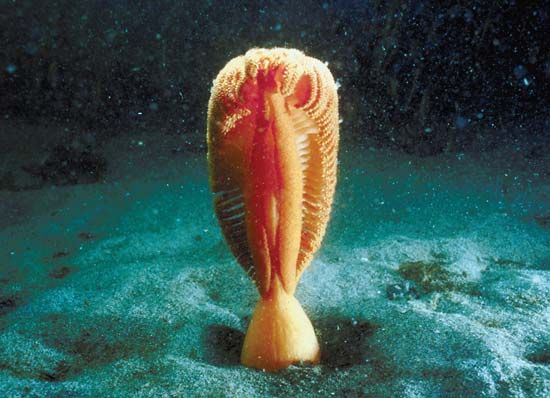
How do sea pens reproduce and what is their life cycle like?
Sea pens reproduce through a process involving specialized polyps known as autozooids. Within a sea pen colony, these autozooids are responsible for both feeding and the production of gametes, specifically eggs and sperm.1
The reproductive cycle follows these steps:
- Spawning: The autozooids expel eggs and sperm through their mouths directly into the open water.1
- Fertilization: Fertilization occurs externally within the water column.1
- Larval Stage: Once fertilized, the eggs develop into ciliated, free-swimming larvae known as planulae.1
- Settlement and Metamorphosis: The planula eventually settles onto the seafloor. Upon settling, it undergoes metamorphosis to form the axial polyp, which serves as the foundation for a new sea pen colony.1
What role do sea pens play in marine ecosystems?
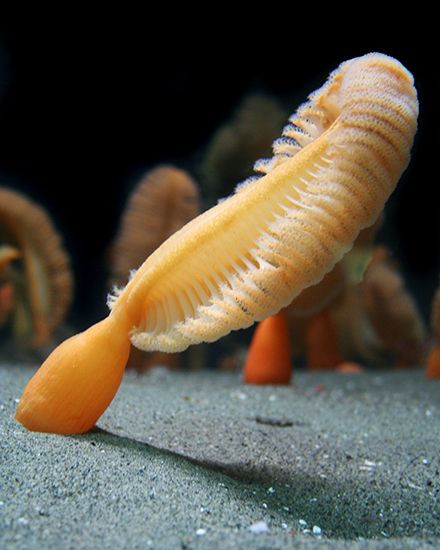
Sea pens, which belong to the order Pennatulacea, function as colonial organisms that contribute to the complexity of marine environments. While the provided information focuses on their biological structure and reproductive processes, their role in the ecosystem is primarily defined by their interaction with the seafloor and the water column.
By anchoring themselves into mud or sand using their peduncle, sea pens help stabilize soft-bottom habitats. They act as active filter feeders, utilizing their secondary polyps—specifically the autozooids—to capture small organisms from the surrounding water. Furthermore, the siphonozooids facilitate the movement of water through the colony’s internal canal system, which supports their physiological maintenance and expansion. As colonial invertebrates, they also serve as a source of bioluminescence, a trait often triggered by physical stimulation, which may serve as a defense mechanism or a form of communication within their habitat.1
How do sea pens feed and what do they eat?
Sea pens are colonial invertebrates that feed by capturing small organisms from the surrounding water using the tentacles located at the end of each polyp. Within the colony, specialized secondary polyps known as autozooids are responsible for this feeding process.1
To facilitate their feeding and physiological maintenance, sea pens utilize a system of interconnecting hollow canals. Siphonozooids, another type of secondary polyp, draw currents of water through this internal canal system, which also allows the colony to expand or deflate. While the provided search results do not specify the exact species of prey, sea pens are generally described as feeding on small organisms present in the water column.1
In what types of marine habitats are sea pens commonly found?
Sea pens, which are colonial invertebrates belonging to the order Pennatulacea, are remarkably adaptable in their habitat preferences. They are found in a wide range of marine environments, spanning from shallow coastal waters to the deep sea. Their distribution is global, occurring in diverse climates ranging from polar seas to the tropics.1
A defining characteristic of their habitat is the substrate; sea pens require soft bottoms to survive. They utilize a specialized lower portion of their central stalk, known as the peduncle, to anchor themselves firmly into mud or sand. Because they rely on this specific type of seafloor for stability, they are typically absent from rocky or hard-bottom environments where they cannot easily embed their stalks.1
Sources
- sea pen — Encyclopædia Britannica
- scorpaeniform - Reproduction — Encyclopædia Britannica
- sea pansy — Encyclopædia Britannica
- Marine ecosystem - Plankton — Encyclopædia Britannica
- Marine ecosystem - Physical and chemical properties of seawater — Encyclopædia Britannica
Published on · 2 min read