How Many Tentacles Does a Jellyfish Have?
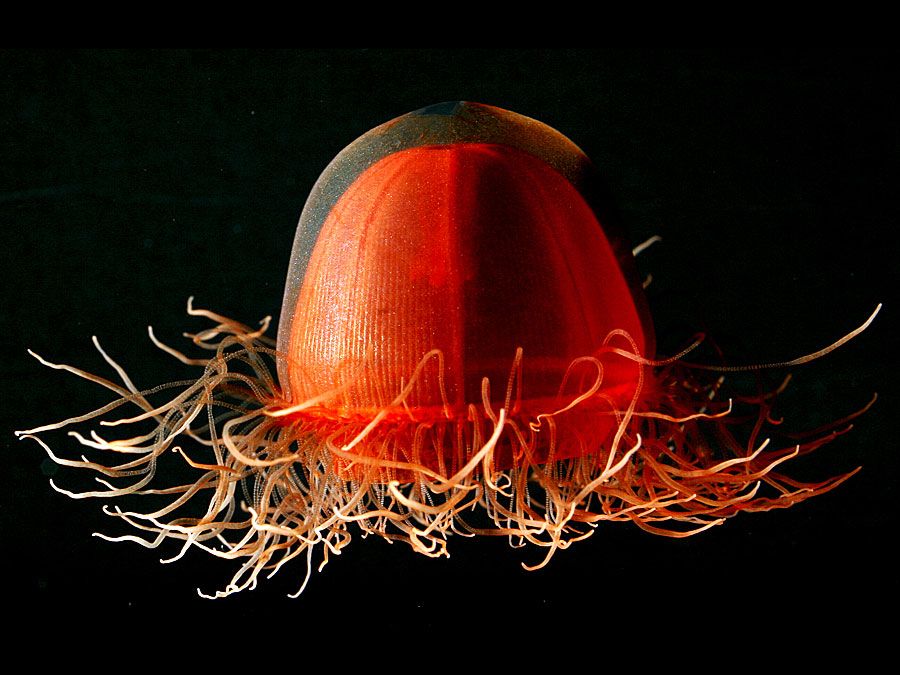
The number of tentacles on a jellyfish varies significantly depending on the species. While some jellyfish have 8 or fewer tentacles, others can possess up…
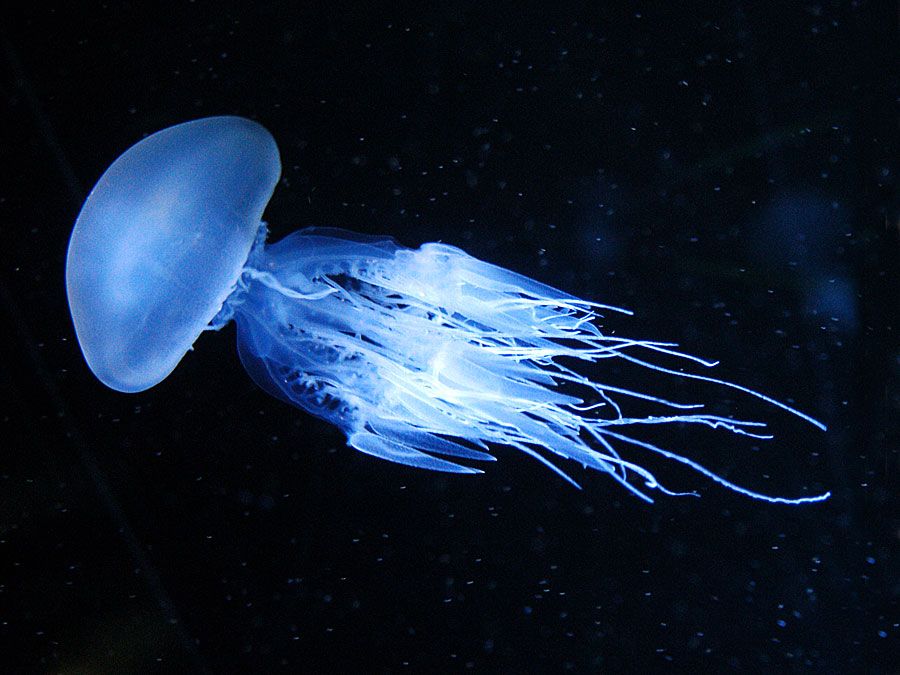
How many tentacles does a jellyfish have?
The number of tentacles on a jellyfish varies significantly depending on the species. While some jellyfish have 8 or fewer tentacles, others can possess up to 1,200.1
The tentacle count often correlates with the species’ size and hunting strategy:
- Lion’s mane jellyfish: Known for having up to 1,200 tentacles, which are organized into eight clusters.1
- Immortal jellyfish: Typically features between 8 and 90 tentacles, depending on its developmental stage.1
- Stauromedusae: These stalked jellies typically bear eight clusters of tentacles.2
- Exceptions: Some species, such as the big red jellyfish (Tiburonia granrojo) and members of the order Rhizostomeae, lack marginal tentacles entirely.2
These tentacles are generally equipped with stinging cells called nematocysts, which are essential for capturing prey and deterring predators.12
How do jellyfish use their stinging cells to capture prey?
Jellyfish capture prey using specialized stinging cells known as nematocysts, which are located on their tentacles. These capsules contain a coiled, hollow, and often barbed thread that acts as a sophisticated delivery system for toxins.3
When a jellyfish’s tentacles make contact with prey, chemical or mechanical cues trigger the nematocysts. A lidlike structure on the capsule opens, and the barbed thread everts explosively with a twisting motion. The barbs function like a drill, penetrating the victim’s tissues to anchor the thread. Once the thread has successfully penetrated the prey, a paralyzing toxin is injected through the hollow center, immobilizing the victim. In some instances, the threads may also ensnare smaller prey by wrapping around them.34
After the prey is immobilized, the jellyfish uses its tentacles to transport the food toward its mouth. In some species, specialized structures called oral arms assist in moving the captured prey to the mouth for consumption.45
What is the difference between a polyp and a medusa in a jellyfish life cycle?
In the life cycle of many cnidarians, the polyp and medusa represent two distinct body forms that often serve different roles in development and reproduction.
The Polyp
The polyp is typically a sessile (attached) form. It has a cylindrical body with its mouth and surrounding tentacles facing upward, and it is usually anchored to a firm surface by its opposite end. In many species, the polyp acts as the juvenile stage, which can reproduce asexually to produce more polyps or bud off new medusae.782
The Medusa
The medusa, commonly known as a jellyfish, is the free-swimming, adult form. It features a bell- or umbrella-shaped body with tentacles hanging downward from the margin. A stalklike manubrium hangs from the center, bearing the mouth at its tip. Medusae are generally planktonic and reproduce sexually, releasing larvae that eventually settle and metamorphose into polyps.782
While many species cycle between these two forms, the prominence of each stage varies; for example, the medusa is the most conspicuous stage in “true” jellyfish, whereas the polyp is the dominant form in many hydroids.8
Are there any jellyfish species that do not have tentacles at all?
Yes, there are jellyfish species that do not have tentacles. While many jellyfish are known for their trailing, stinging tentacles, some groups have evolved different methods for capturing food or have lost these structures entirely.
Specifically, members of the order Rhizostomeae lack marginal tentacles. Instead of using tentacles to capture prey, these jellyfish possess frilly, fused oral arms that form a spongy structure used for filter feeding, allowing them to extract minute animals and algae from the water. Additionally, the big red jellyfish (Tiburonia granrojo) is noted as one of the few species that lack tentacles altogether.1
Sources
- How many tentacles does a jellyfish have? — Encyclopædia Britannica
- jellyfish — Encyclopædia Britannica
- nematocyst — Encyclopædia Britannica
- box jellyfish — Encyclopædia Britannica
- lion’s mane jellyfish — Encyclopædia Britannica
- cnidarian - Food and feeding — Encyclopædia Britannica
- medusa — Encyclopædia Britannica
- cnidarian - Size range and diversity of structure — Encyclopædia Britannica
- Do jellyfish have brains? — Encyclopædia Britannica
- Do jellyfish have a heart? — Encyclopædia Britannica
Published on · 3 min read