Seif
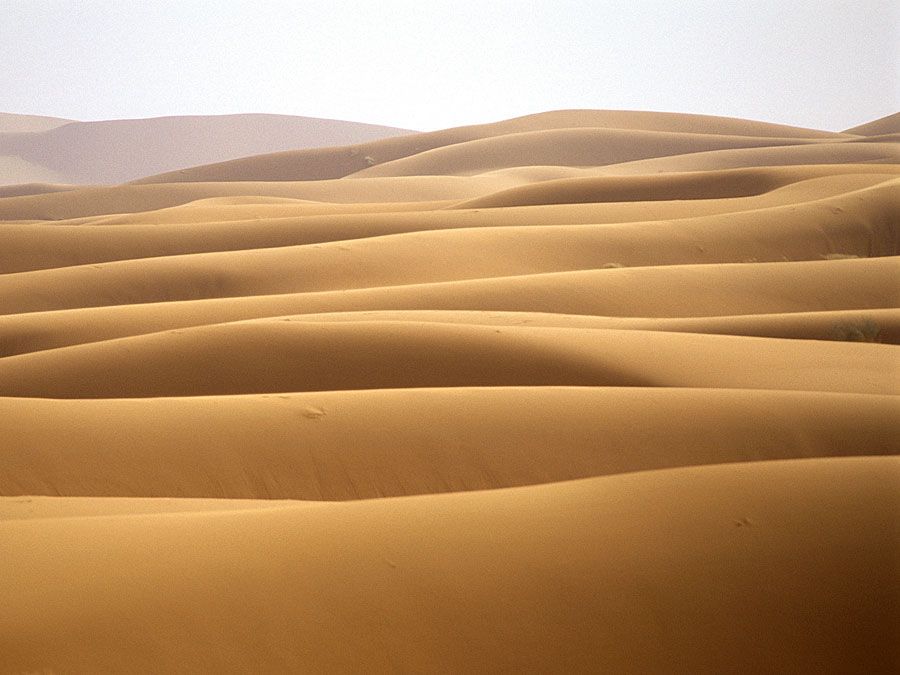
A seif (also spelled saif, from the Arabic word for "sword") is a long, narrow sand dune or chain of dunes. These formations are typically oriented parallel…
What is seif?
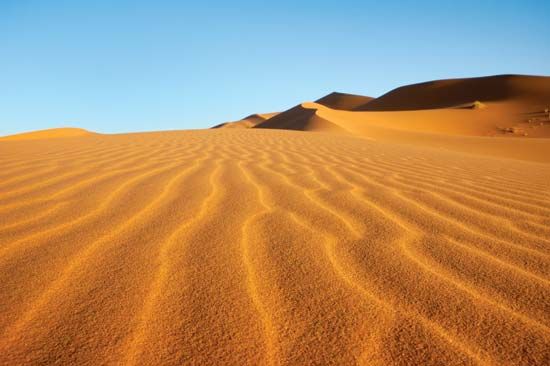
A seif (also spelled saif, from the Arabic word for “sword”) is a long, narrow sand dune or chain of dunes. These formations are typically oriented parallel to the prevailing wind or result from two or more winds blowing at acute angles to one another.12
Key characteristics of seif dunes include:
- Structure: The crest consists of a series of peaks and gaps, and the steep “slip face” can shift sides depending on changes in wind direction.1
- Dimensions: They can reach heights of up to 90 meters (300 feet), widths six times their height, and lengths extending up to 100 kilometers (60 miles).1
- Growth: They increase in height and width through the action of crosswinds, while their length grows due to winds blowing parallel to their axis.1
Most commonly found in open deserts, such as those in Libya and southern Iran, seifs typically rest on a coarse sand sheet.1
How do different wind patterns shape sand dunes?
Wind patterns are the primary architects of sand dunes, with their influence determined by direction, velocity, and turbulence.46
- Wind Direction: When wind blows consistently from one direction, it often creates crescent-shaped barchan dunes. In contrast, seasonal shifts in wind direction can produce “reversing dunes,” where the slip face alternates sides. Complex, network-like patterns often emerge in zones where different circulation systems overlap.46
- Wind Velocity: The volume of sand moved is an exponential function of wind speed; stronger winds are capable of moving coarser grains and creating large-scale undulations in sand sheets. While lighter winds from multiple directions shape finer-grained dunes, intense, unidirectional sandstorms are often responsible for the primary movement of sand in regions like the southern Sahara.6
- Topography and Turbulence: Winds are frequently channeled by topographical features, creating localized patterns. For instance, seif dunes form parallel to prevailing winds or at acute angles between multiple winds. Additionally, air eddies around large hills can deposit “echo dunes” on the upwind side.614
What are some other common types of sand dunes found in deserts?
Beyond the well-known seif and barchan dunes, deserts feature several other distinct types of sand formations shaped by wind and environmental conditions:
- Compound Dunes (Draa): These are massive, complex dune systems—sometimes reaching hundreds of meters in height—that are often covered by smaller, secondary dune patterns and ripples. They can form long ridges parallel to the wind or transverse sand waves.4
- Echo Dunes: These large formations develop on the upwind side of high scarps or large hill massifs. They are separated from the obstacle by a rolling air eddy that keeps a corridor clear of sand, which often serves as a natural route for travel.4
- Reversing Dunes: Formed in areas where wind directions shift seasonally, these dunes have slip faces that alternate sides throughout the year as the prevailing wind changes.4
- Coppice Dunes (Nebkha): Unlike the large, wind-driven “true” dunes, these are small, isolated mounds that accumulate around desert vegetation where groundwater is present.7
- Transverse Ridges: These are long, straight dune ridges that form at right angles to the wind, typically occurring in areas with a continuous sand cover and a consistent wind flow.4
How does vegetation help stabilize shifting sand dunes?
Vegetation plays a critical role in stabilizing shifting sand dunes by anchoring the loose substrate and reducing wind erosion. The process generally occurs through the following mechanisms:
- Root Networks: Plants such as marram grass (also known as beach grass) are particularly effective at stabilization. They extend tuberous roots just beneath the surface of the sand, creating an underground web that binds the grains together and prevents them from being carried away by the wind.10
- Surface Protection: By covering the surface, vegetation acts as a physical barrier that reduces the wind’s ability to pick up and transport sand particles. This allows the soil to stabilize and enables the dune to grow higher as it traps additional windblown sand.10
- Long-term Fixation: In many regions that are now subhumid or humid, older dunes have been completely immobilized by rich grasslands or forests, such as the Sand Hills of Nebraska or coniferous forests in Poland. These “fixed” dunes provide clear evidence of past arid climates, as their original, active forms have been rounded and subdued by long-term vegetative cover.1112
- Localized Mounds: In desert environments where groundwater is available, vegetation can lead to the formation of coppice dunes (or nebkha), which are small, isolated mounds that accumulate around individual plants.12
Sources
- seif — Encyclopædia Britannica
- seif — Merriam-Webster
- coastal landforms - Coastal dunes — Encyclopædia Britannica
- sand dune - Dune and sheet patterns — Encyclopædia Britannica
- saif — Merriam-Webster
- sand dune - Winds — Encyclopædia Britannica
- sand dune - Sands — Encyclopædia Britannica
- sand dune — Encyclopædia Britannica
- sand dune - Fixed dunes in semiarid regions — Encyclopædia Britannica
- Sand Hills — Encyclopædia Britannica
- 11 Questions About Useful Plants Answered - Why do people plant marram grass on sand dunes? — Encyclopædia Britannica
- sand dune - Formation and growth of dunes — Encyclopædia Britannica
- dune plant — Merriam-Webster
Published on · 3 min read