Sahara
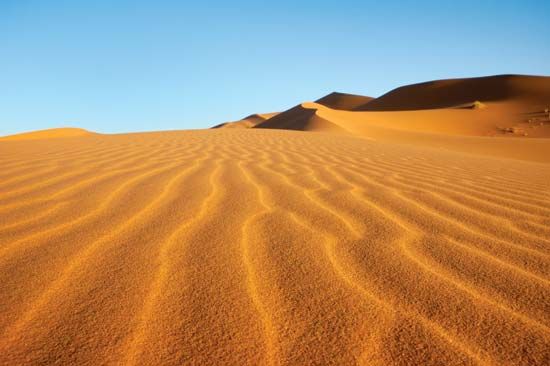
Sand dunes in the Sahara form when wind-blown sand grains accumulate on a surface. Initially, small patches of sand develop in hollows or on smoother ground…
How do the Sahara’s sand dunes form and move?
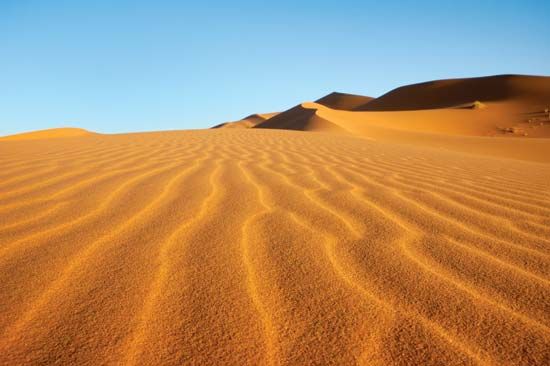
Sand dunes in the Sahara form when wind-blown sand grains accumulate on a surface. Initially, small patches of sand develop in hollows or on smoother ground where wind velocity decreases, causing deposition. As these patches grow, they adjust the local wind flow, eventually building a dune.1
Dunes move through a continuous process of erosion and deposition. Wind carries sand grains up the windward slope; once the wind reaches the crest, it separates from the surface, creating a “dead zone” in the lee. Sand then falls into this area, steepening the leeward slope until it reaches the angle of repose (about 32°). At this point, the added sand slips down the face, and the dune migrates forward as a whole.1
Movement rates vary significantly based on dune size, with smaller dunes generally traveling faster than larger ones. In the Sahara, wind patterns—often channeled by topographical features like the Tibesti Mountains—heavily influence these shapes and migration paths.12
How did the Sahara Desert form, and has it always been a desert?
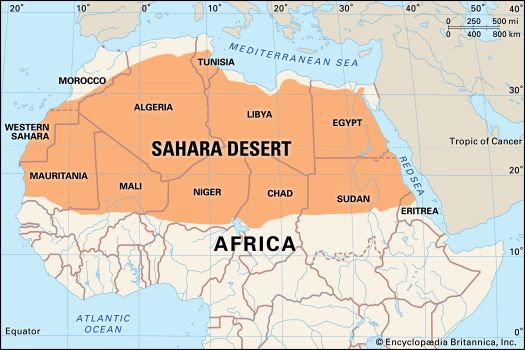
The Sahara has not always been a desert. While it is currently the world’s largest hot desert, it has experienced at least 20 cycles of alternating arid and humid phases over the past 800,000 years.5
These climatic shifts are driven by Milankovitch cycles, specifically the precession of Earth’s axis. During “green” periods, the planet’s orientation increases solar radiation in the Northern Hemisphere, which strengthens the West African monsoon. This intensified monsoon draws humid air from the Atlantic across the region, transforming the landscape into a lush environment of grasslands, woodlands, and rivers.5
The most recent of these, the African Humid Period, occurred from approximately 11,700 to 5,000 years ago. Evidence for these fluctuations is found in fossilized plant waxes, marine sedimentary rock layers, and ancient lake basins that dot the modern landscape.5
What types of plants and animals have adapted to survive in the Sahara Desert?
Life in the Sahara is defined by remarkable adaptations to extreme heat and unreliable precipitation. Organisms have evolved specialized strategies to survive in this harsh environment, often concentrating in highlands, oases, and along wadis.67
Plant Adaptations
Saharan vegetation is sparse but highly resilient. Many herbaceous plants are ephemerals, completing their entire life cycle—from germination to seed dispersal—within a few weeks after heavy rainfall. Other plants, such as halophytes (salt-tolerant species), thrive in saline depressions. Woody plants found in the highlands include date palms, acacia, and olive trees, which utilize deep root systems to access groundwater.67
Animal Adaptations
Animals have developed physiological and behavioral mechanisms to manage environmental stress:
- Dormancy: Desert snails survive through aestivation, a period of inactivity that can last for years until rainfall occurs.87
- Diverse Fauna: The desert supports various mammals like the jerboa, sand fox, and dorcas gazelle, as well as numerous reptiles such as lizards and cobras.8
- Relict Populations: Some species, including catfish, persist in isolated pools and oases, remnants of a time when the region was much wetter.8
What are the unique environmental features and climate conditions of the Sahara?
The Sahara is defined by a diverse landscape and two primary climatic regimes that create its extreme environment.
Physical Features
The topography of the Sahara is varied, consisting of:
- Plains and Plateaus: Extensive gravel-covered plains known as serirs or regs, and rock-strewn plateaus called hammadas.11
- Sand Formations: Sand sheets and dunes cover about 25 percent of the surface, including massive ridges known as draa that can reach 1,000 feet in height.11
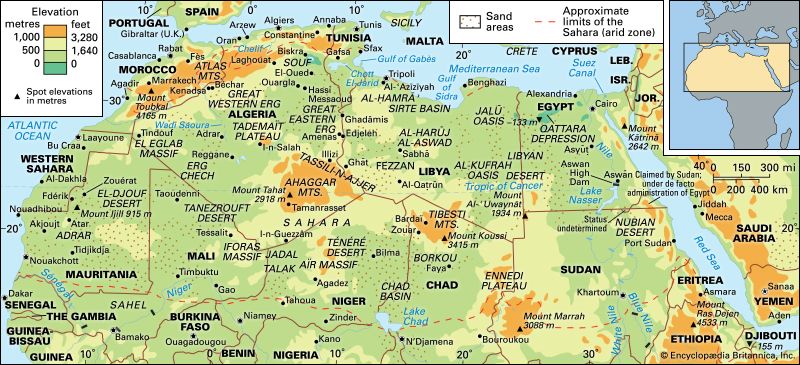
- Mountains and Basins: The region features volcanic massifs like the Ahaggar and Tibesti mountains, alongside deep depressions such as the Qattara Depression, which sits below sea level.11
- Surface Phenomena: Many rocks are covered in a dark patina called desert varnish, and some sands exhibit a mysterious “singing” or booming sound.11
Climate Conditions
The Sahara is divided into two distinct climatic zones:
- Dry Subtropical (North): Characterized by high temperature ranges, cold winters, and hot summers. It is influenced by stable high-pressure cells, leading to significant diurnal temperature swings and occasional winter thunderstorms.3
- Dry Tropical (South): Features a strong annual temperature cycle with mild, dry winters and a hot, dry season. It is influenced by the seasonal interaction of continental and maritime air masses, with rainfall primarily occurring as summer thunderstorms.3
Both zones experience hot, dust-laden winds—such as the khamsin or ghibli—which are particularly common in the spring.3
Sources
- sand dune - Formation and growth of dunes — Encyclopædia Britannica
- sand dune - Winds — Encyclopædia Britannica
- Sahara - Physiography — Encyclopædia Britannica
- sand dune — Encyclopædia Britannica
- The Sahara Was Once Green — Encyclopædia Britannica
- Sahara - Animal life — Encyclopædia Britannica
- Sahara - Plant life — Encyclopædia Britannica
- Africa - Thorn woodland, grassland, and semidesert vegetation — Encyclopædia Britannica
- Sahara: Top Questions — Encyclopædia Britannica
- Sahara - People of the Sahara — Encyclopædia Britannica
- Sahara - Climate of the Sahara — Encyclopædia Britannica
Published on · 4 min read