Conchidium
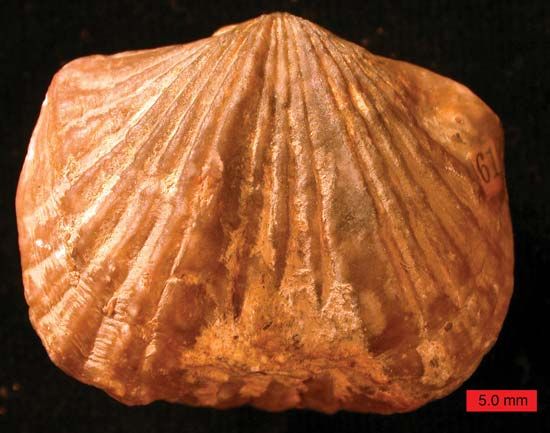
Conchidium is a genus of extinct brachiopods, commonly referred to as lamp shells. These organisms serve as a valuable index fossil found within marine rock…
What is Conchidium?
Conchidium is a genus of extinct brachiopods, commonly referred to as lamp shells. These organisms serve as a valuable index fossil found within marine rock formations dating to the Lower and Middle Silurian Period, which occurred between 444 million and 416 million years ago.1
Physically, Conchidium is characterized by a moderately large shell where both valves are strongly convex. The shells feature prominent linear ridges or markings known as costae, and they may also possess beaks at the dorsal ends. As a member of the broader group of pentamerids, these fossils are significant for geologists studying ancient marine environments.12
What are index fossils and why are they important?
An index fossil is any plant or animal preserved in the Earth’s rock record that serves as a marker for a specific span of geologic time or a particular environment.3
To be considered a useful index fossil, a specimen must meet several criteria:
- Distinctiveness: It must be easily recognizable.
- Abundance: It should be found in large numbers.
- Distribution: It must have a wide geographic range.
- Temporal Range: It must have existed for only a short period of time.3
These fossils are essential because they provide the foundation for defining boundaries within the geologic time scale and for the correlation of strata. By identifying these specific organisms, scientists can link rock layers across different regions, creating a framework that makes historical geology feasible. While modern geochronology also integrates radioisotopic dating and magnetostratigraphy, biostratigraphy—the study of these fossil successions—remains a critical component of our understanding of Earth’s history.34
What defines the Silurian Period in Earth’s history?
The Silurian Period was the third period of the Paleozoic Era, spanning from approximately 443.8 million to 419.2 million years ago. It is defined by several significant environmental and biological shifts that followed the extinctions of the Late Ordovician.56
Key Characteristics
- Sea Levels and Climate: Following the melting of extensive glaciers from the Late Ordovician ice age, global sea levels rose dramatically. This flooded large continental areas with shallow seas, creating widespread environments for coral reefs and diverse marine life.657
- Biological Evolution: The period saw a rapid recovery and evolution of marine faunas. Fishes, including both jawless (agnatha) and primitive jawed varieties, became widespread. Additionally, vascular plants began their colonization of coastal lowlands, though continental interiors remained largely barren.685
- Paleogeography: The Earth featured a supercontinent called Gondwana over the southern pole, while a ring of smaller continents spanned the Equator.7
The period was named by geologist Roderick I. Murchison in 1835, honoring the Silures, a native people of Wales. Geologically, it is considered one of the shortest periods of the Paleozoic, with its exact duration and boundaries often debated by geochronologists due to the scarcity of undisturbed igneous rocks for radioisotopic dating.59
How do brachiopods differ from modern clams?
Although brachiopods and bivalve mollusks (such as clams) both possess two-part shells, they are biologically distinct and unrelated groups.1112
The primary differences include:
- Symmetry: In bivalves, the two valves are typically mirror images of each other (left and right). In contrast, a brachiopod’s shell consists of two unequal valves (dorsal and ventral), where each individual valve is bilaterally symmetrical.1312
- Anatomy: Brachiopods possess a specialized feeding organ called a lophophore, which is not found in bivalves. Bivalves instead use modified gills, known as ctenidia, for both respiration and filter feeding.1312
- Attachment: Many brachiopods are anchored to the substrate by a fleshy stalk called a pedicle. While some bivalves use proteinaceous byssal threads for attachment, many others are free-living or burrow into sediment using a muscular foot, a feature not present in brachiopods.1214
- Evolutionary Lineage: Bivalves belong to the phylum Mollusca, whereas brachiopods belong to their own distinct phylum, BrachiopodaBrachiopoda](https://www.merriam-webster.com/dictionary/brachiopoda).11
Sources
- Conchidium — Encyclopædia Britannica
- pentamerid — Merriam-Webster
- index fossil — Encyclopædia Britannica
- Tertiary Period - Correlation of Tertiary strata — Encyclopædia Britannica
- A Journey Through Time Since the Precambrian - Silurian Period: 443.4 million to 419.2 million years ago — Encyclopædia Britannica
- Silurian Period - Geochemical analyses — Encyclopædia Britannica
- Silurian Period — Encyclopædia Britannica
- Silurian Period - Paleogeography — Encyclopædia Britannica
- Silurian Period - Silurian sea level — Encyclopædia Britannica
- Cambrian explosion — Encyclopædia Britannica
- bivalve — Encyclopædia Britannica
- bivalve - Food and feeding — Encyclopædia Britannica
- bivalve - Size range and diversity of structure — Encyclopædia Britannica
- branchiopod - Distinguishing taxonomic features — Encyclopædia Britannica
- branchiopod - Size range and diversity of structure — Encyclopædia Britannica
- lamp shells - Size range and diversity of structure — Encyclopædia Britannica
- crustacean - Evolution and paleontology — Encyclopædia Britannica
- Circulatory system - Brachiopoda — Encyclopædia Britannica
- Brachiopoda — Merriam-Webster
- skeleton - Calcareous structures — Encyclopædia Britannica
Published on · 3 min read