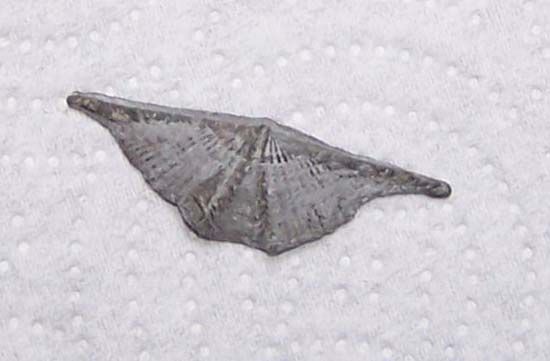
Linoproductus
Linoproductus is a genus of extinct articulate brachiopods, commonly known as lamp shells. These invertebrates existed from the Early Carboniferous to the…
What is Linoproductus?
Linoproductus is a genus of extinct articulate brachiopods, commonly known as lamp shells. These invertebrates existed from the Early Carboniferous to the Late Permian periods, approximately 359 million to 251 million years ago.1
Fossils of this genus are frequently discovered in the midcontinent region of North America. Morphologically, Linoproductus is characterized by a strongly convex pedicle valve paired with a slightly concave brachial valve, with the convex shell featuring distinct fine ribbing.1
What are brachiopods and how do they differ from clams?
Brachiopods, commonly known as lamp shells, are a phylum of sedentary, unsegmented marine invertebrates that possess a lophophore—a specialized organ used for feeding—and are enclosed in a bivalved shell.3
While brachiopods superficially resemble mollusks (such as clams), they are not related. The primary differences include:4
- Symmetry: Brachiopod shells consist of two unequal valves that are typically dorsal and ventral, meaning the plane of symmetry passes through the middle of each valve. In contrast, clams (bivalve mollusks) typically have two equal valves that are left and right, with the plane of symmetry passing between the valves.3
- Anatomy: Brachiopods use a lophophore to direct food-bearing currents to the mouth. Clams are filter feeders that typically use gills for both respiration and food collection.5
- Internal Structure: Brachiopods have a complex coelom (internal body cavity) and a mantle cavity. Their circulatory system is open, featuring a small heart situated over the gut.54
- Attachment: Many brachiopods attach to the substrate using a fleshy, fibrous stalk called a pedicle, whereas many clams are free-living or burrow using a muscular foot.
What defines the Carboniferous and Permian geological periods?
The Carboniferous Period (358.9 to 298.9 million years ago) and the Permian Period (298.9 to 252.2 million years ago) represent the final two intervals of the Paleozoic Era.910
The Carboniferous Period
The Carboniferous is defined by its vast coal-bearing strata and is divided into the Mississippian and Pennsylvanian subperiods. Key features include:9
- Geography: The period saw the fusion of the landmasses Laurussia and Gondwana.11
- Life: Marine environments were dominated by crinoids, bryozoans, and brachiopods. On land, vascular plants flourished, leading to extensive coal formation, while insects grew to large sizes, potentially due to high atmospheric oxygen. It was also a peak time for amphibians and the emergence of reptiles.1211
The Permian Period
The Permian is defined by the assembly of the supercontinent Pangea and a transition toward extreme climates.1314
- Climate: The period began with widespread glaciation but warmed significantly, becoming hot and dry by the end.1315
- Life: Plants and insects diversified rapidly, and reptile lineages that would eventually lead to mammals appeared.1310
- Extinction: The period concluded with the largest mass extinction in Earth’s history, likely exacerbated by massive volcanism in the Siberian traps.1315
How do fossils help scientists understand ancient marine environments?
Fossils serve as essential indicators for scientists to reconstruct ancient marine environments and understand the history of life on Earth. Because the majority of fossils are preserved in water environments, they provide a detailed record of past oceanic conditions.1617
Scientists use fossils to interpret ancient environments in several ways:
- Environmental Indicators: Certain organisms have specific habitat requirements. For example, the presence of specific coral species indicates the existence of warm, shallow water in the past. By analyzing these assemblages, researchers can infer ancient water temperatures and depths.1617
- Climate Reconstruction: Shifts in fossil populations can signal major climatic changes. Studies of foraminiferans in deep-sea cores have shown that species migrated poleward or changed their physical characteristics in response to warming waters, helping scientists map historical climate transitions.18
- Stratigraphic Correlation: Index fossils—which are abundant, widely distributed, and existed for a short geologic time—allow geologists to correlate marine strata across different geographic locations, providing a framework for dating rock layers.1917
- Oceanic Processes: The distribution of carbonate plankton and other microfossils helps researchers model past oceanic circulation patterns and sedimentation rates.2018
Sources
- Linoproductus — Encyclopædia Britannica
- Productus — Merriam-Webster
- lamp shells - Form and function — Encyclopædia Britannica
- lamp shells - Annotated classification — Encyclopædia Britannica
- Brachiopoda — Merriam-Webster
- branchiopod - Evolution and paleontology — Encyclopædia Britannica
- Circulatory system - Brachiopoda — Encyclopædia Britannica
- clam shrimp — Encyclopædia Britannica
- A Journey Through Time Since the Precambrian - Carboniferous Period: 358.9 million to about 298.9 million years ago — Encyclopædia Britannica
- A Journey Through Time Since the Precambrian - Permian Period: 298.9 million to 252.2 million years ago — Encyclopædia Britannica
- Permian Period - Paleoclimate — Encyclopædia Britannica
- Permian Period - The Permian environment — Encyclopædia Britannica
- Carboniferous Period - Distinctive features — Encyclopædia Britannica
- Carboniferous Period — Encyclopædia Britannica
- Permian Period — Encyclopædia Britannica
- index fossil — Encyclopædia Britannica
- fossil record — Encyclopædia Britannica
- Marine ecosystem - Origins of marine life — Encyclopædia Britannica
- fossil — Encyclopædia Britannica
- Tertiary Period - Correlation of Tertiary strata — Encyclopædia Britannica
- Holocene Epoch - Deep oceanic deposits — Encyclopædia Britannica
Published on · 3 min read