Skimmer
The most distinctive physical characteristic of skimmers is their unique, bladelike bill. Unlike other birds, the skimmer’s lower mandible is significantly…
What are the unique physical characteristics of skimmers that set them apart from other birds?
The most distinctive physical characteristic of skimmers is their unique, bladelike bill. Unlike other birds, the skimmer’s lower mandible is significantly longer—about one-third longer—than the upper mandible.1
This specialized bill is adapted for a unique feeding method:
- Structure: The upper mandible is streamlined in cross-section and laterally compressed, while the lower mandible is knifelike. When the bill is closed, the sharp upper edge of the lower mandible fits precisely into a groove in the upper mandible.2
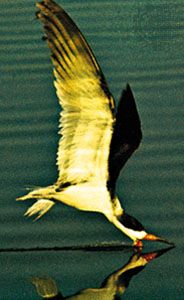
- Feeding Behavior: Skimmers fly over calm, shallow water with the lower mandible submerged, effectively “skimming” the surface. When the bill encounters prey such as a fish or crustacean, the bird’s head doubles under its body, and the bill snaps shut to capture the food.13
- Adaptations: This allows them to feed effectively during both day and night. While they are strong fliers with long, narrow wings, they do not exhibit the bizarre modifications to feathers or feet seen in some other groups, making their bill structure their primary evolutionary standout.324
How do skimmers use their specialized bill to feed, and what do they primarily eat?
Skimmers feed by utilizing a highly specialized, bladelike bill to forage in calm, shallow water. During both day and night, they fly over the water’s surface at speeds reaching up to 30 miles (48 km) per hour with their elongated, knifelike lower mandible submerged to cut through the water.13
When the lower mandible encounters prey—primarily fish or crustaceans—the bird’s head quickly doubles under its body, and the bill clamps shut to secure the catch. Once the prey is captured, the skimmer typically flies upward to swallow the food while in the air or carries it back to the nest.13
How do skimmers’ breeding habits and nesting behaviors compare to other seabirds?
Skimmers exhibit breeding and nesting behaviors that are notably similar to those of terns, yet they possess distinct characteristics that set them apart from other seabirds within the order Charadriiformes.
Nesting Habits
- Colonial Structure: Skimmers form loose colonies ranging from about 100 to several thousand pairs. Unlike many gulls that establish and aggressively defend specific territories, skimmers are not as strongly colonial in their nesting habits.1
- Nest Construction: They do not build elaborate structures; instead, they create simple hollows, or “scrapes,” in the sand of riverbanks and estuaries.61
- Clutch Size: A typical clutch consists of three to five eggs, which are incubated primarily by the female.61
Chick Development and Behavior
- Feeding: Chicks are fed by both parents through regurgitation. Because their mandibles are of nearly equal length at hatching, they are initially unable to skim; instead, they pick up small fish dropped by their parents. They only develop their characteristic adult bill shape after fledging.61
- Defense: In the face of danger, skimmer chicks exhibit a unique survival behavior: they lie flat or burrow into the sand, sometimes even kicking sand onto their backs to camouflage themselves.1
What are the three species of skimmers, and how do they differ from each other?
There are three species of skimmers, which constitute the family Rynchopidae within the order Charadriiformes. While they share a similar appearance—dark plumage above, white below, and a unique bladelike bill with a lower mandible that is one-third longer than the upper—they differ primarily in size and geographic distribution.18
The three species are:
- Black skimmer (Rynchops nigra): Found in the Americas, this is the largest of the three species, reaching lengths of up to 50 cm (20 inches).1
- African skimmer (R. flavirostris): This species is smaller than the black skimmer and is native to Africa.1
- Indian skimmer (R. albicollis): Also smaller than the black skimmer, this species is found in southern and eastern Asia.1
All three species inhabit warm regions, typically frequenting estuaries, wide rivers, and lakes, where they use their specialized bills to forage for fish and crustaceans in calm, shallow water.18
Sources
- Skimmer — Encyclopædia Britannica
- Charadriiform - Adaptations for feeding — Encyclopædia Britannica
- Charadriiform - Locomotion and feeding behaviour — Encyclopædia Britannica
- Charadriiform - Adaptations for flight — Encyclopædia Britannica
- Photoreception - Diversity of eyes — Encyclopædia Britannica
- Charadriiform - Gulls (suborder Lari) — Encyclopædia Britannica
- chondrichthyan - Reproductive behaviour — Encyclopædia Britannica
- Charadriiform - Annotated classification — Encyclopædia Britannica
Published on · 3 min read