Crossbill
A crossbill is any of several species of birds belonging to the finch family, Fringillidae. They are characterized by their unique mandibles, which cross at…
What is Crossbill?
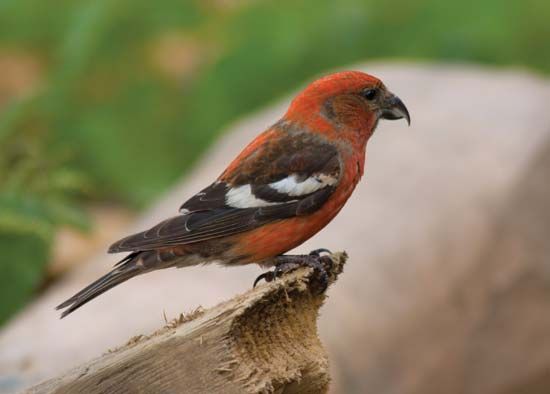
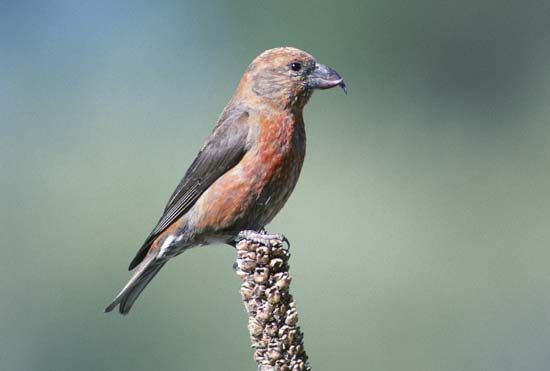
A crossbill is any of several species of birds belonging to the finch family, Fringillidae1. They are characterized by their unique mandibles, which cross at the tips.12
This specialized bill allows the bird to insert its beak between the scales of conifer cones to extract seeds with its tongue. Because conifer seed production is often unpredictable, these birds are known to wander widely in search of food.2
Notable species include:
- Red crossbill (Loxia curvirostra): A species with several varieties that may represent distinct species based on differences in bill size, diet, and call notes.2
- White-winged crossbill (L. leucoptera): A species found in colder regions of the Northern Hemisphere that is known to nest even in midwinter when food is abundant.2
- Scottish crossbill (L. scoticus) and parrot crossbill (L. pytyopsittacus): Species native to Eurasia.2
How do crossbills use their beaks to extract seeds from pine cones?
Crossbills (genus Loxia) possess a highly specialized feeding mechanism adapted for extracting seeds from conifer cones. Their unique mandibles, which cross at the tips, are specifically evolved for this purpose.13
To access the seeds, the bird inserts its crossed bill tips between the tightly closed scales of a cone. Once the bill is positioned, the bird uses its tongue to lift the seed out from beneath the scale. This specialized adaptation allows crossbills to exploit a food source that is otherwise difficult for many other birds to access. Because the production of conifer seeds can be unpredictable, these birds often wander widely, with their presence in a particular area fluctuating significantly from year to year.1
What are some other unique adaptations birds have for feeding?
Birds have evolved a remarkable array of specialized adaptations to secure food, ranging from structural modifications of the bill to unique sensory and mechanical capabilities.
Specialized Feeding Apparatus
- Woodpeckers: These birds possess a “food-gathering apparatus” that includes a thick, shock-absorbing skull and a long, distensible tongue equipped with barbs and sticky mucus to extract insects from deep within trees.5
- Raptors: Birds of prey utilize sharp, hooked bills for tearing flesh and powerful talons for killing and grasping prey. Some species, like the osprey, have reversible outer toes to better handle slippery fish.63
- Probing Specialists: Many shorebirds, such as sandpipers, have long, flexible bills with tactile sense organs at the tip, allowing them to detect and grasp invertebrates hidden underground.7
- Filter and Net Feeders: Pelicans use pouched bills to net fish, while skimmers have a unique, knifelike lower mandible that protrudes beyond the upper, allowing them to feed while flying low over the water.78
- Nectar and Fruit Specialists: Hummingbirds have evolved long, slim bills for sipping nectar, while toucans possess large, serrated bills that provide strength for tearing fruit or securing insects.58
Why do crossbills wander to different areas instead of staying in one place?
Crossbills (genus Loxia) wander widely because their primary food source, conifer seeds, is produced in an unpredictable manner. Unlike species that follow regular seasonal migration patterns, crossbills exhibit nomadic behavior in response to these irregular ecological conditions.91
Because conifers do not produce a consistent annual crop, crossbill populations must remain mobile to locate areas with abundant cones. Consequently, a flock may be abundant in a specific region one year and entirely absent the next. When these birds successfully locate a productive crop of cones, they are opportunistic enough to nest in that location, even during midwinter. This movement is a clear example of how migratory behaviour allows animals to exploit fluctuating resources that would otherwise be inaccessible.9101
Sources
- Crossbill — Encyclopædia Britannica
- crossbill — Merriam-Webster
- Charadriiform - Adaptations for feeding — Encyclopædia Britannica
- Passeriform - Bill — Encyclopædia Britannica
- Piciform - Form and function — Encyclopædia Britannica
- Bird - Feeding habits — Encyclopædia Britannica
- Falconiform - Feet and beak — Encyclopædia Britannica
- Beak — Encyclopædia Britannica
- Migration - Ecological significance of migration — Encyclopædia Britannica
- Migration - Birds — Encyclopædia Britannica
Published on · 3 min read