Soapwort
Soapwort refers to any of about 40 species of flowering plants in the pink family (Caryophyllaceae), belonging to the genus Saponaria. These plants are…
What is soapwort?
Soapwort refers to any of about 40 species of flowering plants in the pink family (Caryophyllaceae), belonging to the genus Saponaria. These plants are native to Eurasia, though some species have become naturalized in other regions, including North America.12
Physical characteristics of soapworts include:
- Growth: They can be annual or perennial herbs, often featuring underground rhizomes.1
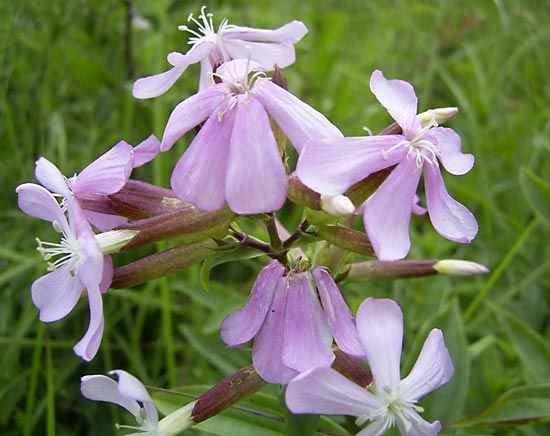
- Appearance: The plants bear simple, oval-shaped leaves and flowers with five petals that range in color from white to shades of pink, pale purple, and red.1
- Utility: The common soapwort (Saponaria officinalis), also known as bouncing Bet, is notable because its sap contains substances that act as a natural substitute for soap. Historically, the roots of this plant have also been used for medicinal purposes.21
While some species are cultivated for their attractive flowers in gardens, others are considered weedy.1
How does soapwort create a lather when mixed with water?
Soapwort creates a lather when mixed with water because it contains a group of naturally occurring compounds known as saponins.1
These substances are glucosides found in various plants, including soapwort (Saponaria officinalis), and are characterized by their ability to produce a soapy lather when agitated in water. In physical chemistry, this lather is a type of foam—a colloidal system where gas bubbles are dispersed within a liquid medium. Saponins act as surfactants, which function as foaming and emulsifying agents, allowing the plant to yield a natural detergent when its leaves or roots are bruised or processed.516
What are some other plants that were historically used as natural soaps?
Beyond soapwort, several other plants have been historically utilized as natural soaps due to their high concentration of saponins, the compounds responsible for creating a soapy lather.8
Key examples include:
- Soapberry: Members of the genus Sapindus (family Sapindaceae) are woody shrubs and trees native to tropical and subtropical regions. Their fruit contains up to 37 percent saponin, making them effective natural detergents.910
- Soaproot: This term refers to several plants, including certain herbs in the genus Gypsophila native to southern Europe, whose roots have traditionally served as a soap substitute.11
- Soap Tree: This is a general classification for any tree that yields saponin, with the term often specifically applied to the soapberry.7
These plants demonstrate the widespread historical reliance on botanical sources for cleaning agents, utilizing the natural surfactant properties of plant-derived glucosides.98
Why is soapwort sometimes considered an invasive species in North America?
Soapwort, specifically the common soapwort (Saponaria officinalis), is often categorized as a weedy or naturalized species in North America rather than strictly invasive, though its behavior can be problematic in certain environments.2
Native to Eurasia, common soapwort was introduced to North America and has successfully established itself across the continent. Its ability to spread is largely attributed to its growth habit; it is a perennial herb that utilizes underground rhizomes to expand and colonize new areas. Because these rhizomes allow the plant to form dense, spreading patches, it can outcompete native vegetation in disturbed habitats, roadsides, and meadows. While it is sometimes cultivated for its attractive flowers, its aggressive vegetative reproduction makes it difficult to control once it has naturalized in a landscape.2
Sources
- soapwort — Merriam-Webster
- soapwort — Encyclopædia Britannica
- poison - Animal poisons ( zootoxins ) — Encyclopædia Britannica
- Saponaria — Merriam-Webster
- foam — Encyclopædia Britannica
- soap and detergent - Raw materials — Encyclopædia Britannica
- saponin — Merriam-Webster
- soap tree — Merriam-Webster
- soapberry — Encyclopædia Britannica
- soaproot — Merriam-Webster
- soapberry — Merriam-Webster
Published on · 2 min read