Soapberry
A soapberry refers to any member of the genus Sapindus, which belongs to the soapberry family (Sapindaceae). This genus comprises approximately 12 species of…
What is soapberry?
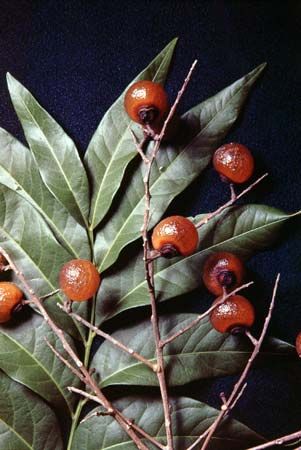
A soapberry refers to any member of the genus Sapindus, which belongs to the soapberry family (Sapindaceae). This genus comprises approximately 12 species of trees and shrubs native to tropical and subtropical regions across Asia, the Americas, and the Pacific islands.12
The plant is characterized by leaves divided into leaflets arranged along an axis and greenish or whitish flowers that grow in large terminal clusters. Its fruit is a leathery berry containing high concentrations of saponin—a chemical substance that produces a soapy lather when mixed with water. Because of this property, the fruit has been used as a natural soap substitute in various tropical regions. The genus name, Sapindus, is derived from Latin and translates to “soap of the Indians”.132
What are some other common plants that contain natural saponins?
Beyond the soapberry, several other plants are known to contain natural saponins, which are substances characterized by their ability to form stable, soapy foams in water.15
Common plants containing these compounds include:
- Soapwort: Often associated with its historical use as a natural cleaning agent due to its lathering properties.5
- Digitalis (Purple Foxglove): Contains cardiac-active saponins that have been utilized in heart therapy since the 18th century.1
- Sapodilla: A plant noted for the presence of these glucosides.5
- Squill: Contains saponins that affect heart function, historically used in various medicinal and toxic applications.1
- Mexican Yam: A source of dioscin, a precursor used in the production of diosgenin.1
- Soybeans: Contain a specific group of triterpenoid saponins.1
How do saponins function as a natural cleaning agent?
Saponins function as natural cleaning agents through their chemical structure and surface-active properties, which are similar to those of conventional soaps and detergents.67
To effectively clean a surface, a substance must act as a surface-active agent (or surfactant) by performing several key physical-chemical steps:
- Wetting and Penetration: Saponins reduce the surface tension of water, allowing the liquid to spread more easily and penetrate the structure of the material being cleaned.6
- Emulsification: Saponin molecules possess both a hydrophobic (water-repelling) part and a hydrophilic (water-attracting) part. The hydrophobic portion attaches to oily or greasy dirt, while the hydrophilic portion remains in the water. This creates a molecular bridge that lifts the grime away from the surface.68
- Dispersion and Suspension: Once the dirt is detached, saponins help disperse it into the wash water. They surround the particles to form stable clusters known as micelles, which prevent the dirt from re-depositing onto the cleaned surface.68
- Foaming: Saponins are well-known for their ability to produce a stable, soapy lather when mixed with water. This foam acts as a medium that helps disperse and carry away soil during the mechanical action of washing.796
What are some examples of edible fruits found in the soapberry family?
The soapberry family (Sapindaceae) is well known for several economically important and edible fruits. These include:
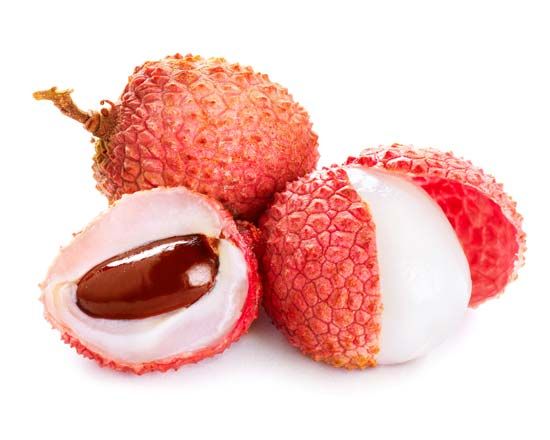
- Lychee (Litchi chinensis): A popular tropical fruit prized for its sweet, translucent flesh.
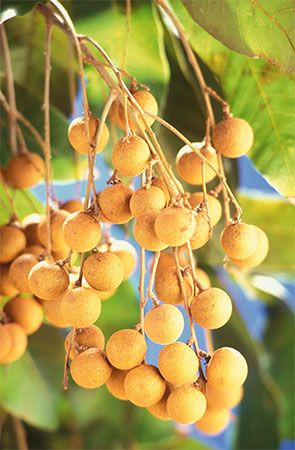
- Longan (Dimocarpus longan): Similar to the lychee, this fruit is widely consumed in tropical regions.
- Rambutan (Nephelium lappaceum): Easily recognized by its hairy, reddish exterior and sweet interior.
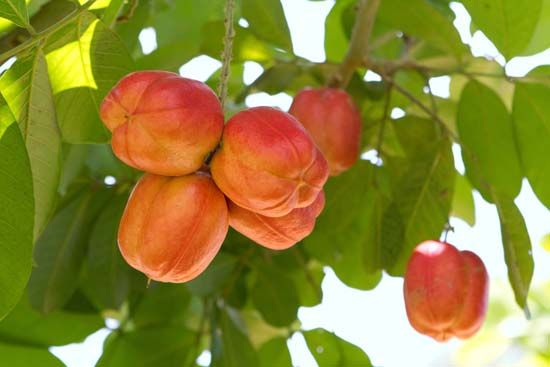
- Ackee (Blighia sapida): The national fruit of Jamaica. It is important to note that it must be prepared correctly; only the fleshy aril is edible, and it is poisonous if consumed before the fruit has opened naturally at the proper stage of ripeness.
- Spanish lime (Melicoccus bijugatus): Also known as mamoncillo, this fruit is another notable member of the family.
- Senegal cherry (Lepisanthes senegalensis): A fruit recognized for its culinary value within the family.
Sources
- soapberry — Encyclopædia Britannica
- Sapindaceae — Encyclopædia Britannica
- saponin — Merriam-Webster
- soapberry — Merriam-Webster
- Saponin — Encyclopædia Britannica
- soap and detergent — Encyclopædia Britannica
- foam — Encyclopædia Britannica
- How Does Soap Work? — Encyclopædia Britannica
- soap and detergent - Early synthetic detergents — Encyclopædia Britannica
- soap and detergent - Raw materials — Encyclopædia Britannica
- list of plants in the family Sapindaceae — Encyclopædia Britannica
- Sapindaceae — Merriam-Webster
- Sapindales - Characteristic morphological features — Encyclopædia Britannica
Published on · 3 min read