Softshell Turtle
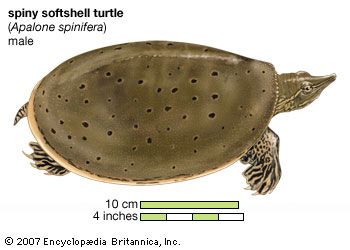
Softshell turtles (family Trionychidae) are distinguished by several unique physical adaptations that set them apart from most other turtles:
What are the unique physical characteristics of softshell turtles?
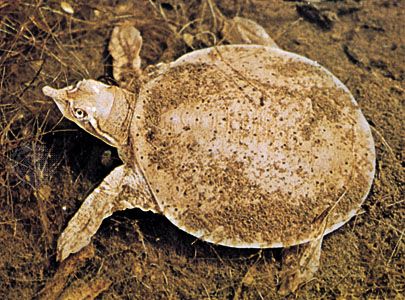
Softshell turtles (family Trionychidae) are distinguished by several unique physical adaptations that set them apart from most other turtles:
- Flattened Shell: Unlike the rigid, scute-covered shells of typical turtles, softshells possess a flattened, oval shell that lacks epidermal scutes (horny plates). Instead, the shell is covered in soft, leathery skin, and its bony architecture is significantly reduced.12
- Specialized Snout: They feature a streamlined head with an elongated, proboscis-like snout. This adaptation allows them to remain buried in mud or sand while extending their nostrils to the water’s surface to breathe in a snorkel-like manner.12
- Hydrodynamic Build: Their flattened shape is hydrodynamically efficient, and they are rapid swimmers propelled by strongly webbed forefeet and hind feet.12
- Anatomy: They have long necks and, as carnivorous predators, possess sharp mandibles and claws.12
These turtles are found across parts of North America, Asia, and Africa, and they range in size from moderate species to giants that can exceed one meter in length.12
What is the diet and feeding behavior of softshell turtles?
Softshell turtles (family Trionychidae) are primarily carnivorous reptiles that employ both active hunting and ambush tactics to secure their food.6
Diet
Their diet consists largely of small aquatic animals. While preferences can vary by species, softshell turtles typically hunt for:
Some specialized species, such as the African Zambezi flapshell turtle (Cyclanorbis frenatum), feed exclusively on mollusks.7
Feeding Behavior
Softshell turtles are well-adapted for their predatory lifestyle. They often remain buried in sand or mud at the bottom of shallow water, using their elongated, snorkel-like snouts to breathe at the surface while remaining concealed. This positioning allows them to ambush passing prey effectively. In addition to this sit-and-wait strategy, they are rapid swimmers capable of actively pursuing and capturing prey.6
Like other turtles, they lack teeth and instead use sharp, keratinous sheaths on their jaws to cut their food into manageable pieces. They do not chew their prey; rather, they use these sharp edges to quickly kill small animals or chop them into bite-size portions.8
What are the typical habitats and geographic distribution of softshell turtles?
Softshell turtles (family Trionychidae) are primarily aquatic reptiles with a broad geographic distribution across parts of North America, Asia, and Africa.19
Geographic Distribution
The family is divided into two evolutionary groups based on their range:
- Cyclanorbinae: Found in southern Asia, northeastern Africa, and sub-Saharan Africa.1
- Trionychinae: Distributed across southeastern North America, southern Asia, and Africa.1
Typical Habitats
Softshell turtles are highly adaptable to various freshwater environments, ranging from tiny ponds and slow-moving streams to large, deep rivers. Their specific habitat preferences often correlate with their size:15
- Small to Moderate Species: Many, such as the Indian and Burmese flapshell turtles (Lissemys), are ubiquitous in slow-moving streams and even rice paddies.5
- Giant Species: Larger varieties, including the narrow-headed softshell (Chitra) and the Asian giant softshell (Pelochelys), typically inhabit large, deep river systems.15
Regardless of the specific water body, these turtles are frequently found in areas with soft substrates like mud or sand, where they can bury themselves to ambush prey or hide from predators. When nesting, they require friable soil in areas adjacent to their aquatic habitats.1
How have softshell turtles adapted to aquatic environments?
Softshell turtles (family Trionychidae) have evolved several specialized adaptations that allow them to thrive in aquatic environments:
- Streamlined Morphology: Unlike most turtles, softshells possess a flattened, leathery shell that lacks hard epidermal scutes. This shape is hydrodynamically efficient, enabling them to be rapid swimmers.81
- Respiratory Adaptations: They feature long necks and elongated, proboscis-like snouts with nostrils at the tips. This allows them to remain buried in sand or mud on the bottom of a water body while extending their snout to the surface to breathe in a snorkel-like manner.8
- Locomotion: Their limbs are strongly webbed on both the forefeet and hind feet, providing the propulsion necessary for their active swimming lifestyle.8
- Feeding Mechanisms: While they lack teeth, they possess sharp, keratinous sheaths on their jaws. These allow them to effectively capture and process prey, whether they are actively pursuing it or using an ambush strategy while concealed in the substrate.28
Sources
- softshell turtle — Encyclopædia Britannica
- What are turtle shells made of? — Encyclopædia Britannica
- sea turtle: Top Questions — Encyclopædia Britannica
- Respiratory system - Reptiles — Encyclopædia Britannica
- softshell turtle — Merriam-Webster
- What do turtles eat? — Encyclopædia Britannica
- turtle - Feeding behaviour — Encyclopædia Britannica
- turtle - Form and function — Encyclopædia Britannica
- turtle - Habitats — Encyclopædia Britannica
- Trionychidae — Merriam-Webster
Published on · 4 min read