Soldier Beetle
Soldier beetles (family Cantharidae) exhibit diverse feeding habits depending on their life stage and species. While adult soldier beetles are commonly found…
What do soldier beetles eat, and how do they catch their prey?
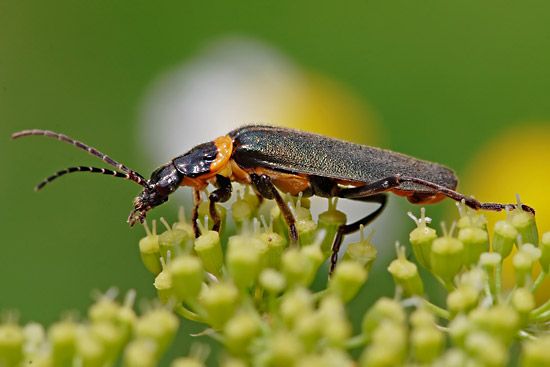
Soldier beetles (family Cantharidae) exhibit diverse feeding habits depending on their life stage and species. While adult soldier beetles are commonly found on vegetation, their diets vary: some species possess specialized mouthparts with long, fleshy filaments used to feed on pollen and nectar, while others are carnivorous predators.1
In contrast, the larvae of most soldier beetle species are predatory. They typically inhabit soil, rotting wood, or areas under bark, where they hunt and feed on worms and the larvae of other insects.2
Regarding their hunting methods, predatory beetle larvae in general—including those adapted for hunting in soil or wood—are often characterized by slender, tapered bodies and large, powerful mandibles. These physical adaptations allow them to act as active hunters that capture and secure their prey using their mandibles. Some predatory larvae also possess specialized mouthpart structures, such as an epipharynx, which are adapted for consuming the body fluids that exude from the wounds inflicted by their mandibles.3
How did soldier beetles get their name, and are there any other common names for them?
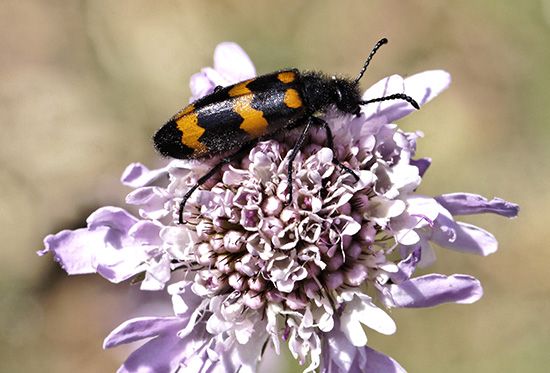
The name “soldier beetle” is derived from the insect’s appearance. These beetles are typically slender and soft-bodied, featuring coloration—often red, yellow, or orange—that resembles the bright, distinct trim of a traditional soldier’s uniform.1
While they are widely known as soldier beetles, they belong to the family Cantharidae. Cantharidae. There are no other widely recognized common names for this specific family, though historical confusion exists regarding their classification; for many years, the name Cantharidae was incorrectly applied to the family Meloidae, which are now known as blister beetles. as blister beetles.135
What is the life cycle of a soldier beetle, from egg to adult?
Soldier beetles, like all members of the order Coleoptera, undergo a process of complete metamorphosis, which consists of four distinct developmental stages: egg, larva, pupa, and adult.7
- Egg: The life cycle begins when the female lays eggs, typically in soil or other protected environments.7
- Larva: Upon hatching, the larva enters a growth phase. As it feeds and increases in size, its skin (cuticle) becomes too small and splits. The larva then crawls out of its old skin in a process called molting. This cycle is usually repeated three to five times until the larva reaches maturity.7
- Pupa: After a final nonfeeding period known as the prepupal stage, the insect enters the pupal stage. The pupa forms beneath the final larval skin and emerges when that skin splits. During this stage, the insect is soft and pale, with its wings folded into wing pads and its appendages loosely attached to the body.78
- Adult: The adult emerges when the pupal skin is shed. The wings then stretch to their full size, and the outer skeleton hardens and develops its final coloration.78
What family do soldier beetles belong to, and how many species are there worldwide?
Soldier beetles belong to the insect family Cantharidae, which is part of the order Coleoptera. There are approximately 3,500 species of soldier beetles distributed worldwide.1
Sources
- soldier beetle — Encyclopædia Britannica
- Coleoptera - Feeding habits and habitats — Encyclopædia Britannica
- soldier beetle — Merriam-Webster
- Coleoptera - Larval features — Encyclopædia Britannica
- Cantharidae — Merriam-Webster
- Cantharidae — Merriam-Webster
- Coleoptera - General features — Encyclopædia Britannica
- Coleoptera - Pupae — Encyclopædia Britannica
- Coleoptera - Adult features — Encyclopædia Britannica
- Coleoptera - Size range and diversity of structure — Encyclopædia Britannica
- homopteran - Annotated classification — Encyclopædia Britannica
Published on · 2 min read