Hairy Fungus Beetle
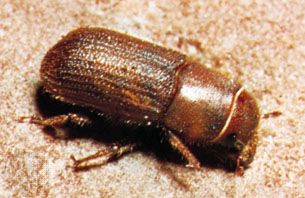
The hairy fungus beetle refers to any of approximately 200 species of beetles belonging to the family Mycetophagidae. These insects are characterized by…
What is hairy fungus beetle?
The hairy fungus beetle refers to any of approximately 200 species of beetles belonging to the family Mycetophagidae. These insects are characterized by their small, oval, and hairy bodies, typically measuring between 1.5 and 5.5 mm (0.06 to 0.2 inches) in length. They are generally black or brown in color, often featuring distinct orange or red markings.12
These beetles are commonly found in environments such as rotting plant material, under bark, or on shelf fungi, which serves as a primary food source for the family. While many species live in these natural habitats, some, such as Typhaea stercorea, are known to infest and become pests of stored products.12
It is important not to confuse these beetles with fungus gnats, which are members of the family Mycetophilidae.3
What role do fungi play in the diet of these beetles?
The hairy fungus beetle, belonging to the family Mycetophagidae, derives its name from its primary dietary habit: these beetles generally feed on fungi.1
They are frequently observed in habitats where fungi are abundant, such as on shelf fungi, under bark, or within rotting plant material, all of which provide consistent sources of fungal growth. While their primary diet consists of fungi, it is worth noting that some species within this family have adapted to different environments and can become pests of stored products.2
How do beetles help decompose rotting plant material?
Beetles play a significant role in the decomposition of rotting plant material, primarily by functioning as scavengers that break down dead logs, decaying vegetation, and other organic debris. Their contribution to this process is multifaceted:89
- Physical Fragmentation: Many beetles, such as those in the family Scarabaeidae and various wood-boring species, physically break down plant tissues as they feed or tunnel through rotting wood, stumps, and humus. This fragmentation increases the surface area of the material, making it more accessible to microorganisms.910
- Substrate Preparation: By feeding on and tunneling through decaying matter, beetles create suitable substrates and environments for primary decomposers, such as fungi and bacteria, to colonize and further break down complex organic compounds like [cellulose].610
- Nutrient Cycling: As beetles consume and process decaying plant matter, they contribute to the carbon cycle and the release of stored nutrients, transforming organic matter into forms that can eventually be utilized by other organisms.810
- Specialized Associations: Some beetles, such as ambrosia beetles, have evolved specialized structures called mycetangia to carry fungi to new host trees, actively facilitating the fungal decomposition of wood.4
What are some other types of beetles that live in forests?
Forests host a vast diversity of beetle species, many of which have evolved specialized roles within the woodland ecosystem. These beetles occupy various niches, ranging from the canopy to the soil and decaying wood.
Wood-Boring and Bark-Dwelling Beetles
Many forest beetles are associated with trees, either as inhabitants of the bark or as borers within the wood:
- Bark beetles (subfamily Scolytinae): These small beetles bore into trees to form egg chambers, often creating distinctive gallery patterns beneath the bark.4
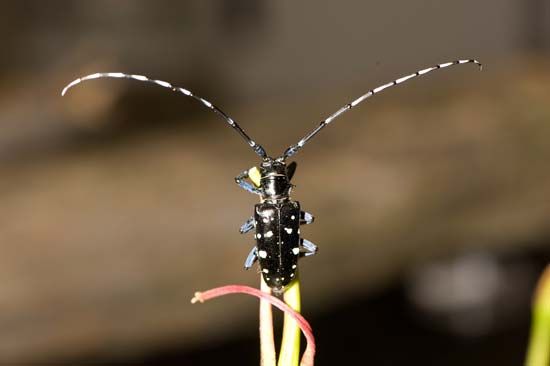
- Long-horned beetles (family Cerambycidae): Known for their exceptionally long antennae, these beetles are significant wood-borers. Their larvae, often called roundheaded borers, feed within woody plants for years.13
- Branch and twig borers (family Bostrichidae): These species typically live in dry wood or under tree bark, with some species capable of boring into living fruit-tree branches.14
- Bess beetles (family Passalidae): These beetles are commonly found in rotting logs, where they exhibit the unusual behavior of adults protecting and feeding their young.15
Scavengers and Fungus-Feeders
Forest floors and decaying organic matter provide habitats for numerous other groups:
- Darkling beetles (family Tenebrionidae): These beetles are highly varied; those found in rotten wood or under bark may act as predators or scavengers, while others feed on fungi.1516
- Hairy fungus beetles (family Mycetophagidae): As their name suggests, these beetles are primarily associated with fungi.1516
- Stag beetles (family Lucanidae): Often found around rotting logs, the larvae feed on the decaying wood, while adults typically consume tree sap.17
Predatory Beetles
Predators are also common in forest environments, helping to regulate other insect populations:
- Ground beetles (family Carabidae): Many are nocturnal predators that hunt small insects, caterpillars, or snails. Some smaller species live in the moss on tree trunks.1518
- Soldier beetles (family Cantharidae): The larvae are often found under bark or in rotting wood, where they prey on worms and other insect larvae.15
Sources
- hairy fungus beetle — Encyclopædia Britannica
- Mycetophagidae — Merriam-Webster
- mycetophilid — Merriam-Webster
- Coleoptera - Feeding habits and habitats — Encyclopædia Britannica
- darkling beetle — Encyclopædia Britannica
- Coleoptera - Special ecological relationships — Encyclopædia Britannica
- fungus - Parasitism in plants and insects — Encyclopædia Britannica
- saprotroph — Encyclopædia Britannica
- Coleoptera - As scavengers — Encyclopædia Britannica
- soil - Biological phenomena — Encyclopædia Britannica
- soil organism — Encyclopædia Britannica
- Coleoptera - As plant feeders — Encyclopædia Britannica
- bark beetle — Encyclopædia Britannica
- stag beetle — Encyclopædia Britannica
- stag beetle — Merriam-Webster
- branch and twig borer — Encyclopædia Britannica
- long-horned beetle — Encyclopædia Britannica
- Coleoptera - Annotated classification — Encyclopædia Britannica
- Coleoptera - Distribution and abundance — Encyclopædia Britannica
- ground beetle — Merriam-Webster
Published on · 3 min read