Solomon’s Seal
Solomon’s seal refers to two distinct concepts: a type of plant and a historical emblem.
What is Solomon’s seal?
Solomon’s seal refers to two distinct concepts: a type of plant and a historical emblem.
The Plant
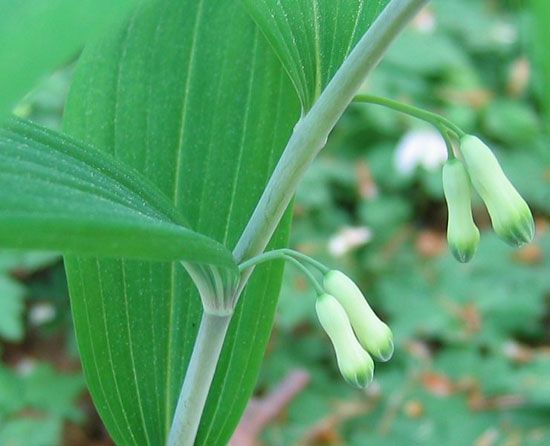
Solomon’s seal is the common name for any herbaceous perennial plant within the genus Polygonatum, part of the asparagus family. These plants are characterized by thick, creeping rhizomes, tall drooping stems, and clusters of white or greenish-white tubular flowers followed by red berries. They are native to the Northern Hemisphere and typically thrive in damp, wooded environments. A related plant, known as false Solomon’s seal, is distinguished by flower clusters that grow at the tips of its stems rather than in the leaf axils.12
The Emblem
The term also describes a symbolic emblem consisting of two interlaced triangles that form a six-pointed star. Historically, this design was used as an amulet, particularly to ward off fever. The name for the plant is believed to be a translation of the Medieval Latin sigillum Salomonis, though the exact origin of the association between the plant and the seal remains a subject of historical interpretation.2
What is the difference between true and false Solomon’s seal?
The primary difference between true and false Solomon’s seal lies in the placement of their flowers and their botanical classification.
- True Solomon’s Seal (Polygonatum): These plants belong to the asparagus family (formerly Ruscaceae) and are characterized by flowers that grow in clusters within the leaf axils—the angle between the leaf and the stem—along the upper portion of the plant.14
- False Solomon’s Seal (Smilacina): These plants are members of the lily family and are distinguished by their flower clusters, which grow in a terminal raceme or panicle at the very tips of the stems.13
While both are herbaceous perennials that thrive in similar damp, wooded habitats, their distinct floral arrangements serve as the most reliable way to identify them in the field.13
What is the history behind the six-pointed star symbol known as Solomon’s seal?
The six-pointed star, or hexagram, known as the Seal of Solomon, has a complex history rooted in magic, folklore, and cross-cultural symbolism rather than the Hebrew Bible.
Origins and Magical Associations
While the Babylonian Talmud mentions a ring possessed by King Solomon that could ward off demons, it does not describe it as a physical hexagram. Over time, the concept of the “Seal of Solomon” evolved to represent a five- or six-pointed star believed to possess magical powers, including the ability to control jinn. This association became particularly prominent in Islamic symbolism, where the motif frequently appeared on signet rings, coinage, and Mughal architecture.53
Historical Usage
The hexagram itself appears sporadically on early artifacts, such as a 7th-century BCE seal from Sidon and a 4th–5th century CE synagogue frieze in Capernaum. Scholars generally view these early instances as decorative or magical rather than religious. The symbol is not unique to one tradition; for instance, in Hinduism, the same figure is known as a shatkona and represents the union of Shiva and Shakti.53
How do rhizomes help perennial plants survive in the winter?
Rhizomes are horizontal, underground stems that play a critical role in helping perennial plants survive through harsh conditions like extended winters. They function as vital storage organs, accumulating starches and proteins that provide the necessary energy for the plant to remain dormant while its top growth dies back.78910
Beyond food storage, rhizomes allow plants to perennate—or survive an unfavorable season—by remaining protected underground. Because they possess nodes with reduced leaves and adventitious roots, they also serve as a means of vegetative reproduction. When conditions improve, these rhizomes can send up new shoots from their nodes, allowing the plant to regenerate and spread its colony. This adaptation is common in many plants, including bamboos, grasses, and ferns.78
Sources
- Solomon’s seal — Encyclopædia Britannica
- Solomon seal — Merriam-Webster
- Solomon's seal — Merriam-Webster
- false Solomon's seal — Merriam-Webster
- Star of David - Early decorative art and magic — Encyclopædia Britannica
- Star of David: Top Questions — Encyclopædia Britannica
- Rhizome — Encyclopædia Britannica
- Plant - Stems — Encyclopædia Britannica
- Angiosperm - Shoot system modifications — Encyclopædia Britannica
- herbaceous perennial — Merriam-Webster
Published on · 3 min read