Spider Monkey
Spider monkeys (Ateles) are highly specialized for an arboreal lifestyle, spending their lives in the forest canopy. Their primary adaptation is a long…
How are spider monkeys adapted for their arboreal lifestyle?
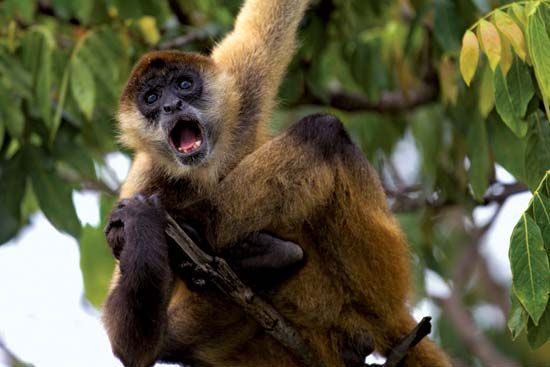
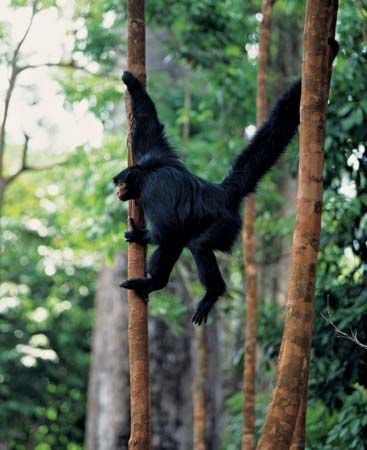
Spider monkeys (Ateles) are highly specialized for an arboreal lifestyle, spending their lives in the forest canopy. Their primary adaptation is a long, prehensile tail that functions as a “fifth limb,” providing increased stability and mobility. This tail is strong enough to support the monkey’s entire body weight, allowing it to hang from branches while feeding or moving.123
In addition to their tails, spider monkeys possess long, slender limbs that facilitate agile movement through the trees. They are considered “semibrachiators,” meaning they combine running along branches with a form of brachiation, where they swing from hold to hold using their arms. Their hands are also adapted for this environment, featuring absent or rudimentary thumbs, which helps them grasp branches more effectively during rapid travel. These physical traits allow them to move swiftly, leap between trees, or drop spread-eagled across the canopy with great dexterity.1456
How do spider monkeys communicate with each other?
Spider monkeys communicate using a variety of vocalizations to convey information and maintain social cohesion within their groups. Their auditory repertoire includes:
- Barking: When approached by intruders, spider monkeys emit sounds similar to the barking of terriers.1
- Whinnying: To maintain contact or signal to others when separated from their group, they produce a distinctive whinnying call that resembles the sound of a horse.1
- Screaming: They are also capable of producing prolonged, intense screams.1
Beyond these vocal signals, spider monkeys exhibit defensive behaviors that serve as a form of non-verbal communication when threatened. For instance, they are known to break off tree branches and drop them on intruders as a warning or deterrent.1
How do spider monkeys compare to other New World monkeys in terms of size and behavior?
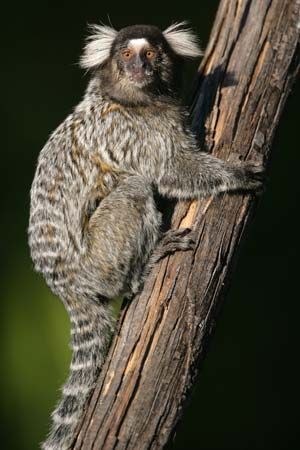
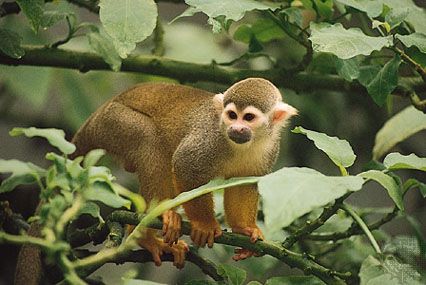
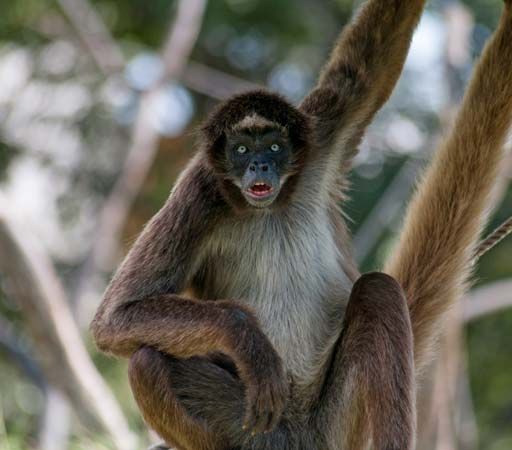
Spider monkeys (Ateles) are among the larger species of New World monkeys, weighing approximately 6 kg (13.2 pounds) and reaching lengths of 35–66 cm (14–26 inches), excluding their exceptionally long, prehensile tails. In contrast, other New World monkeys vary significantly in size; for example, marmosets and squirrel monkeys are much smaller, with some species weighing only about 1 kg (2.2 pounds).17
Behaviorally, spider monkeys are distinguished by their high degree of agility and specialized arboreal adaptations. Unlike many other New World monkeys, they possess a highly functional prehensile tail that acts as a fifth limb, capable of supporting their entire body weight. While many New World monkeys lack manual dexterity compared to Old World species, spider monkeys have evolved to be “semibrachiators,” using their arms and tails to swing through the canopy.17
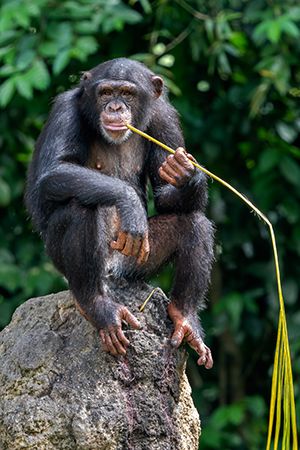
Socially, spider monkeys exhibit a complex structure that is unique among monkeys; their social organization is considered more analogous to that of chimpanzees than to other monkeys. While they live in large bands, they typically forage in smaller, flexible groups, a trait that reflects their high level of intelligence and social coordination.71
In which regions of the world are spider monkeys typically found?
True spider monkeys (genus Ateles) are found in forest environments ranging from southern Mexico through Central and South America, extending as far south as Brazil.1
Specific populations are distributed across various regions:
- Panama and Ecuador: The brown-headed spider monkey is found from eastern Panama through northwestern Ecuador.1
- Colombia and Venezuela: The variegated (or brown) spider monkey inhabits northeastern Colombia and northwestern Venezuela.1
It is important to note that the woolly spider monkey (genus Brachyteles), while a close relative, is a distinct group found exclusively in the remaining Atlantic forests of southeastern Brazil.4
Sources
- spider monkey — Encyclopædia Britannica
- brachiation — Encyclopædia Britannica
- Locomotion - Brachiation — Encyclopædia Britannica
- woolly spider monkey — Encyclopædia Britannica
- spider monkey — Merriam-Webster
- Tail — Encyclopædia Britannica
- monkey - Old World monkeys versus New World monkeys — Encyclopædia Britannica
- monkey — Encyclopædia Britannica
Published on · 3 min read