Squirrel Monkey
Under favorable conditions, squirrel monkeys can live up to 20 years.
How long do squirrel monkeys typically live, and what is their reproductive cycle like?
Under favorable conditions, squirrel monkeys can live up to 20 years.1
Regarding their reproductive cycle, these primates are strictly seasonal breeders. Females typically give birth to a single infant following a gestation period of approximately six months. After birth, the infant rides on its mother’s back for the first few weeks and remains dependent on her for one year. Because the gestation and subsequent care periods are lengthy, the reproductive cycle occupies the female for a full year or more, and she generally does not become receptive to mating again until the previous infant has been weaned.21
What are the physical characteristics of squirrel monkeys?
Squirrel monkeys (genus Saimiri) are small primates characterized by the following physical traits:
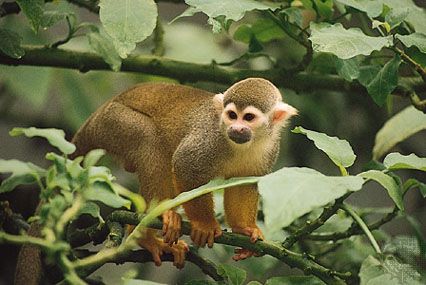
- Size and Build: They measure 25–40 cm (10–16 inches) in length, excluding their heavy, nonprehensile tail, which is at least as long as their body. They typically weigh about 1 kg (2.2 pounds).
- Facial Features: They are distinguished by an expressive white face with a circle of black, hairless skin surrounding the nose and mouth. As New World monkeys, they possess broad noses with a wide septum separating outwardly directed nostrils.
- Fur and Coloration: Their short, soft fur ranges from gray to olive green, with whitish underparts. Their hands, arms, and feet are yellow to orange.
- Species Variations: Common squirrel monkeys have olive or grayish crowns, while the endangered Central American species feature black crowns and reddish backs. Most species have hair on their ears, with the exception of the bare-eared squirrel monkey of central Brazil.
What do squirrel monkeys eat, and how do they forage for food?
Squirrel monkeys are omnivorous primates with a varied diet that includes fruit, leaves, buds, tree gum, insects, spiders, and small vertebrates.1
Regarding their foraging habits, these monkeys are primarily arboreal, preferring to live and search for food in the treetops. They are active during the day and typically move in single file, following a leader along frequently used pathways within the canopy. To maximize their foraging efficiency, they sometimes travel and feed in association with capuchin monkeys.1
How do squirrel monkeys differ from other New World monkey species?
Squirrel monkeys (Saimiri) are distinct from other New World monkeys in several key ways:
- Group Size: They form significantly larger social groups than any other New World monkey, with some troops reaching up to 300 individuals in the wild.1
- Vocal Complexity: They are among the most vocal of all primates, utilizing at least 26 distinct calls—including purrs, barks, and screams—to communicate.1
- Physical Convergence: While they are New World monkeys, they exhibit remarkable evolutionary convergence with the talapoin of West-Central Africa. Both are small (approximately 1 kg), greenish in color, live in large riverside troops, and follow seasonal breeding patterns.4
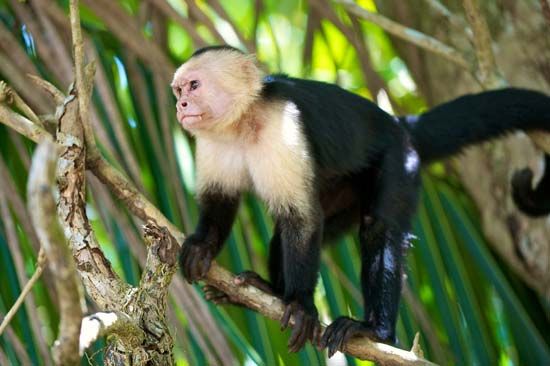
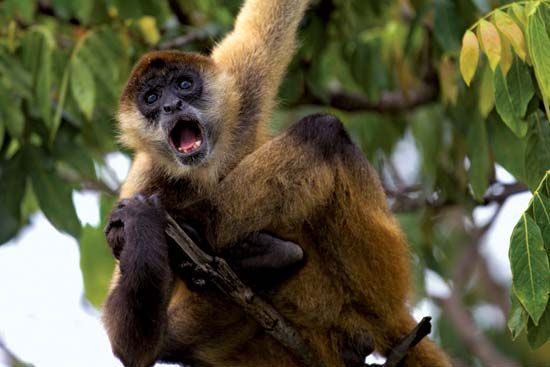
- Tail Function: Unlike some other New World species, such as spider monkeys, squirrel monkeys possess a heavy, nonprehensile tail that cannot support their body weight or grasp objects.14
- Social Structure: While many other New World monkeys exhibit unique social systems—such as the monogamous, cooperative breeding seen in marmosets—squirrel monkeys are noted for their high-density, large-group living and specific foraging associations with capuchin monkeys.16
Sources
- squirrel monkey — Encyclopædia Britannica
- primate - Breeding periods — Encyclopædia Britannica
- primate - Gestation period and parturition — Encyclopædia Britannica
- monkey - Old World monkeys versus New World monkeys — Encyclopædia Britannica
- primate - Diet — Encyclopædia Britannica
- marmoset — Encyclopædia Britannica
Published on · 3 min read