Spongy Moth
The life cycle of the spongy moth (Lymantria dispar) progresses through four distinct stages: egg, larva, pupa, and adult.
How does the life cycle of a spongy moth progress from egg to adult?
The life cycle of the spongy moth (Lymantria dispar) progresses through four distinct stages: egg, larva, pupa, and adult.
- Egg: In July, females deposit eggs in clusters on trees or other surfaces. These masses are covered with buff-colored hair from the female’s abdomen, giving them a characteristic spongelike appearance. The eggs overwinter and hatch the following spring.1
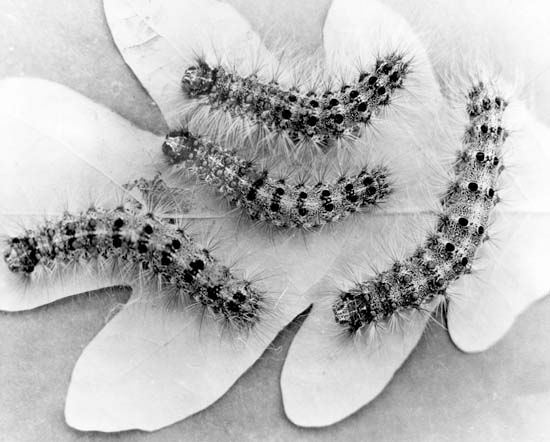
- Larva: The larvae are voracious feeders that can strip trees of their leaves. They are pale brown with tufts of stiff brown and yellow hairs. Because the European strain’s females are flightless, the larvae serve as the primary dispersal stage; they use silk threads to “parasail” on the wind to new trees. Once development is complete, they crawl down to the leaf litter to pupate.1
- Pupa: The larvae settle in the leaf litter at the base of a tree to enter the pupal stage. During this time, they undergo a major transformation of body tissues.12
- Adult: After approximately 10 days, the adult moth emerges, completing the annual generation.1
How do spongy moths spread to new areas?
Spongy moths spread to new areas primarily through their larvae, which serve as the main dispersal stage for the European strain. Because the female European moth is flightless, these young caterpillars spin silk threads and hang from high branches; when the wind breaks these threads, the silk acts as a parasail, carrying the larvae to new, uninfested trees.2
In contrast, the Asian strain of the spongy moth possesses a greater capacity for rapid expansion because the females are capable of flight, allowing them to travel and colonize new areas more effectively than their European counterparts. Additionally, human activity can facilitate the spread of these pests, as evidenced by the accidental introduction of the European strain into North America in the 19th century.2
What impact has the spongy moth had on North American ecosystems since its introduction?
Since its accidental introduction to North America around 1869, the spongy moth has become a significant ecological concern. The primary impact of this species is its role as a destructive defoliator of deciduous forests and fruit trees.26
The larvae are voracious feeders that can completely strip trees of their leaves within a few weeks. While the European strain has spread across the eastern United States and into the western Great Lakes region, the damage it causes is notably more severe in North America than in its native European range, largely because North America lacks the same suite of natural enemies that keep the moth’s population in check abroad.2
Furthermore, the discovery of the Asian spongy moth in northwestern North America in 1991 introduced an even greater threat, as this strain feeds on both coniferous and deciduous trees and possesses a higher capacity for rapid expansion due to the flight capabilities of the females.2
What are some identifying characteristics of spongy moth caterpillars and adult moths?
Identifying the spongy moth (Lymantria dispar) involves looking for specific physical traits across its life stages.
Caterpillar Characteristics
The mature larvae are flat, pale to dark brown, and can grow up to 50 mm (2 inches) in length. Key identifying features include:2
- Hairs: They are covered in tufts of stiff brown and yellow hairs along their sides.2
- Distinctive Markings: A primary diagnostic feature is the presence of two rows of colored dots on the back: five pairs of blue dots followed by six pairs of red dots.7
Adult Moth Characteristics
There is significant sexual dimorphism between the male and female moths, and differences exist between the European and Asian strains.2
- European Spongy Moth:
- Asian Spongy Moth:
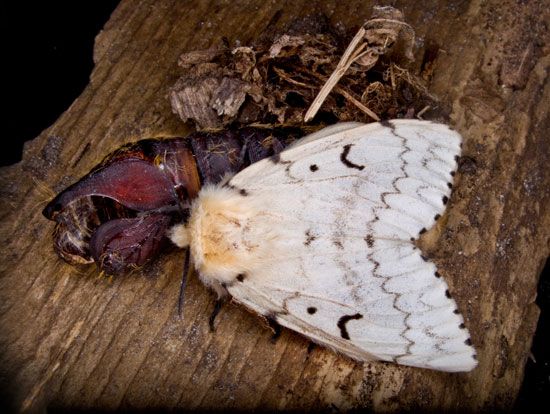
- Females: Larger than the European strain, with a wingspan of approximately 90 mm (3.5 inches), and they are capable of flight.2
Additionally, the species is named for its egg masses, which are deposited in July and covered in a mass of buff-colored, spongelike hair from the female’s abdomen.27
Sources
- Lepidoptera - The adult — Encyclopædia Britannica
- spongy moth — Encyclopædia Britannica
- Lepidoptera - The larva, or caterpillar — Encyclopædia Britannica
- How Many Legs Does a Caterpillar Have? — Encyclopædia Britannica
- Lepidoptera - Pupa , or chrysalis — Encyclopædia Britannica
- spongy moth — Merriam-Webster
- caterpillar — Encyclopædia Britannica
Published on · 3 min read