Oystershell Scale
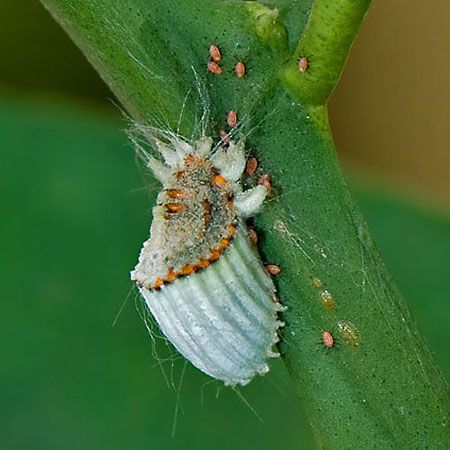
The oystershell scale (Lepidosaphes ulmi) is a species of insect belonging to the armoured scale family, Diaspididae. Likely introduced to the United States…
What is oystershell scale?
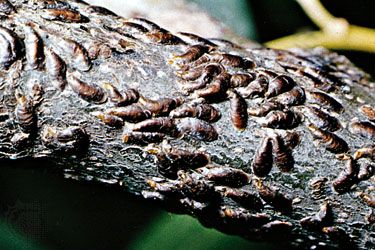
The oystershell scale (Lepidosaphes ulmi) is a species of insect belonging to the armoured scale family, Diaspididae1. Likely introduced to the United States from Europe, this pest infests various trees and shrubs, including lilacs, beeches, maples, and fruit trees.12
The insect is named for the hard, tough protective covering it secretes, which resembles a miniature oystershell. These insects have a modified life cycle; they typically overwinter as eggs beneath the scale covering. Upon hatching, the young—known as “crawlers”—emerge to find food, eventually molting, losing their legs and antennae, and becoming sessile as they insert their mouthparts into the host plant.13
Despite their small size, they can inflict significant damage on their hosts. Management of these infestations often involves the use of dormant or horticultural oil sprays, as well as relying on natural enemies such as birds, mites, and parasitic wasps.14
What are crawlers in the life cycle of scale insects?
In the life cycle of scale insects, crawlers are the newly hatched, immature stage of the insect. Whether a species hatches from eggs laid beneath a protective covering or is born as living young, these crawlers represent the primary mobile phase of the insect’s development.35
Upon emerging, crawlers disperse across the host plant to locate a suitable site for feeding. This stage is short-lived; after a few days, the insect molts and undergoes significant physical changes, including the loss of its legs, antennae, and anal spines. Following this transition, the insect becomes sessile, secreting a hard or waxy protective scale over its body and inserting its mouthparts into the plant to feed. While females remain in this stationary, wingless form throughout their maturity, males also begin as crawlers but eventually undergo a more complete metamorphosis to emerge as winged adults.35
How do parasitic wasps help control garden pests?
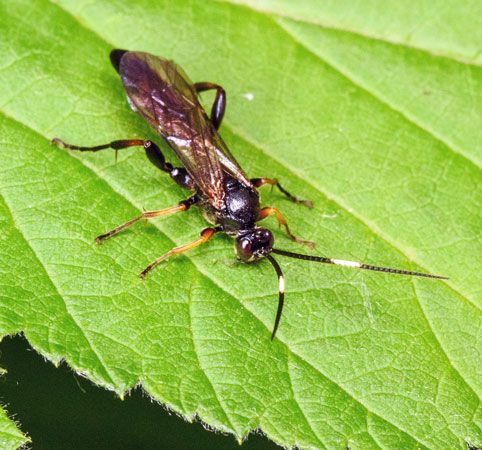
Parasitic wasps, particularly those in the families Braconidae and Ichneumonidae, play a vital role in managing garden and agricultural pests through biological control. These insects are parasitoids, meaning their larvae develop on or within the bodies of other arthropods, ultimately killing the host.67
How They Control Pests
- Targeted Parasitism: Female wasps use a specialized organ called an ovipositor to deposit eggs in or on specific hosts, such as caterpillars, beetle grubs, or flies. Some species can even drill through solid wood to reach wood-boring pests.67
- Larval Development: Once hatched, the wasp larvae feed on the host’s body fluids and tissues. In many cases, the host continues to behave normally until the parasite has completed its development, at which point the host dies.687
- Population Regulation: By consistently preying on specific pests—such as the cabbage looper, tobacco hornworm, or various wood-boring beetles—these wasps help keep pest populations in check naturally.67
Beyond their role as natural pest controllers, adult parasitic wasps feed on nectar and pollen, serving as incidental pollinators in the garden.67
What are some other common pests that affect woody plants?
Beyond scale insects, woody plants are frequently targeted by a wide variety of pests, particularly beetles and aphids.
Common Pests of Woody Plants
- Bark Beetles: Species such as Dendroctonus and Ips are among the most destructive insects for trees. They bore beneath the bark to feed on the cambium, creating channels that disrupt nutrient flow and often kill the tree.11
- Long-horned Beetles: Members of the family Cerambycidae are significant pests that bore into the trunks, stems, and roots of living and dead trees. A notable example is the Asian long-horned beetle, which infests various hardwood species like maples and elms.1213
- Metallic Wood Borers: These beetles (Buprestidae) have habits similar to long-horned beetles and can kill trees or branches by boring into the cambium.12
- Aphids: These minute insects can cause severe damage to commercial crops and ornamental trees. They are often introduced to new regions on living plants and can make it impossible to raise certain conifer species.11
- Defoliating Caterpillars: Various moth larvae, such as the spongy moth, can cause widespread damage by consuming tree foliage.11
Sources
- oystershell scale — Encyclopædia Britannica
- oystershell scale — Merriam-Webster
- homopteran - Scale insects — Encyclopædia Britannica
- insect - Ecological factors — Encyclopædia Britannica
- scale insect — Encyclopædia Britannica
- braconid wasp — Encyclopædia Britannica
- Hymenoptera - Solitary forms — Encyclopædia Britannica
- ensign wasp — Encyclopædia Britannica
- wasp — Encyclopædia Britannica
- ichneumon wasp — Encyclopædia Britannica
- Coleoptera - As plant feeders — Encyclopædia Britannica
- forestry - Insect and disease control — Encyclopædia Britannica
- long-horned beetle — Encyclopædia Britannica
Published on · 3 min read