Pine Weevil
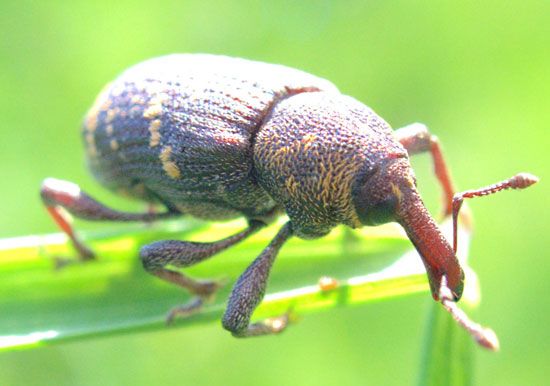
A pine weevil is any wood-boring beetle belonging to the insect family Curculionidae, characterized by a distinct elongated snout or beak.
What is pine weevil?
A pine weevil is any wood-boring beetle belonging to the insect family Curculionidae, characterized by a distinct elongated snout or beak.1
The most notable species in North America is the white pine weevil (Pissodes strobi). This insect feeds on and destroys the central growth shoots of white pines, Norway spruces, and other related conifers. By killing the primary leader shoot, the weevil forces a side shoot to assume upward growth, which results in permanent bends in the tree trunk and significantly reduces the tree’s value as lumber.12
While foresters generally accept limited insect activity as part of a natural ecosystem, pests like the pine weevil can cause localized damage that impacts timber quality. Management strategies often focus on maintaining vigorous tree growth and, in severe cases, employing monitoring or direct control measures to protect forest health.3
What are some other common insects that damage forest trees?
Beyond the pine weevil, several other insects are recognized as significant threats to forest health. These pests often disrupt a tree’s vascular system, leading to widespread mortality and ecological damage.
Notable Forest Pests
- Emerald Ash Borer (Agrilus planipennis): This metallic green beetle is one of the most destructive invasive species in North America. Native to East Asia, its larvae bore into ash trees, creating S-shaped tunnels that girdle the tree and disrupt its vascular system. It has caused the death of hundreds of millions of ash trees across the United States and Canada.45
- Bark Beetles (Subfamily Scolytinae): Comprising over 2,000 species, these small beetles are among the most destructive insects in forests. They bore beneath the bark to feed and lay eggs, creating gallery networks that can kill trees by cutting off the flow of nutrients. Some species, such as those in the genera Scolytus and Hylurgopinus, are also vectors for Dutch elm disease.26
- Woolly Adelgids (Genus Adelges): These aphid-like insects are serious pests introduced to North America. The hemlock woolly adelgid (A. tsugae), native to Asia, poses a severe threat to hemlock trees, while the balsam woolly adelgid (A. piceae), native to Europe, targets fir trees.78
- Defoliating Caterpillars: Various moth larvae, such as the spongy moth, can reach epidemic levels and strip trees of their leaves. While these outbreaks are sometimes managed with targeted pesticide applications, foresters must balance these interventions to avoid harming beneficial predatory insects.2
Management and Control
Foresters generally prioritize maintaining vigorous, healthy stands to increase resistance to infestation. When outbreaks occur, strategies include:
- Biological Control: Deploying natural enemies, such as parasitoid wasps, to manage pest populations.452
- Sanitation and Salvage: Removing infested trees to limit the spread of pests to healthy areas.2
- Quarantine Laws: Enforcing regulations on the movement of firewood and timber to prevent the human-facilitated spread of invasive species.52
How do foresters use pheromones to control pest populations?
Foresters utilize pheromones—naturally occurring chemicals secreted by insects to communicate—as a strategic tool for managing pest populations. Because these chemicals are highly specific to individual species, they allow for targeted interventions that minimize harm to beneficial insects and the surrounding environment.91011
Foresters primarily employ two methods using synthetic pheromones:
- Monitoring: Traps baited with sex-attractant pheromones are used to detect the presence and density of harmful insects. By tracking the number of insects caught, foresters can predict potential outbreaks and determine if further action is necessary.1210
- Population Control: This approach often involves “mating disruption.” By saturating an area with synthetic pheromones, foresters can confuse male insects, making it impossible for them to locate females. This prevents successful mating and reduces the overall breeding population. These pheromones are typically released slowly from small capsules or fibers dispersed over the forest.1210
These methods are considered a promising alternative to broad-spectrum chemical pesticides, which can inadvertently eliminate predatory insects that naturally keep pest numbers in check.210
What is the difference between invasive species and native pests in a forest?
In a forest ecosystem, the primary distinction between native pests and invasive species lies in their origin and the ecological checks and balances that govern their populations.
Native Pests
Native insects, fungi, and bacteria are natural components of forest ecosystems. They have co-evolved with local tree species, and their populations are typically held in check by natural enemies, such as predators and parasitoids, or by environmental factors like cold winters.14
- Ecological Role: While they can cause damage, their impact is usually limited, resulting in only minor reductions in tree growth or the death of a small number of trees.
- Management: Foresters often tolerate these losses as unavoidable. When outbreaks do occur, they are frequently linked to weakened or overmature trees, and management focuses on long-term practices like thinning and selective cutting to promote forest vigor.14
Invasive Species
Invasive species are non-native organisms introduced to a new habitat, often through human activities like global commerce.214
- Ecological Impact: Because they are in a new environment, they often lack the natural predators or pathogens that would normally regulate their numbers. This lack of control can lead to devastating epidemics that threaten biodiversity and cause significant economic harm.214
- Consequences: Invasive species can outcompete native organisms for resources or act as disease vectors. For example, the chestnut blight fungus nearly wiped out the American chestnut, a species that was not adapted to the introduced pathogen.14
- Management: Because invasive species can cause extreme mortality, foresters often employ aggressive direct control measures, such as quarantine laws, eradication zones, and the removal of infested trees, to prevent their spread.1415
Sources
- pine weevil — Encyclopædia Britannica
- forestry - Insect and disease control — Encyclopædia Britannica
- white pine weevil — Merriam-Webster
- Emerald Ash Borer: At a Glance — Encyclopædia Britannica
- emerald ash borer — Encyclopædia Britannica
- bark beetle — Encyclopædia Britannica
- hemlock woolly adelgid — Merriam-Webster
- woolly adelgid — Merriam-Webster
- Chemoreception - Monitoring and controlling pests — Encyclopædia Britannica
- pheromone — Encyclopædia Britannica
- Hormone - Pheromones — Encyclopædia Britannica
- Chemoreception - Aphrodisiac pheromones — Encyclopædia Britannica
- Chemoreception - Pheromones — Encyclopædia Britannica
- invasive species — Encyclopædia Britannica
- Asian longhorned beetle — Encyclopædia Britannica
- invasive — Merriam-Webster
Published on · 4 min read