Spring Peeper
The spring peeper (Pseudacris crucifer) is a small tree frog native to the eastern United States and Canada. Typically measuring only 2 to 3.5 cm (about 1…
What is spring peeper?
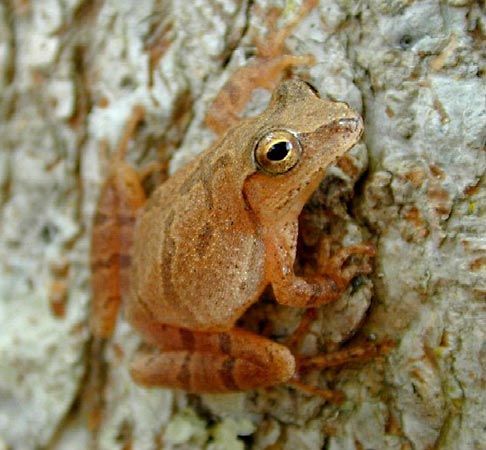
The spring peeper (Pseudacris crucifer) is a small tree frog native to the eastern United States and Canada. Typically measuring only 2 to 3.5 cm (about 1 inch) in length, these frogs are grayish, tan, or olive brown and are often identified by a distinct, dark X-shaped mark on their backs.123
They are well-known for their high-pitched, whistling “peep” call, which is one of the first signs of spring. While they are commonly heard during the breeding season in ponds, streams, and swamps, they are rarely seen because of their small size and their habit of hiding in forest floor debris. They are highly successful in both permanent and ephemeral woodland ponds, and their chorus can often be heard from hundreds of yards away on warm late-winter or early-spring evenings. Two subspecies are recognized: the northern spring peeper (P. crucifer crucifer) and the southern spring peeper (P. crucifer bartramiana).134
How do spring peepers produce their loud whistling sound?
Spring peepers produce their characteristic high-pitched, whistling call using a specialized throat structure known as a vocal sac.
The process is a unique physiological feat among vertebrates:
- Air Cycling: Unlike many other animals, frogs do not expel air to produce sound. Instead, they cycle air back and forth between their lungs and the buccal cavity (mouth) without releasing it.
- Sound Production: The male frog inflates his vocal sac with air from his lungs. He then forces a controlled rush of air through the larynx and across his vocal cords.
- Amplification: The resulting vibrations are amplified by the resonating qualities of the inflated vocal sac, which acts as a sound-resonating chamber.
This mechanism allows the small frog to broadcast its shrill, piping call across distances of several hundred yards, serving as a primary signal during the breeding season.54
What is the purpose of the X-shaped mark on their backs?
While the X-shaped mark on the back of a spring peeper is a distinct identifying feature, the provided search results do not specify a unique, singular purpose for this specific pattern.
However, in the broader context of frog coloration, such markings generally serve as concealing or visually disruptive patterns. These adaptations help frogs blend into their natural environments, such as forest floors or leaf litter, making them more difficult for predators to detect. While some species use “flash colors” to confuse predators or for species recognition, the X-shaped mark on the spring peeper is primarily considered a form of camouflage that helps the small frog remain inconspicuous in its woodland habitat.178
How do spring peepers survive the cold winter months?
Spring peepers, like many other amphibians, are ectotherms, meaning their body temperature is regulated by their environment. To survive the cold winter months, they enter a state of dormancy to avoid extreme temperatures.93
During the winter, spring peepers seek out protective niches to remain inactive until environmental conditions become favorable again. They typically overwinter in moist terrestrial locations, such as within the debris on the forest floor, inside rotting logs, or in the mud along the banks of marshes and ponds. By retreating into these sheltered areas, they are able to wait out the freezing temperatures of the winter season.13
Sources
- spring peeper — Encyclopædia Britannica
- spring peeper — Merriam-Webster
- 7 Awesome Frog Species of Canada and the United States — Encyclopædia Britannica
- 12 Words for Signs of Spring | Spring peeper — Merriam-Webster
- vocal sac — Encyclopædia Britannica
- Animal social behavior - Social interactions involving sex — Encyclopædia Britannica
- frog and toad - Coloration — Encyclopædia Britannica
- frog and toad - Size range and diversity of structure — Encyclopædia Britannica
- Ectotherm — Encyclopædia Britannica
- Dormancy - Fishes and amphibians — Encyclopædia Britannica
Published on · 2 min read