Springtail
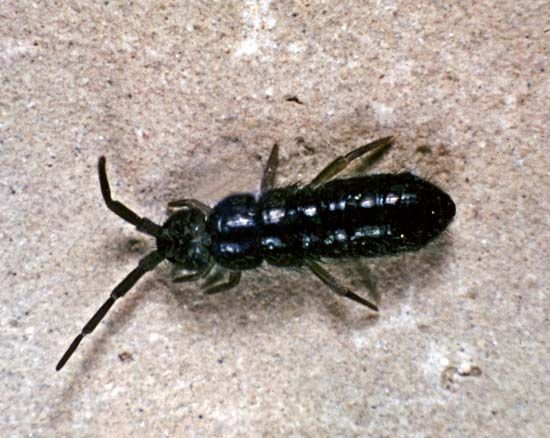
Springtails are small, primitive, wingless arthropods belonging to the order Collembola. Ranging from 1 to 10 mm in length, they are named for their unique…
What are springtails and how are they classified within the arthropod phylum?
Springtails are small, primitive, wingless arthropods belonging to the order Collembola. Ranging from 1 to 10 mm in length, they are named for their unique furcula—a forked, spring-like appendage on the abdomen used for jumping, though they typically move by crawling. They are also characterized by a ventral tube called a collophore, which aids in water absorption and adhesion.123
Within the phylum Arthropoda, springtails are classified under the subphylum Hexapoda, which they share with insects. Their precise taxonomic placement remains a subject of discussion; depending on the classification scheme, they are either considered true insects (class Insecta) or placed in a closely related group known as the class Parainsecta. They are among the most widely distributed arthropods, inhabiting diverse environments ranging from soil and leaf litter to the surface of water and snow across the globe, including Antarctica.412
What types of habitats do springtails typically inhabit?
Springtails are among the most widely distributed arthropods, inhabiting a vast array of environments across the globe, from the Arctic to Antarctica.1
Their typical habitats include:
- Soil and Leaf Litter: They are found in almost all types of soil and decaying organic matter, where they feed on vegetable debris.1
- Water Surfaces: Many species reside on the surface of water.1
- Snow: Certain species, commonly referred to as snow fleas, are uniquely adapted to remain active at near-freezing temperatures and can often be seen in large numbers on the surface of snow.1
- Agricultural Areas: They are frequently found in gardens and crop fields, where they may feed on mushrooms or garden crops, occasionally becoming pests.1
Because they are permanent residents of even the most extreme climates, such as Antarctica, they are considered highly resilient organisms.1
Are there any species of springtails that are considered pests, and if so, how are they managed?
While most springtails are harmless decomposers that contribute to soil health, some species can become pests when they damage garden crops or mushrooms.1
A notable example is the lucerne flea (Sminthurus viridis), a small, green-colored species measuring approximately 2 mm in length. It is recognized as a serious agricultural pest, particularly in Australia, where it can cause significant damage to crops.1
When springtail populations reach levels that require intervention, they are typically managed through the application of insecticides.1
What do springtails eat and how do they obtain their food?
Springtails (order Collembola) are primarily detritivores and microbivores that play a crucial role in the decomposition of organic matter within their environments. Their diet is diverse, consisting mainly of:15
- Vegetable Matter: They consume both living and decaying plant material, including leaf litter and vegetable debris.16
- Fungi and Microorganisms: A significant portion of their diet includes fungi, algae, and [spores].64
- Other Sources: While less common, some species are known to feed on carrion, and a small number of species are predatory, feeding on other small [invertebrates].6
Regarding how they obtain their food, springtails possess internal mouthparts that are enclosed within folds of the head. As they move through soil and leaf litter, they act as both primary and secondary decomposers. They help fragment organic litter, making it more palatable for other microorganisms, and they further break down the material into simpler chemical compounds. This process is essential for nutrient cycling, as it releases stored nutrients back into the soil, making them available for plants.45
Sources
- springtail — Encyclopædia Britannica
- Collembola — Merriam-Webster
- arthropod — Encyclopædia Britannica
- springtail — Merriam-Webster
- apterygote - Life cycle — Encyclopædia Britannica
- soil organism — Encyclopædia Britannica
Published on · 3 min read