Squirrelfish
A squirrelfish is any of approximately 70 species of tropical reef fish belonging to the family Holocentridae. These fish are characterized by their large…
What is squirrelfish?
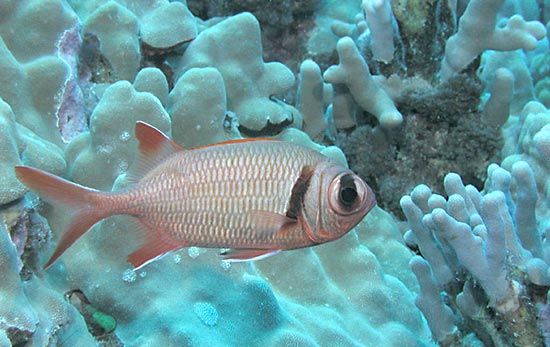
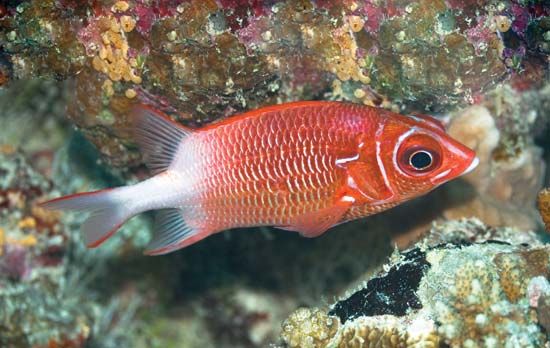
A squirrelfish is any of approximately 70 species of tropical reef fish belonging to the family Holocentridae. These fish are characterized by their large eyes, spiny fins, and rough, prickly scales.12
Most squirrelfish are red, often featuring markings in yellow, white, or black. They are nocturnal carnivores that spend their days hiding within reefs. While they are considered edible, some species possess a sharp spine on each cheek. The largest known species, the Pacific squirrelfish (Holocentrus spinifer), can reach lengths of approximately 60 cm (24 inches).1
Why do squirrelfish have such large eyes?
Squirrelfish have large eyes primarily as an adaptation to their nocturnal lifestyle. Because these fish are active at night and spend their daylight hours hiding in the dim environments of coral reefs, their large eyes help them maximize light capture in low-light conditions.13
In general, fish that inhabit dark or dim environments often evolve larger eyes to improve their visual sensitivity, unless they have developed other dominant senses to compensate. This structural adaptation allows them to navigate and hunt effectively in the darkness of their reef habitats.31
What are some other nocturnal animals that live on coral reefs?
While the provided information notes that many tetraodontiforms are diurnal—meaning they are active during the day and seek shelter in reef crevices at night—it does not explicitly list other nocturnal animals that inhabit coral reefs.
Because the available data focuses on the activity cycles of diurnal species rather than nocturnal ones, I cannot provide a list of nocturnal reef-dwelling animals from this source.
How do spiny fins and sharp scales help fish survive?
Spiny fins and sharp scales are essential evolutionary adaptations that provide fish with physical protection, defense against predators, and, in some cases, chemical deterrence.
Physical Protection and Armor
Scales serve as a primary barrier against the environment and potential predators. While early fish relied on heavy, thick bony plates for protection, modern teleost fishes have evolved thinner, overlapping scales that offer protection while allowing for greater freedom of movement. Some species have even developed secondary bony plates in their skin for added defense.789
Defense and Deterrence
Spines and sharp structures provide specialized defensive capabilities:
- Predator Deterrence: Spines on fins, tails, and gill covers often serve as a deterrent to predators. In some species, such as the triggerfish, these spines can be used to deliver painful punctures to an attacker.910
- Chemical Defense: Many fishes possess poison glands in their skin that are frequently associated with these sharp spines, allowing them to inject toxins into predators.910
- Structural Armor: Some groups, such as the scorpaeniforms, have evolved bony stays or protrusions that form a hard, armor-like exterior to protect the head and body.11
- Ctenoid Scales: Higher bony fishes possess ctenoid scales, which are distinguished by small, comblike teeth or spines along their edges, providing a rougher, more protective surface compared to smooth cycloid scales.79
Sources
- squirrelfish — Encyclopædia Britannica
- squirrelfish — Merriam-Webster
- atheriniform - Annotated classification — Encyclopædia Britannica
- Photoreception - Diversity of eyes — Encyclopædia Britannica
- fish - Sight — Encyclopædia Britannica
- tetraodontiform - Activity cycle — Encyclopædia Britannica
- scorpaeniform - Camouflage and coloration — Encyclopædia Britannica
- fish - The skin — Encyclopædia Britannica
- scale — Encyclopædia Britannica
- Integument - Fishes — Encyclopædia Britannica
- Avoidance behaviour - Protection reflexes, armour, and spines — Encyclopædia Britannica
- scorpaeniform - General features — Encyclopædia Britannica
Published on · 2 min read