Wrasse
A wrasse is any of nearly 500 species of marine fish belonging to the family Labridae. These fish, which range from 5 cm to over 2 meters in length, are…
What is wrasse?
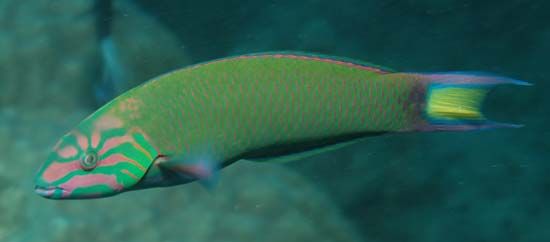
A wrasse is any of nearly 500 species of marine fish belonging to the family Labridae. These fish, which range from 5 cm to over 2 meters in length, are typically slender with thick lips, smooth scales, and large, protruding canine teeth. They are found globally in tropical and temperate seas, particularly among coral reefs.1
Many wrasses are protogynous hermaphrodites, meaning they function as females before transitioning into males. Their coloration is often vibrant and can change significantly based on age, sex, or the transition between sexes.12
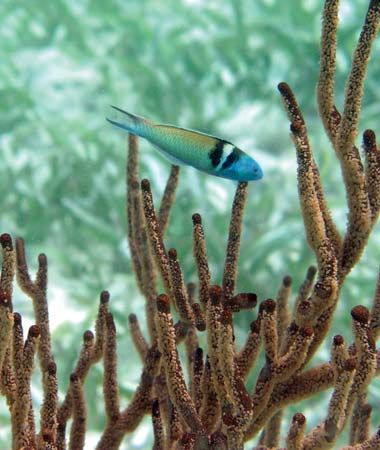
Ecologically, wrasses are important predators of crustaceans, mollusks, and other invertebrates. Some species, such as the bluehead wrasse, serve as “cleaners” by removing parasites from larger fish at specialized underwater stations. While some species like the tautog and hogfish are consumed as food, the group holds little overall commercial importance.12
How do cleaner wrasses help other fish survive?
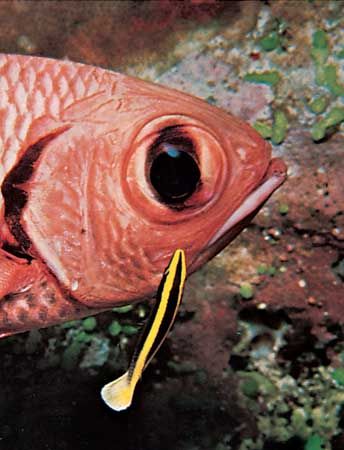
Cleaner wrasses, particularly those of the genus Labroides, provide a vital service to larger marine animals by acting as cleaner fish. They establish “cleaning stations” on coral reefs where they remove external parasites and dead tissue from the bodies, mouths, and gill chambers of larger fish such as groupers, eels, snappers, and surgeonfish.314
This interaction is a remarkable example of interspecific cooperation. When larger fish visit these stations, they suspend their predatory instincts, often entering a trance-like state with their mouths and gills held open to allow the wrasses to work safely. By removing these parasites, the cleaner wrasses help maintain the health and hygiene of their “customers,” who in turn recognize the cleaners and refrain from eating them.341
What does it mean for a fish to be a protogynous hermaphrodite?
For a fish, being a protogynous hermaphrodite means that the individual functions as a female during the early part of its life and later transitions to function as a male. This form of hermaphroditism is quite common among bony fishes, including many species of wrasse, parrot fishes, and sea basses.56
This reproductive strategy is thought to be evolutionarily advantageous for several reasons:
- Energy Efficiency: Producing eggs requires significantly more energy than producing sperm. By functioning as a female while smaller, a fish can allocate its limited energy resources more effectively.5
- Mating Systems: In certain promiscuous mating systems, it may be more advantageous to be a male when the individual is larger and more experienced, rather than when it is young and small.5
This process is the opposite of protandrous hermaphroditism, where an individual begins life as a male and later transitions into a female.57
Why do some wrasse species change color as they age?
Some wrasse species undergo significant color changes as they age, a phenomenon often linked to their complex life cycles and social structures. These changes are primarily driven by the following factors:
- Sex Transformation: Many wrasses are protogynous hermaphrodites, meaning they begin life as females and later transition into males. In these species, a dramatic change in color often accompanies the transition from female to male, signaling the individual’s new reproductive status.1
- Social and Territorial Dynamics: Coloration serves as a vital tool for territorial advertising. In many reef-dwelling species, juveniles and subadults exhibit coloration that is radically different from that of adults. This allows them to live within an adult’s territory without being perceived as a threat or a competitor for food. Once they assume the distinct adult coloration, they are often driven away by the dominant fish.9
- Reproductive Signaling: Bright, intricate color patterns are frequently used as reproductive signals to attract mates. As fish reach sexual maturity, hormonal changes can trigger the development of these vibrant displays to enhance courtship success.1011
Sources
- wrasse — Encyclopædia Britannica
- Christmas plants and animals: 12 festive species - Christmas wrasse ( Thalassoma trilobatum ) — Encyclopædia Britannica
- cleaner wrasse — Merriam-Webster
- perciform - Interspecific relationships — Encyclopædia Britannica
- Reproductive behaviour - Fishes — Encyclopædia Britannica
- Sex - Sex patterns — Encyclopædia Britannica
- bivalve - Reproduction and life cycles — Encyclopædia Britannica
- Animal reproductive system - Gonads, associated structures, and products — Encyclopædia Britannica
- coloration - Territorial advertising — Encyclopædia Britannica
- coloration - Reproductive signals — Encyclopædia Britannica
- coloration - Short-term changes — Encyclopædia Britannica
- coloration - Physiological control — Encyclopædia Britannica
Published on · 3 min read