Stable Fly
The stable fly (Stomoxys calcitrans), often referred to as a biting housefly, is a vicious bloodsucking insect belonging to the family Muscidae. While they…
What is stable fly?
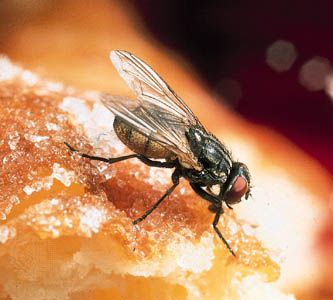
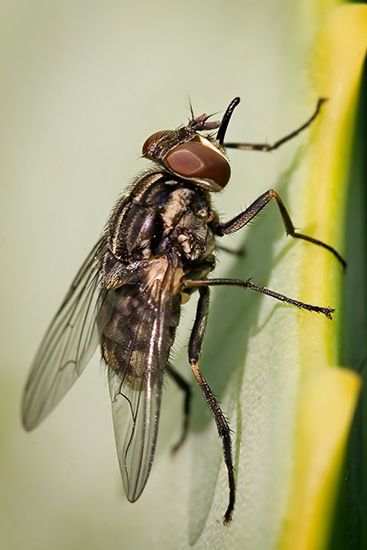
The stable fly (Stomoxys calcitrans), often referred to as a biting housefly, is a vicious bloodsucking insect belonging to the family Muscidae. While they resemble the common housefly, they are distinguished by a hard, drill-like labium used to pierce the skin of vertebrates to feed on blood. Unlike many other blood-feeding flies where only the females bite, both male and female stable flies feed on blood.123
These flies are typically found in open, sunny areas and are commonly associated with stables, though they may enter homes during inclement weather. Their life cycle, which lasts approximately three weeks, involves the female laying eggs in rotting or fermenting straw, where the larvae subsequently develop. Beyond the irritation caused by their bites, stable flies are significant because they can mechanically transmit various animal diseases, including anthrax. The most effective method for controlling stable fly populations is the systematic elimination of their breeding sites.123
How do stable flies differ from common houseflies?
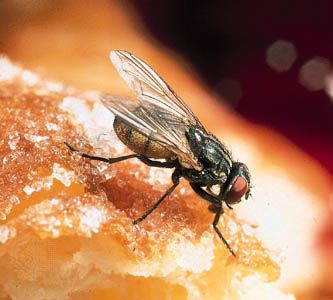
While stable flies and common houseflies share a similar appearance, they differ significantly in their feeding mechanisms and behaviors.
- Feeding Mechanism: The most critical difference lies in their mouthparts. Common houseflies (Musca) have lost their mandibles and maxillae, possessing only a tonguelike labium used for feeding on exposed surfaces. In contrast, the stable fly (Stomoxys calcitrans) has evolved a specialized bloodsucking mechanism where labial teeth are used to cut through the skin of vertebrates, allowing the labium to be plunged into tissues to feed on blood.1
- Dietary Habits: Because of these anatomical differences, common houseflies are restricted to liquid or dissolved food sources on surfaces. Stable flies, however, are vicious bloodsuckers that require blood meals.51
- Disease Transmission: While both are flies, stable flies are specifically noted for their ability to mechanically transmit animal diseases, such as anthrax, due to their blood-feeding habits.5
What diseases can stable flies transmit to animals and humans?
Stable flies (Stomoxys calcitrans) are known to be vectors for various animal diseases, most notably anthrax.1
Because stable flies possess a hard, drill-like labium used to pierce the skin of vertebrates to feed on blood, they are capable of mechanical disease transmission. This process occurs when a fly picks up microorganisms from an infected host and subsequently injects them into a new host via its contaminated mouthparts or saliva during a blood meal. While the provided information highlights their role in transmitting animal diseases, it does not specify a list of diseases they transmit to humans.3
Why do both male and female stable flies feed on blood?
It is a common misconception that only female stable flies feed on blood; in fact, both male and female stable flies (Stomoxys calcitrans) are vicious bloodsuckers that require blood meals.1
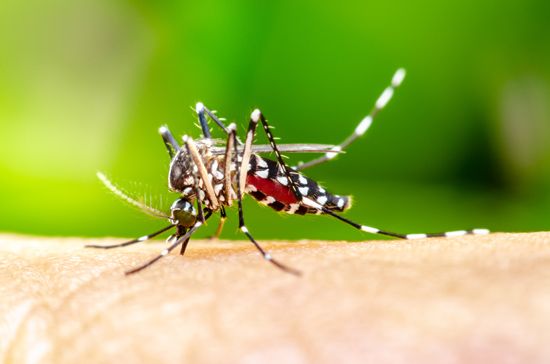
While many other blood-feeding fly species—such as mosquitoes and black flies—exhibit a pattern where only the females take blood meals to supplement their diet for egg production, the stable fly is distinct in that both sexes possess the specialized mouthparts necessary to pierce the skin of vertebrates and feed on blood. This behavior allows both males and females to obtain the necessary nutrients for their survival.167
Sources
- stable fly — Encyclopædia Britannica
- stable fly — Merriam-Webster
- Diptera - Importance — Encyclopædia Britannica
- Agricultural technology - Biological controls — Encyclopædia Britannica
- insect - Head — Encyclopædia Britannica
- Diptera - Eggs — Encyclopædia Britannica
- Diptera - Adults — Encyclopædia Britannica
- Diptera - General features — Encyclopædia Britannica
Published on · 2 min read