Housefly
Controlling housefly populations primarily involves managing their breeding grounds and employing targeted treatments. Because houseflies thrive where…
What are some effective methods for controlling housefly populations?
Controlling housefly populations primarily involves managing their breeding grounds and employing targeted treatments. Because houseflies thrive where decomposing organic waste and garbage accumulate, the most effective preventative measure is to make these materials inaccessible to them.1
When waste cannot be fully secured, the following methods can be utilized:
- Chemical Treatments: Residual insecticidal sprays can remain effective for several weeks, though it is important to note that some populations have developed resistance to certain chemicals like DDT. For areas where waste cannot be removed, larvicidal drenches or dusts may be applied to prevent the development of maggots.1
- Integrated Pest Management: This approach combines multiple strategies to reduce reliance on chemicals and protect the environment. Techniques include using chemical attractants to lure flies into contact with small amounts of insecticide or employing light traps.2
- Biological and Advanced Controls: While less common for household use, methods such as the release of sterilized males or the use of specific microbial agents are part of broader efforts to manage insect populations.2
How have houseflies adapted to living in close proximity to humans?
Houseflies (Musca domestica) have successfully adapted to human environments by exploiting the resources generated by human activity, particularly the accumulation of decomposing organic waste and garbage, which serve as primary breeding grounds. Their close proximity to humans is facilitated by several key biological and behavioral traits:1
- Physical Mobility: Houseflies possess specialized glandular pads called pulvilli beneath their claws, which allow them to walk on vertical surfaces like window panes or hang upside down on ceilings.1
- Feeding Habits: Equipped with sponging or lapping mouthparts, they are highly efficient at feeding on human food, drink, and waste. This behavior allows them to move constantly between human habitations and contaminated materials, making them effective vectors for transmitting diseases such as typhoid, cholera, and dysentery.13
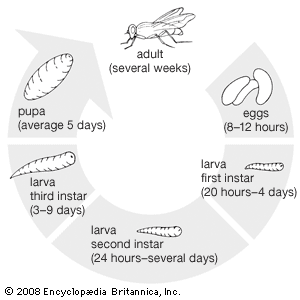
- Reproductive Efficiency: A female housefly can produce hundreds of eggs in her lifetime, which hatch rapidly—often within 12 to 24 hours—allowing populations to thrive wherever waste is accessible.1
- Chemical Adaptation: Houseflies have demonstrated a significant capacity for evolutionary adaptation, including the development of resistance to various insecticides like DDT, which were once used to control their populations.14
What are the key physical characteristics of a housefly?
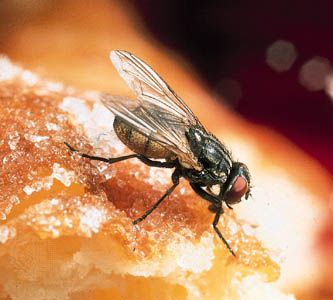
The housefly (Musca domestica) is a common, sturdy, and bristly insect characterized by several distinct physical features:
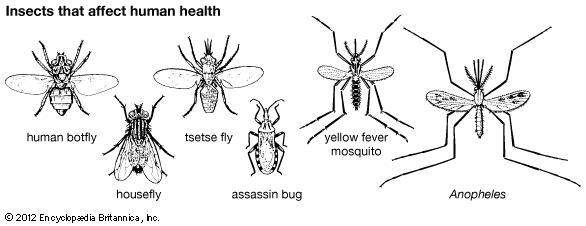
- Size and Coloration: Adults typically range from 5 to 7 mm (0.2 to 0.3 inches) in length. They are dull gray in color, featuring dirty-yellowish areas on the abdomen and longitudinal lines on the thorax.17
- Eyes: They possess large compound eyes that contain approximately 3,000 to 4,000 facets, which provide a wide field of vision.18
- Mouthparts: Unlike some related species, the housefly lacks mandibles and maxillae. Instead, it has specialized sponging or lapping mouthparts—specifically a tonguelike [labium]—designed for feeding on exposed surfaces rather than biting.19
- Locomotion: Beneath each claw on their feet are tiny glandular pads called [pulvilli]. These pads produce a secretion that allows the fly to walk on vertical surfaces, such as window panes, or hang upside down on ceilings.1
What role do houseflies play in the ecosystem?
Houseflies (Musca domestica) play a complex role in the ecosystem, primarily functioning as part of the broader Diptera order, which is essential to global food chains.1110
Their ecological contributions include:
- Nutrient Cycling: Like many other fly larvae, housefly maggots assist in the breakdown and redistribution of organic matter. Their waste products provide necessary nutrients for plants and fungi.britannica.com/plant/plant) and fungi.1110
- Food Source: Both the larval and adult stages of many flies serve as a vital food source for a wide variety of predators, including birds, fish, amphibians, spiders, and other insects.310
While they contribute to these natural processes, houseflies are also widely recognized for their role as a nuisance and a public health hazard. Because they frequently move between decomposing waste, feces, and human food, they act as mechanical vectors capable of transmitting bacteria and viruses that cause diseases such as typhoid, cholera, and dysentery.111
Sources
- housefly — Encyclopædia Britannica
- Agricultural technology - Biological controls — Encyclopædia Britannica
- Diptera - Importance — Encyclopædia Britannica
- Chemoreception - Blood-feeding insects — Encyclopædia Britannica
- Chemoreception - Sex recognition — Encyclopædia Britannica
- insecticide - Environmental contamination and resistance — Encyclopædia Britannica
- insect - Head — Encyclopædia Britannica
- Diptera - General features — Encyclopædia Britannica
- Photoreception - Differences in resolution — Encyclopædia Britannica
- blow fly: Top Questions — Encyclopædia Britannica
- Diptera - Ecology — Encyclopædia Britannica
- Diptera: Top Questions — Encyclopædia Britannica
Published on · 3 min read