Stickleback
Stickleback fish, particularly the three-spined stickleback, demonstrate remarkable adaptability by inhabiting diverse environments, including fresh…
How do stickleback fish adapt to different environments?
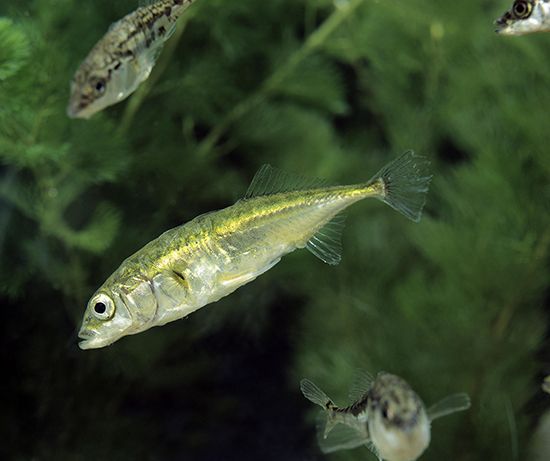
Stickleback fish, particularly the three-spined stickleback, demonstrate remarkable adaptability by inhabiting diverse environments, including fresh, brackish, and marine waters throughout the Northern Hemisphere.12
Their ability to thrive in these varied settings is rooted in genetic variation within local populations. Because sticklebacks are sexually reproducing, different populations possess distinct combinations of genes, or genotypes, which influence their expressed physical and physiological traits, known as their phenotype3. Through the process of natural selection, individuals with traits best suited to their specific environment—such as salinity levels or water conditions—are more likely to survive and reproduce, passing those advantageous genes to the next generation.3
This genetic flexibility allows them to maintain populations across a wide range of temperate regions, from the Arctic Ocean to various freshwater systems. Their physical structure, including protective bony plates and defensive spines, also provides a consistent baseline for survival across these different habitats.1
How do stickleback fish communicate with each other?
Stickleback fish primarily communicate through highly ritualized reproductive behaviour and aggressive displays, which serve to convey information regarding status, territory, and mating readiness.145
Visual Communication
During the breeding season, male sticklebacks undergo significant physical changes, becoming suffused with vibrant colors ranging from red to yellow-orange or black. These colors act as visual signals to both rivals and potential mates. Because males are highly territorial and aggressive during this period, they use these colorations and specific postures to defend their breeding grounds.14
Aggressive and Courtship Displays
Communication often begins with relatively harmless displays rather than direct physical conflict. When a male encounters an intruder in his territory, he may engage in aggressive posturing to signal his dominance and exclude the rival. Conversely, when interacting with a female, the male performs ritualized courtship behaviors to reduce hostility and facilitate mating. These displays are essential for:415
- Species Recognition: Acting as isolating mechanisms to prevent cross-mating between different species.5
- Appeasement: Reducing the male’s natural aggression toward the female, allowing the pair to cooperate in the nest-building and fertilization process.15
What are the distinctive physical characteristics of stickleback fish?
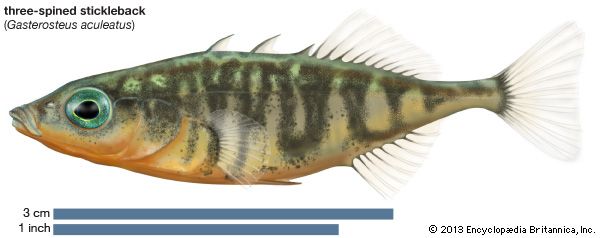
Sticklebacks are small, elongated fishes belonging to the family Gasterosteidae, typically reaching a maximum length of about 18 cm (7 inches). Their most distinctive physical features include:
- Dorsal Spines: They possess a row of 2 to 16 sharp spines on their back, positioned in front of a soft-rayed dorsal fin.12
- Pelvic Spines: Each pelvic fin contains a sharp, defensive spine.1
- Body Armor: Their skin is scaleless and generally protected by a variable number of hard, thin, bony plates along the sides of the body.12
- General Morphology: They feature a slender caudal peduncle (tail base), a squared tail, large eyes, and an upturned mouth.1
These physical traits, particularly the defensive spines and bony plates, are adaptations that help these fish survive in diverse environments ranging from freshwater streams to marine habitats.12
How do stickleback fish defend themselves against predators?
Stickleback fish utilize a combination of physical adaptations to defend themselves against predators. Their primary defense mechanism involves a series of sharp, defensive spines located on their back and pelvic fins, which make them difficult for predators to swallow or handle.1
Additionally, their bodies are protected by a series of hard, thin, bony plates along their sides, which provide a physical barrier against injury. These bony plates, which were secondarily acquired during their evolution, serve as a robust form of armor. Together, these structural features—the spines and the bony plates—act as significant deterrents against potential threats in their environment.18
Sources
- stickleback — Encyclopædia Britannica
- three-spined stickleback — Merriam-Webster
- population ecology - Genetic variation within local populations — Encyclopædia Britannica
- Aggressive behaviour - The nature of animal aggression — Encyclopædia Britannica
- Animal communication - Signal production — Encyclopædia Britannica
- Reproductive behaviour - Courtship — Encyclopædia Britannica
- stickleback — Merriam-Webster
- fish - The skin — Encyclopædia Britannica
Published on · 3 min read