Tubesnout
The tubesnout refers to either of the two marine fish species belonging to the family Aulorhynchidae, within the order Gasterosteiformes. These fish are…
What is tubesnout?
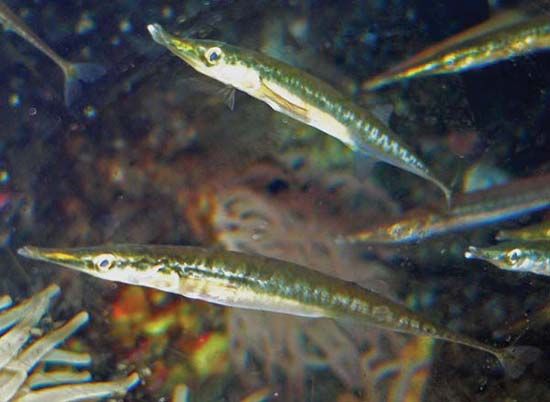
The tubesnout refers to either of the two marine fish species belonging to the family Aulorhynchidae, within the order Gasterosteiformes. These fish are named for their characteristically extended snouts and are found exclusively in coastal regions of the northern Pacific Ocean.1
The two recognized species are:
- Aulorhynchus flavidus: Found along the North American coast from Alaska to Mexico, this species lives among kelp and eelgrass. It grows to approximately 18 cm (7 inches) and is known for building nests out of kelp fronds to house its eggs.1
- Aulichthys japonicus: This species inhabits the northwestern Pacific, specifically near Japan and Korea.1
Both species primarily consume small crustaceans and fish larvae. Taxonomically, they are sometimes grouped with the stickleback family.1
How are tubesnouts related to sticklebacks?
Tubesnouts and sticklebacks are closely related as members of the same order, Gasterosteiformes. While sticklebacks belong to the family Gasterosteidae and tubesnouts belong to the family Aulorhynchidae, their classification is so closely linked that tubesnouts are sometimes placed within the stickleback family itself.21
Beyond their taxonomic proximity, the two groups share notable behavioral similarities, particularly regarding reproduction. Both groups exhibit parental care, with males playing a central role in protecting their offspring. Specifically, tubesnouts secrete threads to bind masses of algae for their eggs in a manner similar to the way sticklebacks use mucous secretions to cement plant materials together when building their nests. Like sticklebacks, male tubesnouts also take responsibility for caring for the egg clusters.3
What role does kelp play in the tubesnout’s life cycle?
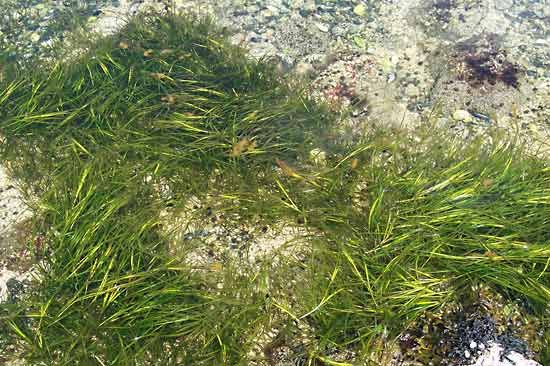
Kelp serves as a vital component in the life cycle of the larger tubesnout, Aulorhynchus flavidus, particularly during the reproductive phase. These fish inhabit coastal regions where they reside among giant kelp and eelgrass beds.1
When it comes to reproduction, the male tubesnout utilizes giant kelp fronds to construct a nest. After the female deposits her eggs, they adhere directly to these kelp fronds, which provide a secure environment for the developing offspring. Beyond their role in reproduction, these marine growths provide essential habitat for the fish, offering both safety and a source of food, as the species feeds on small, planktonic crustaceans and fish larvae found within these environments.14
What are some other unique fish found in the North Pacific?
The North Pacific is home to a diverse array of fish species, ranging from specialized bottom-dwellers to those adapted for the open ocean. Some notable examples include:
- Wolf-eel: A black-spotted fish found in the eastern Pacific, this species is related to the wolffish. It possesses formidable teeth, including large canines and heavy molars, which allow it to consume prey such as crabs, sea urchins, and starfish.5
- Salmon: The North Pacific is a major habitat for salmon, which thrive there in five distinct species of the genus Oncorhynchus, showing greater diversity than the single species found in the Atlantic.6
- Demersal Species: The North Pacific supports a high abundance of bottom-living fish, with the Alaska pollock and the North Pacific hake being two of the most prominent examples.6
- Plankton-feeders: In areas where nutrient-rich waters upwell, dense concentrations of plankton-feeding fish, particularly members of the herring family, are found in great numbers.6
Sources
- tubesnout — Encyclopædia Britannica
- gasterosteiform — Encyclopædia Britannica
- gasterosteiform - Reproduction and life cycle — Encyclopædia Britannica
- gasterosteiform - Ecology and behaviour — Encyclopædia Britannica
- wolffish — Encyclopædia Britannica
- Pacific Ocean - Biological resources — Encyclopædia Britannica
- Pacific Ocean - Fisheries — Encyclopædia Britannica
- deep-sea fish — Encyclopædia Britannica
Published on · 2 min read