Sue
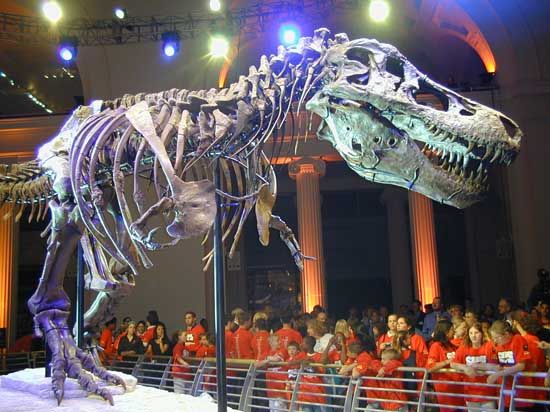
The discovery of Sue, one of the most complete Tyrannosaurus rex skeletons, triggered a decade-long legal battle regarding ownership and excavation rights.
What controversies or legal issues surrounded the excavation and ownership of Sue?
The discovery of Sue, one of the most complete Tyrannosaurus rex skeletons, triggered a decade-long legal battle regarding ownership and excavation rights.
After paleontologist Peter Larson paid the landowner, Maurice Williams, $5,000 for excavation rights, the specimen was moved to the Black Hills Institute. However, disputes soon arose because Williams’s land was held in trust by the United States government. Williams argued he had not authorized the removal of the fossil, and because the land was held in trust, any sale required consent from the U.S. Department of the Interior, which was never obtained.1
In 1992, federal agents seized the skeleton. Following a ruling by a U.S. district court and validation by the U.S. Supreme Court, the fossil was declared the property of Williams and the Bureau of Indian Affairs. The subsequent decision to auction the specimen through Sotheby’s sparked significant controversy among scientists, who feared that commercialization would lead to the loss of scientifically vital specimens to private collections.1
What is the estimated age of Sue the T. rex when it died?
The provided search results do not contain information regarding the specific estimated age of Sue the T. rex at the time of her death. While the articles note that T. rex specimens generally reached full size in less than 20 years, they do not provide a specific age estimate for this individual specimen.23
What other famous T. rex skeletons have been discovered, and how do they compare to Sue?
Since 1980, paleontologists have discovered more than two dozen Tyrannosaurus rex specimens, significantly expanding our understanding of the species beyond the four incomplete skeletons known before that time. Among these, several notable specimens stand out for their completeness and scientific value:24
- Scotty: Discovered in Saskatchewan in 1991, this specimen is often compared to Sue in terms of size. It is estimated to be slightly larger and heavier than Sue, measuring approximately 13 meters (42.7 feet) in length and weighing about 8,870 kg (19,555 pounds).2
- Wankel T. rex: Unearthed in 1990, this specimen is 85 percent complete. It is currently on display at the Museum of the Rockies in Bozeman, Montana.24
- B-rex: Discovered in 2000 in the Hell Creek Formation, this specimen is scientifically significant for preserving soft tissues and medullary bone, which provided evidence that the individual was female.24
- Maximus: This specimen is noted for its exceptional skull, which spans 2 meters (6.6 feet) in length, making it the longest known T. rex skull.2
While Sue remains one of the most complete specimens at 90 percent, these other discoveries have been vital for studying T. rex biology, growth, and sexual dimorphism.24
Who was Sue named after, and why?
The T. rex specimen known as “Sue” is named after the American marine archaeologist and paleontologist Susan Hendrickson.
Hendrickson discovered the fossil on August 12, 1990, while she was searching for fossils on a cattle ranch in South Dakota alongside paleontologist Peter Larson. Because she was the scientist who made the discovery, the specimen was named in her honor.4
Sources
- Sue — Encyclopædia Britannica
- Tyrannosaurus rex — Encyclopædia Britannica
- tyrannosaur - Other skeletal features — Encyclopædia Britannica
- tyrannosaur - Hell Creek discoveries — Encyclopædia Britannica
Published on · 2 min read