Tyrannosaur
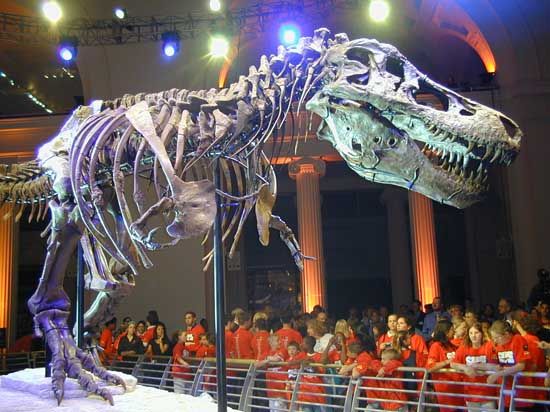
Tyrannosaurs are distinguished from other theropods by several unique anatomical features, most notably their specialized dentition and skeletal structure.
What are the defining characteristics of tyrannosaurs that set them apart from other dinosaur groups?
Tyrannosaurs are distinguished from other theropods by several unique anatomical features, most notably their specialized dentition and skeletal structure.
Key Characteristics
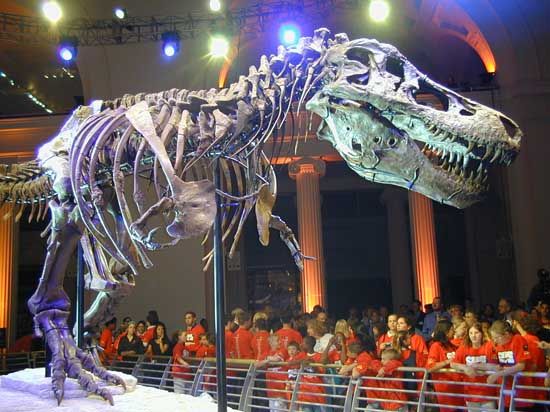
- Distinctive Teeth: Unlike the daggerlike teeth of most theropods, mature tyrannosaurs possess teeth that are D-shaped in cross-section. Their front teeth are small and U-shaped, while the side teeth are large and robust, designed to bite through the skulls, pelvises, and limbs of prey.1
- Reduced Forelimbs: Tyrannosaurs are characterized by very small forelimbs, often with hands reduced to only two digits. These limbs were too short to reach the mouth or grasp prey, potentially evolving to keep the appendages out of the way of their powerful, snapping jaws.2
- Skull Structure: Their skulls are heavily braced and thick, providing resistance to the immense bite forces they exerted.1
- Classification: While once grouped with carnosaurs, tyrannosaurs are now classified as gigantic members of the coelurosaurs. They share a unique “pinched” foot structure with ornithomimids.3
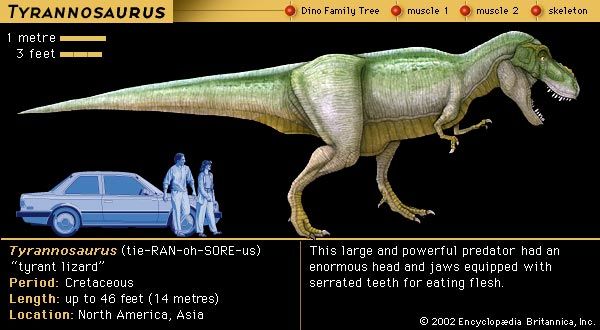
How large were tyrannosaurs, and how did their size compare to other predatory dinosaurs?
Tyrannosaurs exhibited a wide range of sizes, evolving from small, basal forms to the massive apex predators of the Late Cretaceous.
Size of Tyrannosaurs
While the group is famous for its giants, tyrannosaurs varied significantly throughout their history:
- Basal Forms: Early species were relatively small. For example, Dilong measured about 1.5 meters (5 feet) in length, while Guanlong and Raptorex kriegsteini stood roughly 3 meters (10 feet) tall.5
- Late Cretaceous Giants: The most well-known member, Tyrannosaurus rex, was among the largest terrestrial predators. Large adults typically measured over 12 to 14 meters (39 to 46 feet) in length and weighed between 4,000 and 7,000 kg (9,000 to 15,000 pounds). Exceptional specimens, such as “Scotty,” have been estimated to weigh as much as 8,870 kg (19,555 pounds).62
Comparison to Other Predatory Dinosaurs
Historically, large predatory dinosaurs were grouped together as “carnosaurs,” but paleontologists now recognize that size alone does not indicate close evolutionary relationships.3
- Evolutionary Context: Tyrannosaurs are now classified as gigantic coelurosaurs, a group that typically consists of smaller, more slender forms.35
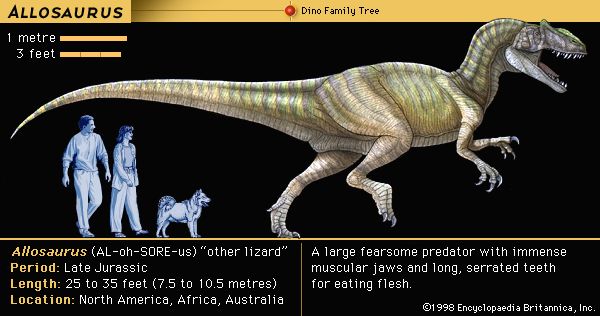
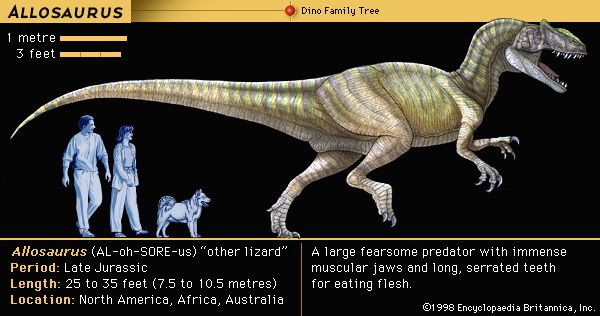
- Distinctive Traits: Unlike the “true” carnosaurs—such as Allosaurus and Giganotosaurus—tyrannosaurs are distinguished by their exceptionally large, high skulls and specialized teeth with rounded cross-sections. While other large theropods had limbs proportional to their bodies, tyrannosaurs evolved uniquely reduced forelimbs.357
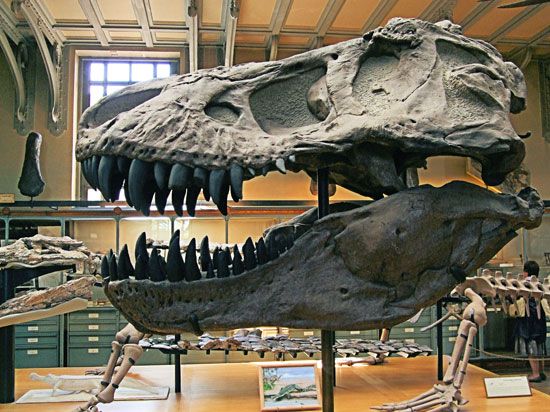
What adaptations did tyrannosaurs have that made them such successful predators?
Tyrannosaurs were highly effective predators, possessing a suite of specialized anatomical adaptations that allowed them to dominate their environments.
Cranial and Dental Specializations
The most striking feature of the tyrannosaur was its massive, heavily braced skull, which was engineered to withstand immense bite forces. Their mouths contained approximately 60 teeth that were frequently shed and regrown. Unlike the daggerlike teeth of other theropods, mature tyrannosaurs possessed robust, D-shaped teeth capable of crushing through the skulls, pelvises, and limbs of prey. Furthermore, the serrations on their teeth may have harbored bacteria, potentially resulting in an infectious bite.12
Skeletal Adaptations
While their jaws were powerful, their forelimbs were significantly reduced, often featuring only two digits. These limbs were too short to grasp prey or reach their mouths; some researchers suggest this reduction evolved to keep the appendages out of the way of their snapping jaws during feeding, thereby preventing injury. Conversely, their hind limbs were massive yet lightly constructed, allowing for efficient movement. Evidence suggests that Tyrannosaurus rex could reach speeds of approximately 32 km (20 miles) per hour, enabling them to pursue prey effectively.82
What evidence do we have about the social behavior of tyrannosaurs?
Evidence regarding the social behavior of tyrannosaurs remains a subject of ongoing scientific investigation, as definitive proof of complex social structures is difficult to obtain from the fossil record.
Group Association and Evidence
While pack hunting in tyrannosaurs has not been proven conclusively, there is evidence that these animals sometimes gathered in groups. Paleontologists have discovered sites where multiple Tyrannosaurus rex individuals were preserved together, suggesting some level of group association. Some researchers have hypothesized that their reduced forelimbs may have evolved to prevent injury during feeding when multiple individuals gathered around a carcass, as large, grasping arms could have been a disadvantage in such close-quarters competition.1910
Interspecific Interactions
Evidence of social interaction—or at least intraspecific conflict—is found in the physical remains of the animals themselves:
- Bite Marks and Cannibalism: Bite marks identified on the bones of other tyrannosaurs, particularly T. rex, are interpreted by some scientists as evidence of cannibalismcannibalism](https://www.britannica.com/science/cannibalism-animal-behavior).19
- Skull Bracing: The skull bones of large tyrannosaurs were heavily braced, a feature that likely provided resistance to the immense bite forces they could inflict upon—and receive from—other members of their own species.29
Reproductive Biology
Scientists have also gained insight into their biology through the study of fossil remains. By identifying medullary bone—a tissue deposited in female birds during reproductive cycles—in certain T. rex specimens, researchers have been able to determine the sex of specific individuals.910
Sources
- tyrannosaur - Skull and dentition — Encyclopædia Britannica
- tyrannosaur - Other skeletal features — Encyclopædia Britannica
- tyrannosaur - Classification — Encyclopædia Britannica
- Tyrannosaurus rex: Top Questions — Encyclopædia Britannica
- How tall was T. rex? — Encyclopædia Britannica
- dinosaur - Tetanurae — Encyclopædia Britannica
- tyrannosaur — Encyclopædia Britannica
- T. rex — Merriam-Webster
- Tyrannosaurus rex — Encyclopædia Britannica
- dinosaur - Herding behaviour — Encyclopædia Britannica
- dinosaur - Modern studies — Encyclopædia Britannica
Published on · 4 min read