Sulfur Cycle
Sulfur is classified as an essential macroelement for plants, meaning it is required in relatively large quantities to support healthy growth and…
What role does sulfur play in plant nutrition and growth?
Sulfur is classified as an essential macroelement for plants, meaning it is required in relatively large quantities to support healthy growth and development. Along with other essential minerals, plants absorb sulfur from the soil through their roots.12
For an element to be considered essential, it must be directly involved in the plant’s metabolism, such as serving as a component of an enzyme or other vital organic cellular constituent. While the provided search results identify sulfur as a necessary macroelement, they do not detail the specific biochemical pathways or structural roles it occupies within the plant.1
How does volcanic activity contribute to the sulfur cycle?
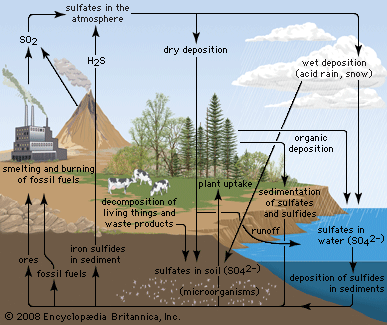
Volcanic activity serves as a natural source of sulfur in the global sulfur cycle. Through volcanic eruptions and emissions from fumaroles, volcanoes release sulfur-bearing gases—primarily sulfur dioxide and hydrogen sulfide—into the atmosphere.345
The impact of these emissions depends on the altitude at which they are released:
- Stratospheric Injection: When powerful eruptions inject sulfur dioxide into the stratosphere, it reacts to form aerosol droplets of sulfuric acid. These particles can persist for extended periods, creating haze layers that reflect solar radiation and potentially lower global temperatures.67
- Atmospheric Deposition: Sulfur gases released into the lower atmosphere eventually return to Earth’s surface through dry deposition or precipitation. While these natural emissions contribute to the sulfur budget, they are generally smaller in volume compared to sulfur released by human activities, such as the combustion of fossil fuels.83
Beyond gas emissions, volcanic activity also contributes to the lithosphere by depositing ash that weathers into nutrient-rich soil, supporting long-term ecosystem productivity.6
What are sulfur-reducing bacteria, and how do they contribute to the sulfur cycle?
Sulfur-reducing bacteria are a specialized group of microorganisms that play a critical role in the sulfur cycle by facilitating the conversion of sulfur compounds in oxygen-deprived environments.
Role in the Sulfur Cycle
Unlike sulfur-oxidizing bacteria, which convert hydrogen sulfide into sulfates, sulfur-reducing bacteria—such as Desulfovibrio desulficans—perform anaerobic respiration to reduce sulfates into hydrogen sulfide (H₂S) gas. This process is particularly active in waterlogged soils, sewage, marshes, and tidal flats where oxygen is scarce.93
The contributions of these bacteria include:
- Gas Release: By producing hydrogen sulfide, these bacteria return sulfur to the atmosphere, where it can eventually be oxidized and returned to the earth.310
- Sediment Chemistry: In marine environments, the hydrogen sulfide produced can combine with iron to form ferrous sulfide (FeS), which is responsible for the characteristic black color of marine sediments.3
- Decomposition: They are essential components of the microbial communities that break down organic matter, ensuring that sulfur trapped in dead organisms is recycled back into the environment.310
How do microorganisms play a role in the sulfur cycle?
Microorganisms are essential to the sulfur cycle, acting as primary agents in the transformation of sulfur compounds across the atmosphere, lithosphere, and hydrosphere.9
Microbial Transformations
The cycle relies on a diverse group of sulfur bacteria that metabolize sulfur for energy. Key processes include:10
- Decomposition: When organisms die, soil microbes break down sulfur-containing proteins into amino acids, which are further converted into hydrogen sulfide (H₂S).3
- Oxidation: In the presence of oxygen, sulfur bacteria such as Thiobacillus oxidize hydrogen sulfide into elemental sulfur and eventually into sulfates, which are essential for plant nutrition. Other groups, including purple and green sulfur bacteria, perform this oxidation using light energy in oxygen-free environments.103
- Reduction: In anaerobic environments like waterlogged soils or marshes, sulfate-reducing bacteria such as Desulfovibrio desulficans perform anaerobic respiration, converting sulfates back into hydrogen sulfide gas.109
These microbial activities ensure that sulfur is continuously recycled, though they also influence environmental chemistry, such as the formation of ferrous sulfide in marine sediments or the production of compounds that contribute to acid rain.39
Sources
- Plant - Essential elements and minerals — Encyclopædia Britannica
- nutrition - Nutrition in plants — Encyclopædia Britannica
- Biosphere - The sulfur cycle — Encyclopædia Britannica
- Climate change - Volcanic activity — Encyclopædia Britannica
- volcano - Gas clouds — Encyclopædia Britannica
- Atmosphere - Sulfur budget — Encyclopædia Britannica
- volcano - Long-term environmental effects — Encyclopædia Britannica
- oxide - Oxides of sulfur — Encyclopædia Britannica
- Sulfur bacterium — Encyclopædia Britannica
- Sulfur cycle — Encyclopædia Britannica
Published on · 3 min read