Surgeonfish
Surgeonfish are primarily found in tropical marine environments across the globe.
Where are surgeonfish typically found in the ocean?
Surgeonfish are primarily found in tropical marine environments across the globe.12
Their distribution varies by species, with different types inhabiting specific regions:
- Indo-Pacific: This region is home to species such as the yellow surgeon, also known as the yellow tang1.
- Atlantic and Caribbean: These waters host species like the blue tang.1
- Hawaii: Certain forms, such as the manini, are common in these islands.1
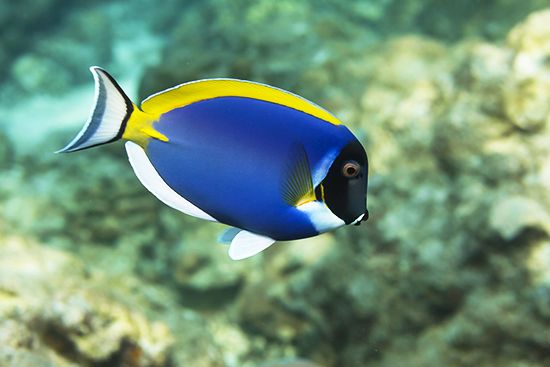
These fish are characterized by their thin, deep bodies and sharp, scalpel-like spines located near the base of the tail.12
What do surgeonfish primarily eat, and how does their diet affect their ecosystem?
Surgeonfish are primarily herbivores that feed on algae. By grazing on these aquatic plants, they play a vital role in their ecosystem by preventing algae from overgrowing and smothering coral reefs. This grazing activity helps maintain the health and balance of the reef environment, ensuring that corals have the space and light necessary to thrive.1
What are some common species of surgeonfish, and how do they differ?
Surgeonfish, belonging to the family Acanthuridae, are characterized by their thin, deep bodies and the presence of sharp, scalpel-like spines near the base of their tails. While they share these general traits, different species exhibit distinct variations in size, color, and geographic range.34
Common species include:
- Yellow Surgeon (Yellow Tang, Zebrasoma flavescens): Found in the Indo-Pacific, this species typically reaches about 20 cm (8 inches) in length. It is notable for its vibrant coloration, which can range from bright yellow to deep brown.3
- Blue Tang (Acanthurus coeruleus): Native to the Atlantic and Caribbean, this fish undergoes a significant color change as it matures. While young individuals are yellow, adults are typically bright blue with darker longitudinal stripes.13
- Manini (A. triostegus sandvicensis): This form is particularly common in the waters around Hawaii.3
These fish often undergo dramatic transformations in both form and color as they develop from their transparent larval stage, known as an acronurus.3
What are the distinctive physical characteristics of surgeonfish?
Surgeonfish, members of the family Acanthuridae, are defined by several distinctive physical characteristics:
- Body Shape: They possess thin, deep, and laterally compressed bodies.15
- Tail Spines: The most notable feature is the presence of one or more sharp, scalpel-like spines located on either side of the tail base. These spines can be fixed in place or hinged, allowing the fish to direct them outward for defense, capable of producing deep cuts.15
- Scales and Fins: They are small-scaled fish and typically feature a single dorsal fin.1
- Dentition: Their teeth are shaped like incisors, which are well-suited for their primarily herbivorous diet.5
Surgeonfish are relatively small, with a maximum length that usually does not exceed 50 cm (20 inches). As they develop from their transparent larval stage, known as an acronurus, they may undergo significant changes in both form and color.1
Sources
- surgeonfish — Encyclopædia Britannica
- surgeonfish — Merriam-Webster
- blue tang — Merriam-Webster
- perciform - Annotated classification — Encyclopædia Britannica
- Acanthuridae — Merriam-Webster
- ostariophysan - Annotated classification — Encyclopædia Britannica
Published on · 2 min read