Weever
A weever is any of four species of small marine fishes belonging to the family Trachinidae. These long-bodied fish are known for their habit of burying…
What is weever?
A weever is any of four species of small marine fishes belonging to the family Trachinidae. These long-bodied fish are known for their habit of burying themselves in the sand, leaving only their upwardly slanted mouths and eyes visible.1
Weevers are considered dangerous to humans because they possess venomous spines. Each gill cover features a sharp stinger, and the first dorsal fin is also associated with venom glands. Stepping on these fish in shallow waters can result in extremely painful wounds. Three species are found in the Old World, while one species inhabits the waters along the Chilean coast. Well-known examples include the greater weever and the lesser weever, both of which are found in Europe and the Mediterranean.21
How should someone treat a weever fish sting?
What other marine animals possess venomous spines?
Many marine animals possess venomous spines or similar structures used for defense or capturing prey. These animals inject toxins through specialized apparatuses, such as grooved spines or stingers, rather than relying on oral poisons.
Venomous Fish
Several fish species are well-known for their venomous spines:
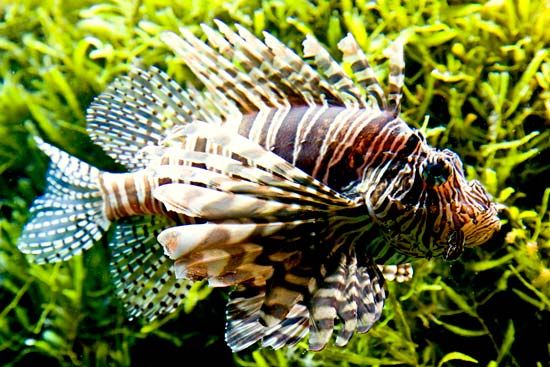
- Scorpionfishes: This family includes the stonefish, which hides on the seafloor and can inject potent venom through its dorsal-fin spines when stepped on. The red lionfish also features venomous fin spines used for defense.34
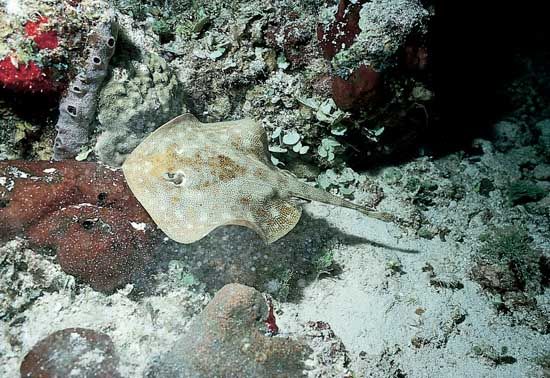
- Stingrays: Many stingrays possess long, slender tails equipped with barbed, venomous spines that can inflict serious, painful wounds.2
- Other Perciforms: Beyond weevers, dragonets and surgeonfishes possess venom-bearing structures. Surgeonfishes specifically have venomous spines located on either side of their caudal peduncle. Additionally, electric stargazers possess a venom spine above their pectoral fins in addition to their ability to discharge electricity.5
- Catfishes: Certain groups, including sea catfishes, have venom glands at the base of their dorsal and pectoral fin spines.6
Other Marine Invertebrates
- Echinoderms: The crown-of-thorns starfish and various sea urchins use venomous spines or pincerlike organs to deliver toxins.7
We could dive deeper into the differences between venomous and poisonous animals, or explore the specific biological mechanisms of how these toxins affect the human body.
Why do weever fish bury themselves in the sand?
Weevers are small marine fishes that habitually bury themselves in the sand as a natural behavior. While the provided information confirms this behavior is characteristic of the family Trachinidae, it does not explicitly state the evolutionary or survival purpose behind the action. Given their physical anatomy—specifically their upwardly slanted mouths and eyes positioned near the top of their heads—this behavior likely allows them to remain camouflaged while waiting to ambush prey or hide from potential predators.
Sources
- weever — Encyclopædia Britannica
- perciform - Danger to human life — Encyclopædia Britannica
- ray: Top Questions — Encyclopædia Britannica
- poison - Animal poisons ( zootoxins ) — Encyclopædia Britannica
- ostariophysan - Defense — Encyclopædia Britannica
- 10 of the World’s Most Dangerous Fish - Stonefish — Encyclopædia Britannica
- 10 of the World’s Most Dangerous Fish - Red Lionfish — Encyclopædia Britannica
- Avoidance behaviour - Protection reflexes, armour, and spines — Encyclopædia Britannica
- mollusk - Features of defense — Encyclopædia Britannica
- What’s the Difference Between Venomous and Poisonous? — Encyclopædia Britannica
Published on · 2 min read