Swallow
Swallows are members of the family Hirundinidae and are distinguished by their highly aerial lifestyle, spending significant time in the air to capture…
How are swallows different from other bird species?
Swallows are members of the family Hirundinidae and are distinguished by their highly aerial lifestyle, spending significant time in the air to capture insects. While they share morphological adaptations for insect-catching—such as long, narrow wings, large mouths, and short, weak bills—with unrelated swifts, they remain distinct in several ways.12
Key differences include:
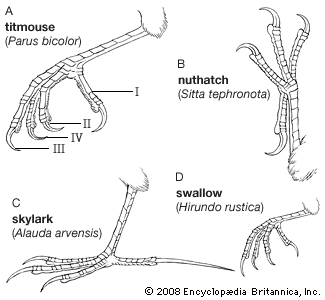
- Locomotion and Perching: Unlike true swifts, which have feet too weak to perch on twigs or wires and must cling to vertical surfaces, swallows are capable of perching.2
- Nesting Habits: Swallows exhibit diverse nesting behaviors, including burrowing into sandbanks, utilizing holes in trees, or plastering mud onto walls and ledges to create nests. Some species, such as the cliff swallow, construct elaborate flask-shaped mud nests. In contrast, swifts are known for using saliva to glue nest materials together or even constructing nests entirely out of saliva.13
- Physicality: Swallows are small birds with small, weak feet and, in some species, forked tails. Their plumage can be plain or feature metallic blue or green markings.1
How do swallows build their nests and what materials do they use?
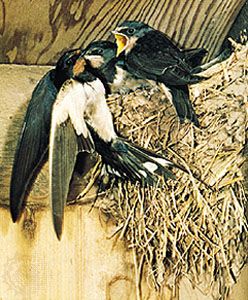
Swallows exhibit diverse nesting strategies, often choosing locations that provide protection for their eggs. Depending on the species, they may nest in existing holes or crannies in trees, burrow into sandbanks, or construct their own structures by plastering mud onto walls and ledges.1
When building mud-based nests, swallows often utilize saliva as a cement to bind the materials together. Some species, such as the cliff swallow, are particularly noted for their architectural skill, creating elaborate, flask-shaped or jug-like mud nests that are often attached to cliffs or under the eaves of buildings. These nests serve as secure environments to house their clutches, which typically consist of three to seven white, sometimes speckled, eggs.617
What are the different species of swallows found around the world?
The family Hirundinidae comprises approximately 90 species of small, streamlined birds known as swallows and martins. These birds are found globally, with the exception of polar regions and certain remote islands. While they share common characteristics—such as long, pointed wings, short bills, and small, weak feet—they exhibit significant diversity in their specific behaviors and appearances.89
Some notable species and groups include:
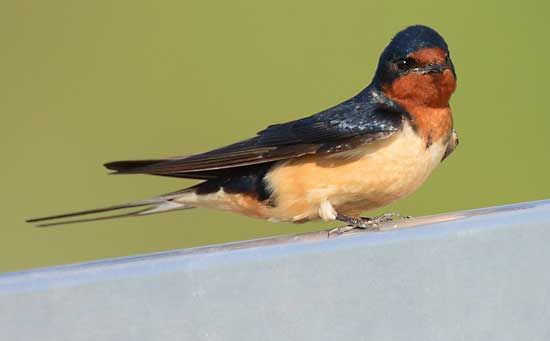
- Barn swallow: A widespread species in the Northern Hemisphere, recognized for its deeply forked tail and tendency to nest in or near human-made structures.8109
- Purple martin: The largest swallow species in North America.81
- Sand martin (Bank swallow): A small, brown-and-white bird that breeds across the Northern Hemisphere and is known for burrowing its nests into sandbanks.19
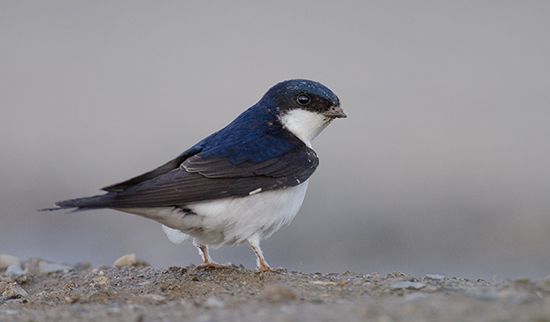
- House martin: A common European species characterized by its blue-black upper plumage and white rump.1
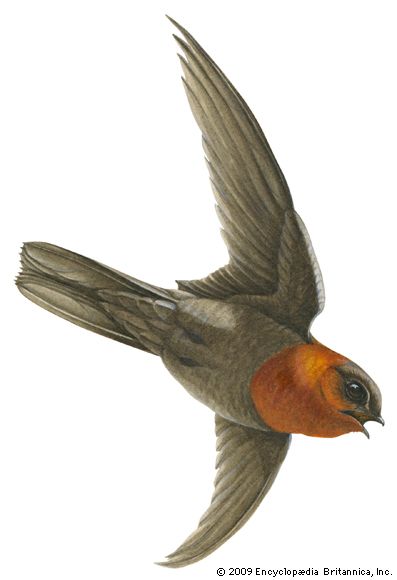
- Cliff swallow: Part of the Petrochelidon genus, these birds are famous for constructing elaborate, flask-shaped mud nests.9
- African river martin: A distinct, black-plumaged bird with red eyes and a red bill, sometimes classified in its own family, Pseudochelidonidae.1
How do swallows navigate during their long-distance migrations?
Swallows, like many migratory birds, possess remarkable navigational abilities that allow them to travel thousands of miles to return to specific breeding grounds. Their navigation relies on a combination of celestial and geophysical cues, often referred to as a navigational “grid”.1314
Key mechanisms include:
- Celestial Navigation: Swallows and other migrants use the Sun as a compass during the day, compensating for its movement across the sky using an internal clock. At night, they can orient themselves using star patterns to determine their bearings.14
- Magnetic Sensitivity: It is widely understood that birds possess a sensitivity to the intensity and direction of the Earth’s magnetic field, which helps them maintain a constant direction during flight.1415
- Landmarks: While celestial and magnetic cues facilitate long-distance travel, swallows also utilize familiar topographical landmarks—such as coastlines, mountain ranges, and river systems—when navigating closer to their destination or during homing flights.13
Unlike some species that rely heavily on fluctuating weather conditions, swallows are often noted for their remarkable regularity in arrival and departure times, suggesting a strong, internally regulated migratory drive.16
Sources
- Swallow — Encyclopædia Britannica
- Bird - Feeding habits — Encyclopædia Britannica
- Apodiform - Size range and diversity of structure — Encyclopædia Britannica
- Bird - Nesting — Encyclopædia Britannica
- Apodiform - Behaviour and locomotion — Encyclopædia Britannica
- Nest — Encyclopædia Britannica
- cliff swallow — Merriam-Webster
- Hirundinidae — Encyclopædia Britannica
- barn swallow — Merriam-Webster
- Martin — Encyclopædia Britannica
- Swan — Encyclopædia Britannica
- swallow — Merriam-Webster
- Migration - Birds — Encyclopædia Britannica
- Migration - Physiological stimulus of migration — Encyclopædia Britannica
- Migration - Navigation and orientation — Encyclopædia Britannica
- Homing — Encyclopædia Britannica
Published on · 3 min read